

Türkiye is pursuing a continent-wide strategy in Africa, positioning itself both as a security partner through arms procurement and military training, and as an investor in large-scale infrastructure projects. Ankara seeks to present itself as an alternative partner capable of negotiating sophisticated military agreements without the political and structural constraints commonly associated with cooperation with China, Russia, or traditional Western allies.
Göktuğ Çalışkan, a foreign policy analyst at the Ankara Center for Crisis and Policy Studies, characterizes Türkiye as a distinctive geopolitical actor, describing Ankara as “a unique geopolitical hybrid: a NATO member with NATO-standard military capabilities, yet a diplomat that speaks the language of the Global South.”
Partly due to Ankara’s flexibility in exporting unmanned aerial vehicle (UAV) technology, the Turkish defense company Baykar has expanded its client base to include Angola, Burkina Faso, Djibouti, Ethiopia, Kenya, Mali, Morocco, Niger, Nigeria, Somalia, Togo, and Tunisia. These UAVs have been deployed prominently across multiple conflict zones.
In December 2024, Baykar initiated a multimillion-dollar project in Morocco to produce and maintain Bayraktar TB2 systems and the more advanced Akıncı UAVs. While Turkish drone exports have attracted significant public attention, Çalışkan argues that Ankara is simultaneously recalibrating its broader strategic posture more quietly across a corridor stretching from the Sahel to Senegal, Morocco, and the Mediterranean.
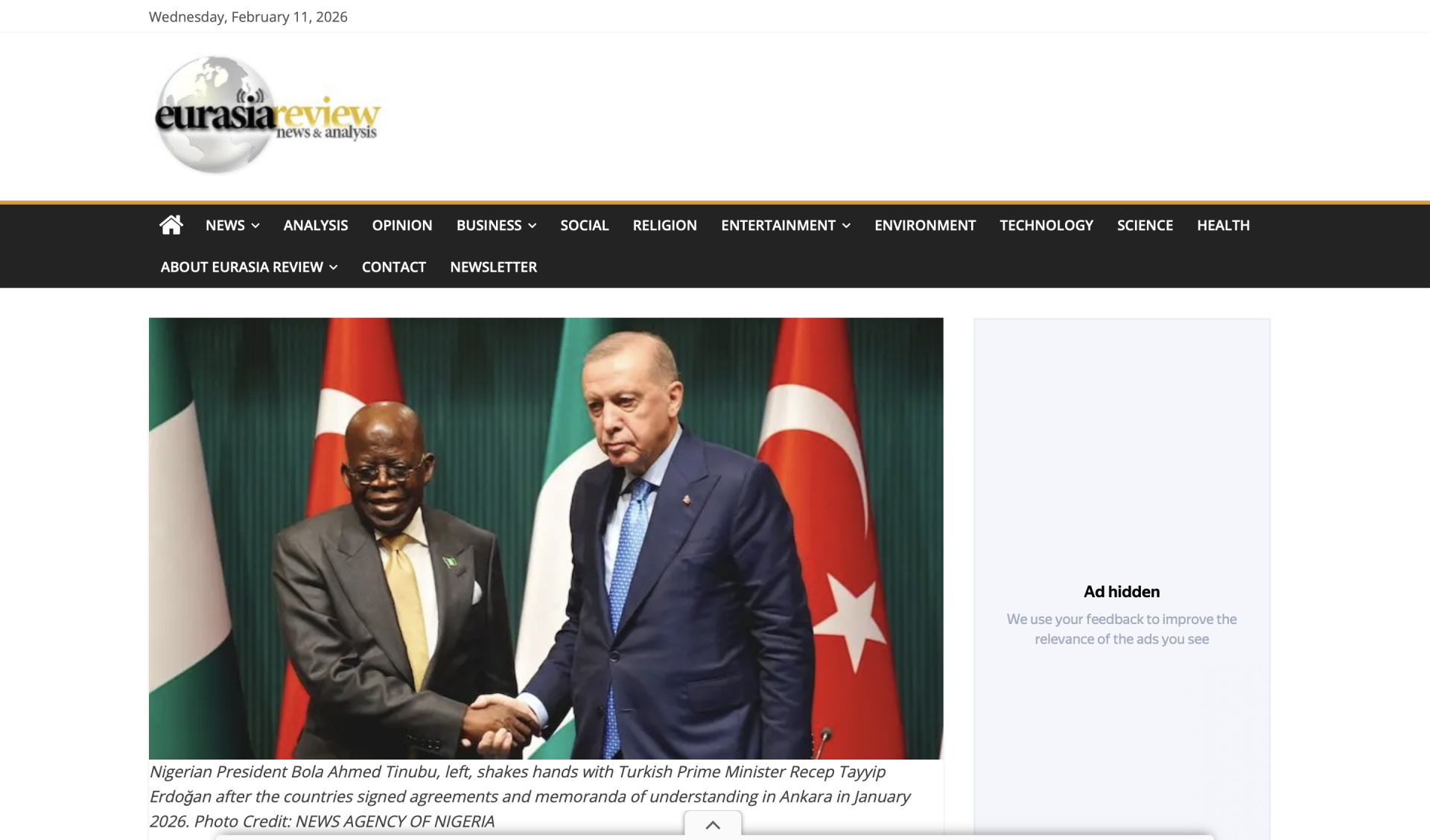
Türkiye’s Africa policy under Prime Minister Recep Tayyip Erdoğan integrates security cooperation, economic investment, and diplomatic outreach. A central pillar of this approach has been the control of and investment in key African ports. This strategy aligns with Morocco’s Atlantic Initiative, which seeks to provide landlocked Sahelian states with strategic access to the Atlantic Ocean through major infrastructure investments.
According to Çalışkan, “Türkiye has positioned itself as the natural partner in this new architecture. Ankara’s deep ties with Rabat enable it to project power and logistical capabilities from the Mediterranean deep into the Atlantic coast. Every Turkish-built port, highway, and logistics hub in Senegal, Mauritania, or Côte d’Ivoire represents a tangible strategic stake in this emerging order.”
In late 2024, Ankara-based Metag Holding signed an agreement to develop Hobyo Port, Somalia’s second-largest seaport, with an initial investment of USD 70 million. The project is expected to transform the Galmudug State port into a regional trade hub, easing congestion at Mogadishu Port and providing an alternative trade route for Ethiopia and Djibouti. The agreement grants Metag Holding an 80-year operational concession.
Galmudug State President Ahmed Abdi Kariye stated, as reported by Turkey Today, that the port would enhance regional economic activity and improve trade connectivity nationwide.
According to the Observer Research Foundation, Türkiye maintains direct influence or control over Mogadishu Port, Sudan’s Suakin Port, and several Libyan ports, while exercising indirect influence in ports located in Djibouti and Egypt.
Yuvvraj Singh of the foundation argues that by prioritizing ports as focal points of its African outreach, Türkiye aims to secure strategic maritime trade routes, expand its presence in highly contested regions such as the Horn of Africa and the Red Sea, and compete more effectively with both global and regional rivals.
Çalışkan further contends that African governments increasingly favor Türkiye for military procurement and infrastructure development because agreements with Ankara are perceived as more transparent and are not accompanied by the political conditionality or operational restrictions often associated with Chinese or Western partnerships.
According to Turkey Journal, Turkish construction firms have completed more than 2,000 infrastructure projects across Africa, with a cumulative value exceeding USD 100 billion. At the Türkiye–Africa Business and Economic Forum in Istanbul, Turkish Trade Minister Ömer Bolat emphasized that these partnerships are grounded in principles of fairness, equality, and mutual benefit, aimed at fostering sustainable growth.
This expansion has coincided with enhanced air connectivity across the continent. Turkish Airlines now operates flights to 62 destinations in 40 African countries. Ankara’s foreign policy strategy further seeks to build connections not only with governments but also with societies, including youth, academics, artists, students, and local communities.
Çalışkan describes Türkiye’s approach as offering a model of “strategic autonomy,” noting that Ankara’s emphasis on capacity building—through military academies, police reform, and technology transfer—resonates with African partners because it treats African security forces as sovereign actors capable of managing their own defense.
While several junta-led Sahelian states have turned to Russia’s paramilitary Africa Corps for security assistance, these forces have been associated with serious human rights abuses and have failed, according to multiple analysts, to deliver sustained improvements in security. In contrast, Çalışkan reiterates that Türkiye distinguishes itself as a NATO member that simultaneously adopts a diplomatic posture aligned with the political discourse of the Global South.
Finally, Çalışkan argues that Ankara has accumulated a significant reservoir of goodwill by educating West African students in Turkish universities and by delivering healthcare services directly to underserved communities. In a regional context marked by rising anti-foreign sentiment, the Turkish flag has become closely associated with solidarity. This grassroots legitimacy, he suggests, fosters a symbiotic relationship in which security cooperation and societal development mutually reinforce one another.