

ANKARA, February 11. /Dunyo News Agency/.
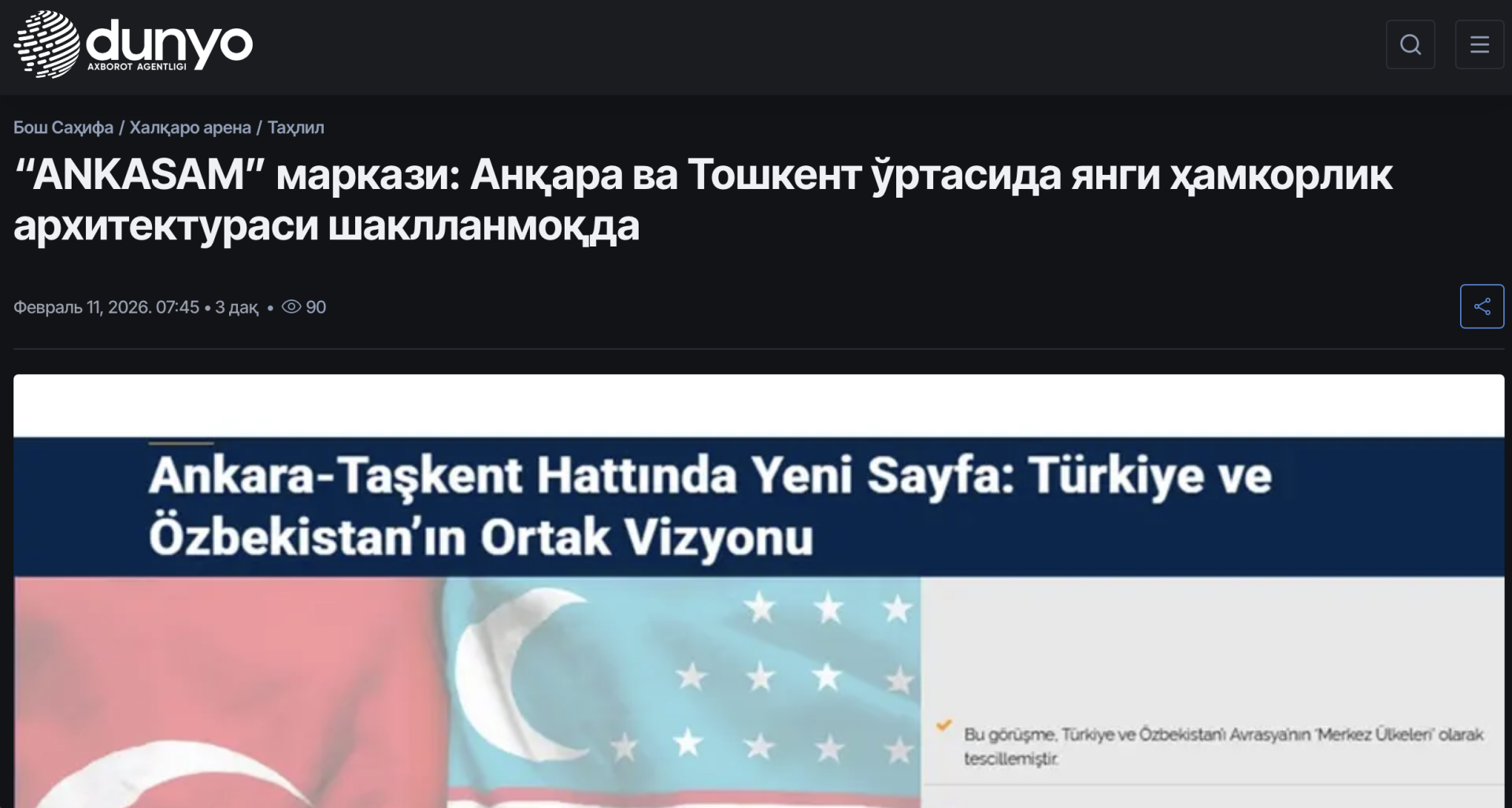
The Ankara Center for Crisis and Political Studies (ANKASAM) has published an article titled “A New Chapter in the Ankara–Tashkent Cooperation Line: The Shared Vision of Türkiye and Uzbekistan” by Turkish independent researcher and international relations expert Göktuğ Çalışkan, Dunyo News Agency reports.
The article emphasizes that high-level diplomatic engagements between the Presidents of Uzbekistan and Türkiye carry significant strategic importance. Under the leadership of the two heads of state, bilateral relations are evolving from personal rapport into a fully institutionalized strategic partnership between the two countries.
The joint declaration signed during the meeting further consolidated the existing level of comprehensive strategic partnership between Ankara and Tashkent. This development is interpreted as evidence of the emergence of a new power architecture in the heart of Eurasia.
According to the author, one of the most remarkable moments of the summit, beyond official meetings, was the live connection to the housing handover ceremony in Hatay. The residential units constructed with Uzbekistan’s high-level solidarity following the 2023 earthquakes have become a lasting symbol of fraternal ties. This concrete initiative demonstrates that bilateral relations are not confined to diplomacy alone, but also encompass a strong humanitarian dimension. The project stands as a clear indicator of mutual trust and institutional depth in interstate relations.
The President of Uzbekistan described Türkiye as “one of the emerging geopolitical power centers of the world.” President Shavkat Mirziyoyev’s characterization reflects that bilateral relations are no longer limited to a purely bilateral framework but are increasingly acquiring a global dimension. In this context, Ankara is now positioned as an indispensable strategic partner for Tashkent.
Relations between the two countries have evolved into a mutually beneficial partnership model. Ankara has demonstrated its readiness to actively contribute to Tashkent’s reform process and development initiatives. This approach can be interpreted as a concrete manifestation of solidarity within the Turkic world.
One of the most significant outcomes of the Ankara summit was the strengthening of institutional dialogue mechanisms. The Fourth High-Level Strategic Cooperation Council meeting established new foundations for coordination among ministries and institutions. The parties agreed to manage political, economic, and cultural agendas on the basis of structured coordination. This has led to the emergence of a systematic cooperation model in which close relations between leaders are embedded across the entire state apparatus, which is crucial for the long-term sustainability of bilateral relations.
The material notes that economic integration objectives constitute one of the strongest pillars of political dialogue. Bilateral trade volume exceeded USD 3 billion by the end of 2025, and the leaders agreed to raise this figure to USD 5 billion in the near future. To achieve this target, simplification of customs procedures and removal of trade barriers are planned. New incentive mechanisms will be introduced to ensure that economic relations fully reflect their existing potential.
The participation of Turkish companies in strategic sectors in Uzbekistan is deepening further. Beyond construction and contracting, significant investments are being made in textiles, food processing, and energy. Uzbekistan is increasingly relying on Turkish technologies to mobilize its rich underground resources into the national economy. For Turkish industrialists, Uzbekistan holds a special position as an “industrial hub” opening access to the broader Central Asian market. These dynamics provide a structural foundation for further stabilization of economic relations.
Cooperation in the energy and mining sectors was also among the top priorities on the Ankara summit agenda. Uzbekistan’s reserves of gold, uranium, and natural gas are of critical importance for Türkiye’s raw material supply security. The signed agreements envisage joint projects for processing these resources, generating added value, and delivering them to global markets.
Transport and logistics constitute the geopolitical backbone of Türkiye–Uzbekistan relations. Uzbekistan, along with its neighboring states, is a landlocked country. In this context, the Trans-Caspian “Middle Corridor” represents a key alternative for overcoming geographical constraints. Given Türkiye’s role as the most important western gateway of this corridor, the integration of logistics lines positions both countries to play a central role in the China–Europe trade corridor.