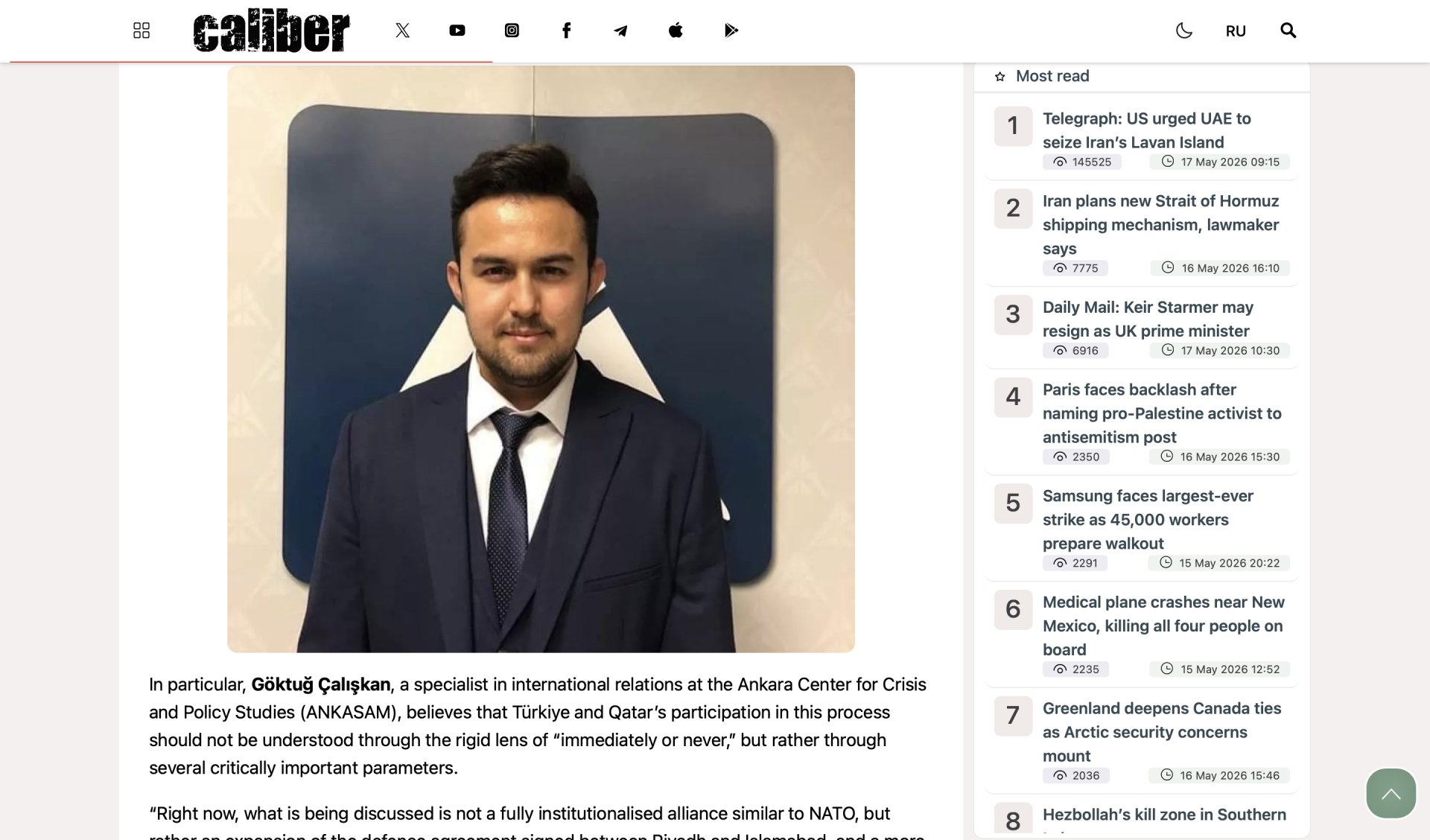



In particular, Göktuğ Çalışkan, a specialist in international relations at the Ankara Center for Crisis and Policy Studies (ANKASAM), believes that Türkiye and Qatar’s participation in this process should not be understood through the rigid lens of “immediately or never,” but rather through several critically important parameters.
“Right now, what is being discussed is not a fully institutionalised alliance similar to NATO, but rather an expansion of the defence agreement signed between Riyadh and Islamabad, and a more flexible security architecture built around it. Therefore, the concept must first be properly assessed, and only then should all the ‘pros and cons’ be weighed. At this stage, I view this initiative less as a bloc with strong ideological connotations, such as an ‘Islamic NATO’, and more as an attempt to align the defence, technological, and, to some extent, geopolitical interests of certain Muslim-majority countries.
It brings together Saudi Arabia’s financial capabilities, Pakistan’s nuclear deterrence potential, and Türkiye’s defence industry and operational experience. Qatar, with its political capital and investment capacity, is a natural component of this picture. However, how this framework is ultimately presented as a whole will be the key factor determining Türkiye’s position,” he said.
According to the expert, from Ankara’s perspective, participation in such an initiative has attractive aspects:
“Firstly, it provides an opportunity to elevate the Türkiye–Saudi Arabia–Qatar axis, which has already gained momentum following the normalisation of relations, to a more institutional level. For example, within the framework of this initiative, joint exercises, defence industry projects, and cooperation that could be developed using UAVs and air defence systems could be considered.

Secondly, it aligns with Türkiye’s long-standing goal of a ‘multi-axis foreign policy’. Ankara is seeking to build its own security network in the Persian Gulf and South Asia while remaining a member of the North Atlantic Treaty Organization. This expands its room for manoeuvre both politically and economically.
However, there is also a risk dimension. If Türkiye sits at this negotiating table, it will do so very cautiously, because a NATO member entering into frameworks resembling ‘collective defence’ alongside nuclear-armed Pakistan and Saudi Arabia, which sometimes experiences tensions with the West, could reignite debates within the Alliance about Türkiye’s strategic direction.
In addition, there is a possibility that such a formation could be interpreted by actors such as Israel, India, or Greece as a ‘Muslim military bloc’ directed against them, which could intensify competition along a broad arc stretching from the Eastern Mediterranean to the Indian Ocean,” he noted.
Ankara, he said, does not want to be perceived as a factor that could damage both potential channels for normalising relations with Israel and the economic and technological programme it is trying to develop jointly with India.
“Therefore, I would describe the path Türkiye would take in this case as follows: Ankara would be open to expanding cooperation in areas such as the defence industry, joint exercises, counterterrorism, and intelligence sharing, but would distance itself from agreements that create an automatic collective defence obligation similar to NATO’s Article 5, making it a direct party to conflicts with third countries.
In other words, the Turkish side would prefer a flexible, functional security platform from which it can step back if necessary, rather than a fully binding military bloc,” the political scientist emphasised.
https://caliber.az/en/post/islamic-nato-ankara-and-doha-s-red-lines