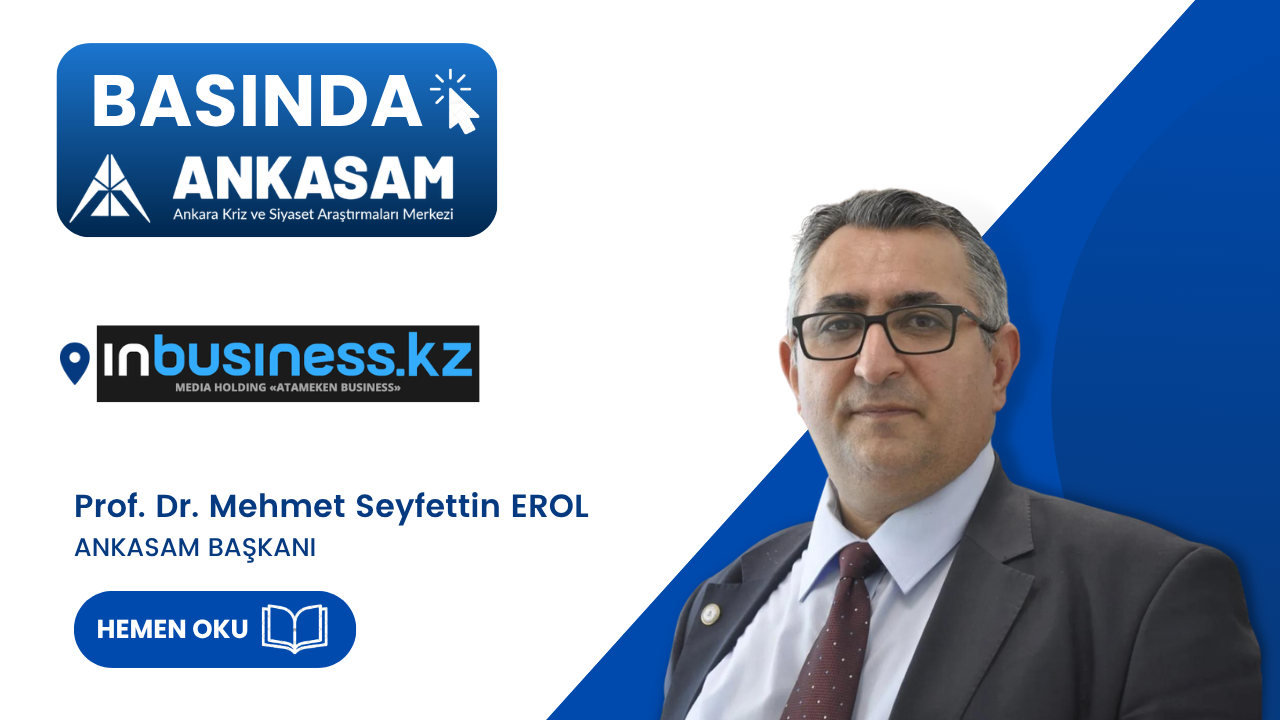


President Kassym-Jomart Tokayev’s decision to transform the Apparatus of the Security Council into an independent state body, directly subordinate and accountable to the head of state, could significantly change the architecture of national security decision-making. The expected introduction of the position of Deputy Chairman of the Security Council takes on added significance. The President of ANKASAM (Ankara Center for Crisis and Policy Studies), Professor Dr. Mehmet Seyfettin Erol, believes that these changes should be viewed in the context of growing global turbulence and Kazakhstan’s broader institutional transformation, reports inbusiness.kz.
According to his assessment, the new model is capable of forming an autonomous and centralized core of strategic management directly around the President.
– President Kassym-Jomart Tokayev issued a decree according to which the Apparatus of the Security Council becomes a state body directly subordinate and accountable to the President. How significant is this decision for Kazakhstan’s public administration system?
This decision represents a major institutional change and indicates the formation of an architecture in Kazakhstan of an “isolated core of the state, resilient to global turbulence.” The current unstable international environment, growing systemic uncertainty, exacerbation of geopolitical contradictions, as well as new risks associated with the global struggle for influence, make traditional cumbersome bureaucratic mechanisms less effective. President Tokayev’s step can be seen as a preventive institutional shield and a model of proactive crisis management, created in response to the destructive dynamics of this new ‘great game.’ In conditions where uncertainty about the future has reached a high level, the need for proactive and centralized mechanisms capable of reducing state vulnerability is particularly increasing.
Granting the Security Council Apparatus a more autonomous status takes national security issues beyond the usual scope of public administration, transforming this structure directly into an “operational command center of presidential sovereignty.” At the same time, the classic executive branch focuses more on the practical implementation of decisions, while the determination of the strategic course is centralized within the new structure. Thus, the system is moving away from a horizontal model with several decision-making centers toward a more rigid vertical one. As a result, the mechanism for making strategic state decisions gains a kind of “reaction accelerator,” as well as the ability to develop advance response measures to hybrid threats and external shocks.
Ultimately, against the backdrop of an expanding public sphere and internal transformations, this step represents a pragmatic “strengthening of the security perimeter” that protects the most sensitive part of the state system. This is one of the strategically important institutional mechanisms aimed at preserving Kazakhstan’s sovereign integrity amidst an unstable geopolitical situation. Such a structure allows anticipating potential crisis situations in advance and unifying the work of intelligence and defense structures around a single center.
– At the same time, the introduction of the post of Deputy Chairman of the Security Council is expected, a new position that should be distinguished from the previously existing posts of Deputy Secretaries of the Security Council. What might the emergence of such a post indicate?
The introduction of this position shows that it should be viewed not just as an administrative tool, but as a political and operational lever of a “state core resilient to global turbulence.” That is, its significance may go far beyond the work of the secretariat, which is primarily engaged in the organization and coordination of bureaucratic processes.
In a situation of high systemic uncertainty, this position can be viewed as a “macro-operational filter” and a coordination center that, on behalf of the President, is capable of uniting the work of security, intelligence, and foreign policy structures. It can be said that this role will allow for faster navigation of complex bureaucratic procedures and the direct implementation of that very “reaction accelerator,” which is especially important during a crisis when decisions must be made as quickly as possible.
Politically, this post can be seen as the “supreme guardian of sovereignty,” strengthening the central power of the state amidst the expansion of the public sphere resulting from internal reforms. The new position, which ensures the implementation of the presidential line through the state apparatus within a rigid vertical structure, is not simply an administrative reorganization. It is a step conceived as an important preventive mechanism that allows for preemptively closing potential gaps in the governance system that external shocks could exploit under the conditions of the new great game. This can also be seen as a manifestation of the state’s strategic approach.
– Can these two changes be seen as the formation of a more autonomous and centralized decision-making system in the sphere of national security directly around the President?
The transformation of the Security Council Apparatus into an independent structure and the establishment of the post of Deputy Chairman form two complementary elements of a single institutional defense system. Such an architecture allows freeing strategic state decision-making from cumbersome bureaucratic procedures.
We are talking about a transformation in which national security decisions are removed from the space of lengthy interagency approvals and are directly linked to the presidential vertical. The goal is to create a proactive mechanism of “preventive crisis management” capable of acting even before systemic risks escalate into full-scale crises.
Ultimately, against the backdrop of a civil public sphere that is becoming more decentralized due to internal reforms, this comprehensive restructuring, on the contrary, strengthens the core of the state through a more rigid vertical hierarchy. It represents a pragmatic model of a “state core resilient to global turbulence,” designed to increase Kazakhstan’s resilience to external shocks by concentrating mechanisms for protecting sovereignty within a single decision-making center.
– How might the strengthening of the institutional role of the Security Council affect the relationship between the presidential administration, the government, security forces, and other state institutions?
The strengthening of the institutional role of the Security Council significantly changes the traditional balance of power in Kazakhstan’s public administration system, forming a more centralized hierarchy. The new institutional design shifts relations between state structures from a horizontal coordination model to a more rigid vertical one, in which the Security Council is given a priority role.
As part of this transformation, the presidential administration, which has traditionally been one of the most influential elements of the state apparatus, transfers some of its strategic functions in the fields of security and foreign policy to the new Council structure, focusing to a greater extent on domestic policy, the economy, and the social sphere. Similarly, the government and the cabinet of ministers yield a key role in strategic decision-making to the Council, concentrating primarily on the practical implementation of socio-economic policy.
Security structures such as the KNB (National Security Committee), the Ministry of Defense, and the Ministry of Internal Affairs cease to act in this model as completely independent decision-making centers interacting directly with the President. Instead, they become part of a unified rapid-response mechanism coordinated through the new Council structure.
As a result, the new hierarchy acts as a mechanism for preventive crisis management, allowing for the reduction of interagency bureaucracy and avoiding situations where decisions are made simultaneously by multiple centers. Such vertical integration allows for preemptively resolving potential coordination problems within the system and represents a pragmatic model of a “state core resilient to global turbulence,” fortifying Kazakhstan in the face of external shocks.
– To what extent does such a model correspond to international practice? Are there examples of countries where national security councils play such a significant role in strategic planning and the coordination of state policy?
The new model implemented by Kazakhstan largely corresponds to the most influential models of national security councils existing in international practice. In the modern global system, where the rivalry of major powers is intensifying, the unstable international environment pushes states to create an architecture of a “state core resilient to global turbulence.” Such a model entails the concentration of strategic decisions in a single center and increasing the state’s ability to withstand external shocks, instead of relying on traditional cumbersome bureaucratic mechanisms.
The most notable examples of such institutional structures can be seen in the United States, the Russian Federation, and Turkey. In the US, the National Security Council (NSC) coordinates foreign policy and the work of intelligence structures directly under the White House, serving as a strategic coordinator in relation to institutions like the State Department and the Department of Defense. Similarly, the Security Council of the Russian Federation is a centralized hub that plays a significant role in determining the strategic course and responding to threats, thanks to the influential position of its Deputy Chairman and its own apparatus. In Turkey, the National Security Council (MGK) acts as an institutional mechanism that synchronizes the activities of civil, military, and intelligence structures to protect the key interests of the state.
Kazakhstan’s step to some extent adopts the operational logic of these international examples, striving to reduce the dependence of strategic decisions on complex interagency approvals.
– Kazakhstan has been undergoing a broader political and institutional transformation in recent years. How do the changes in the Security Council fit into President Tokayev’s overall reform agenda?
This structural transformation of the Security Council demonstrates a certain logic that at first glance might seem contradictory, but in fact complements President Tokayev’s large-scale program of institutional reforms in recent years.
Under the concept of a “Just Kazakhstan,” President Tokayev has taken steps to expand the powers of parliament, develop public participation mechanisms like the Kurultai, and gradually transition the public administration system away from a “super-presidential” model. However, the processes of decentralization and the distribution of authority within the civil public sphere and the classic state bureaucracy can create certain gaps and vulnerabilities in the state apparatus, especially in the current unstable international environment and amidst high systemic uncertainty.
The more autonomous position of the Security Council and the strengthening of the governance vertical act in this situation as a strategic balancing factor—a mechanism of “preventive crisis management” that helps to preemptively minimize potential vulnerabilities arising during the reforms. While Tokayev is making the country’s political and socio-economic system more flexible, participatory, and technocratic, he is simultaneously strengthening the most sensitive part of the state mechanism and the sovereignty protection system within a newly centralized governance perimeter.
This structure gives the state that very “reaction accelerator” in the face of risks associated with the global struggle for influence and the new great game. Thus, the consolidation of the Security Council, which is occurring in parallel with the expansion of the public sphere through internal reforms, becomes an important pragmatic mechanism allowing for internal transformations in a more secure environment while simultaneously increasing Kazakhstan’s resilience to global turbulence.
– How significant a figure will the future Deputy Chairman of the Security Council become? Could the choice of candidate and the powers granted to them indicate whether this is primarily an administrative reform or the emergence of a new influential decision-making center?
The future Deputy Chairman of the Security Council has the potential to become one of the most significant players in Kazakhstan’s new power architecture, which is built on strengthening the decision-making vertical. The profile of the person appointed to this position and the scope of powers granted to them will be the main indicator of whether this step is strictly a technical reorganization of workflows or if it heralds the emergence of a new influential center focused on rapid response to hybrid threats.
If an influential political heavyweight is appointed to this position—someone whose career is tied to intelligence, defense, or diplomacy, or a person from the president’s inner circle who enjoys his full trust—it will demonstrate that the institutional restructuring goes far beyond a simple administrative reform.
Such an appointment will signify the emergence of a de facto geopolitical command center, fortifying the core of the state in the face of a complex system of risks associated with the current unstable international environment and the global struggle for influence. This influential figure will be able to act as a coordinator, uniting the work of intelligence, security, and defense structures on behalf of the president within a single center, as well as ensuring the fastest possible decision-making in crisis situations where every second counts.
Conversely, if this position is taken by a less public technocrat known primarily for their bureaucratic coordination skills, this step is more likely to remain an institutional optimization focused on preventive crisis management and the proactive resolution of potential coordination problems within the system.
Ultimately, it is the choice of a specific figure and the extent of their powers that will define the real boundaries of this reform aimed at increasing Kazakhstan’s resilience to global turbulence, and will also reveal where the center of gravity of the state’s strategic decision-making system will lie in the future.
https://inbusiness.kz/ru/last/yadro-suvereniteta-zachem-tokaev-usilivaet-sovet-bezopasnosti