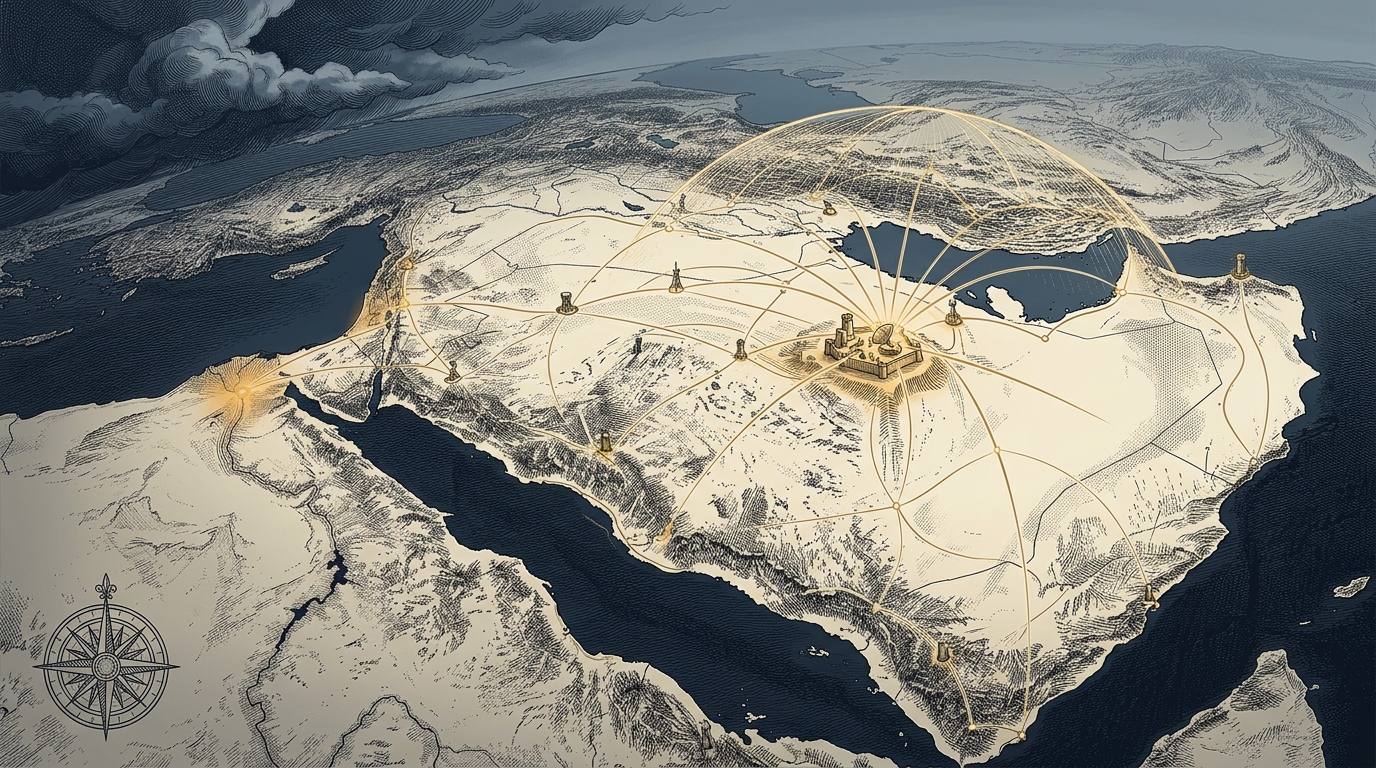


Signed on 7 August 2026, the Mecca Joint Defense Agreement (Mecca Pact), which ushered in a new era in the security architecture of the Middle East and South Asia, has been subjected to an asymmetric litmus test that has shaken the regional status quo before its institutional construction was even completed. Following critical Houthi attacks targeting Saudi Arabia’s civilian and economic infrastructure, the Strategic Political and Defense Committee, the alliance’s highest decision-making body, convened in Riyadh on Monday, 5 October 2026, with an extraordinary agenda, transforming the pact from a mere declaration of intent on paper into an operational reality.
Beyond this, the summit triggered efforts by Iran and Israel—the two poles of the regional power matrix—to limit or manipulate the pact’s sphere of influence, while also activating the global geopolitical assessments of the United States/CENTCOM, Europe, Russia, China, and India regarding the pact’s autonomous structure, as well as dynamics of geographical expansion centered on Qatar, Oman, Kuwait, and the UAE in the Gulf. This study subjects the Riyadh Summit and the joint communiqué to a methodological analysis through the conceptual frameworks of the “Flexible Resistance Doctrine” and “Premature Birth Pressure”—concepts that I highlighted in my ANKASAM analysis titled “Premature Birth Pressure on the Mecca Pact and the Flexible Resistance Doctrine as a Crisis-Exit Strategy” and which are defined in the literature as fundamental paradigms of the pact’s existence.
Institutional Rationality in the Face of “Premature Birth Pressure”
One of the most important geopolitical assessments made during the establishment phase of the alliance was that revisionist actors in the region—particularly Iran-backed proxy forces and Israel’s aggressive expansionism—would force this formation to react before it had matured, thereby creating a form of “premature birth pressure.” Indeed, the Houthi missile and UAV attacks were intended to test the pact’s collective-defense logic—“an attack against one is an attack against all”—before its institutional structures, such as the secretariat and joint headquarters, had been fully established.
So, was this first extraordinary meeting effective?
The meeting was unquestionably productive and operationally successful. Rather than panicking under premature birth pressure or seeking to evade its obligations, the alliance demonstrated a will to use the crisis as leverage to accelerate institutionalization. The appointment of retired Pakistani Lieutenant General Nauman Mahmood as Secretary-General for a three-year term was the clearest indication that the alliance had acquired an institutional backbone and had ceased to be merely “a declaration of intent on paper.” By transforming crisis management into a stage of institutionalization, the meeting generated strategic rationality.
The “Flexible Resistance Doctrine” in the Field: The National-Law Filter
The most striking and analytically significant phrase in the joint statement issued following the meeting is the following:
“…the provision of agreed military forces and capabilities to Saudi Arabia within the framework of agreed arrangements, subject to the national laws of the parties…”
This formulation constitutes concrete evidence that the “Flexible Resistance Doctrine,” proposed as the pact’s crisis-exit strategy, has been fully put into practice. “Flexible Resistance” is an intelligent flexibility model that provides a collective deterrence umbrella while safeguarding the sovereignty rights, domestic legal mechanisms, and national interests of member states.
The distinctive dynamics of this doctrine become evident on three principal levels when compared with classical rigid alliance structures.
First, the response mechanism characteristic of traditional alliance models—such as NATO’s Article 5, which seeks an automatic and binding military commitment—is replaced under the Flexible Resistance Doctrine by a gradual process subject to national legislation and domestic legal approval.
Second, instead of traditional burden-sharing obligations that impose an all-out war or rigid military integration, the model is based on the transfer of the parties’ “agreed capabilities,” namely strategic assets such as intelligence, technology, and logistics.
Finally, the pressure for top-down collective command is replaced by a structure that prioritizes the absolute primacy of national parliaments and constitutional processes and places the preservation of sovereignty at the forefront.
The fact that the deterrence message in the joint statement was framed within national legislation and calibrated around the “minimum necessary level of responsibility” should not be interpreted as a weakness or an attempt to evade commitments. Rather, it constitutes a geopolitical insurance policy that ensures the sustainability of the alliance. Had the pact automatically dragged its members into a proxy war—or “common war”—in the Yemeni deserts, the result could have been the collapse of the pact during its first crisis while its institutional and identity-building processes were still underway, or it could have triggered extremely severe reactions on the grounds that it would lead to an “Islamic civil war.” Thanks to flexible resistance, the alliance has pledged to defend Saudi Arabia’s territorial integrity (“collective defense”) while leaving the legal and military boundaries of any operation to the discretion of each member’s own capital.
The Geopolitical Reading of Global Powers
The institutionalization of the Mecca Alliance will undoubtedly have a direct impact on Washington’s military and strategic architecture in the Middle East. The United States and CENTCOM (Central Command) are analyzing the emergence of this autonomous pact and its demonstration of resolve in Riyadh from two different perspectives and are shaping their future institutional relations accordingly:
- “Tactical Integration” with CENTCOM and Early-Warning Cooperation: Rather than seeing the pact evolve into a completely independent command center, the United States is likely to seek its integration into the existing U.S. military umbrella. CENTCOM will particularly seek to incorporate the Mecca Pact into its Prosperity Guardian operation against Houthi missile/UAV threats along the Red Sea and Gulf corridor, as well as into the concept of a regional integrated air-defense network. In the future, it is highly likely that data-sharing protocols will be signed between the pact’s new secretariat and CENTCOM, with tactical early-warning intelligence flowing into the pact’s “Intelligence Pool.”
- Washington’s Satisfaction with “Burden Sharing”: Washington has long called upon its Gulf partners to assume greater responsibility for their own security. In this respect, the Mecca Pact’s willingness to provide collective protection to Saudi Arabia represents a strategic development that could reduce the U.S. military burden in the region. It would therefore come as no surprise if Washington viewed this structure as a “cost-effective” means of balancing the Iranian axis without directly exposing American troops to risk, and encouraged the pact’s institutional development through logistical and technological support.
- The Risk of “Autonomy Friction”: On the other hand, the fact that the pact is likely to be shaped by actors such as Turkey and Pakistan, which operate outside NATO or pursue autonomous policies, creates structural reservations in Washington. In this context, the United States may seek to constrain the institutional relationship to “defense industry cooperation and counter-Iranian terrorism” in order to prevent the pact from evolving into a collective pressure mechanism against Israel.
As I also addressed in my ANKASAM Outlook titled “The ‘Mecca Pact’ in the Expanded Indo-Pacific Geopolitics: The Strategic Construction of Geographical Will from Gibraltar to Malacca,” the institutional resolve demonstrated by the Mecca Alliance in Riyadh has generated profound strategic reverberations in other global centers of power beyond Washington. Their approaches to the “Flexible Resistance” doctrine and the pact’s emerging military architecture can be summarized as follows:
- Europe (the United Kingdom and the EU): “Cautious Support and Commercial Pragmatism”: The United Kingdom and the EU regard the preservation of energy infrastructure in the Gulf and the security of maritime trade in the Red Sea as vital interests and therefore view the pact’s deterrence measures with cautious approval. London, in particular, appears likely to seek to institutionalize its traditional defense cooperation with Gulf states through the secretariat. Brussels, however, appears concerned that the alliance’s autonomous structure and Turkey’s growing regional weight could bypass the EU’s Middle East policies.
- Russia: “Balancing Strategy and Diplomacy-Oriented Approach”: Moscow views the pact as a multipolar development capable of breaking the West’s absolute military monopoly in the region. However, given Russia’s strategic partnership with Iran, Moscow opposes the transformation of this structure into a rigid anti-Iranian bloc. Russia’s strategy appears to involve supporting the allocation of decisions to national legislation by praising the alliance’s “Flexible Resistance” structure, thereby seeking to prevent the pact from launching an all-out military operation against Tehran.
- China: “Belt and Road Security and Concern over Mediation”: Beijing advocates stability in view of its enormous energy investments in the region and the security of the Belt and Road Initiative. Having mediated Saudi-Iranian normalization in 2023, China is concerned that the institutionalization of the pact could overshadow this diplomatic achievement. China may therefore seek close relations with the secretariat under Lieutenant General Mahmood’s leadership and encourage the pact to remain a “stabilizing factor” securing economic corridors rather than becoming an instrument of military escalation.
- India: “Pakistan Concern and Corridor Diplomacy”: New Delhi is the actor most distant from the pact’s institutional backbone. The fact that a retired general from nuclear rival Pakistan has assumed the top position within the pact represents a major setback to India’s efforts to contain Pakistan through the Gulf. India is uncomfortable with Pakistan gaining military and strategic legitimacy in the Gulf. Moreover, concerned that the pact could make the security of the U.S.-backed India–Middle East–Europe Economic Corridor (IMEC) dependent on a Pakistan-oriented military umbrella, New Delhi appears likely to deepen its bilateral defense relations with Saudi Arabia while keeping the pact outside that framework.
Regional Reaction Matrix: Possible Responses from Iran and Israel
The institutionalization steps of the Mecca Alliance, the new secretariat model led by a Pakistani Secretary-General, and potential areas of engagement with the United States are being monitored by Iran and Israel—the region’s two principal geopolitical poles—from different threat perceptions. Tehran interprets this institutional structure directly as a “regional containment project” directed against itself. However, the alliance’s adoption of the “Flexible Resistance” doctrine rather than a rigid bloc also differentiates Iran’s response strategy. In this context, Iran may pursue the following courses:
- A “Test of Institutional Resilience” through Proxy Forces: Iran may continue a policy of controlled escalation through the Houthis or other proxy forces in Iraq in order to measure the pact’s capacity for a collective response. The objective could be to paralyze the coordination speed of the secretariat and expose the pact’s deterrence vulnerability by portraying “Flexible Resistance” as merely a cover for inaction.
- The Pakistan Factor and Asymmetric Diplomacy: Lieutenant General Mahmood’s position as Secretary-General creates sensitive balances for Tehran. Seeking to avoid tensions with Islamabad over border security and the Balochistan issue, Iran may seek diplomatic assurances along the Islamabad–Ankara axis in order to prevent the pact from transforming into an anti-Iranian military offensive alliance.
- Exploiting Gaps in “National Legislation”: Iranian diplomacy may use the emphasis on national legislation in the joint statement as leverage to divide the pact. By exploiting domestic political debates and delays in members’ constitutional processes, Tehran could wage information campaigns designed to prevent the pact from producing a unified response during crises.
Israel, meanwhile, may view the emergence of defense architectures against Iran positively in principle, but is structurally uncomfortable with the Mecca Alliance being established around an Arab-Turkish-Pakistani axis as a model of regional ownership independent of the West and Israel itself. In this context, Israel may pursue the following courses:
- Pressure for Integration through the “Abraham Accords” Axis: Tel Aviv may interpret Riyadh’s effort to establish and expand its own security through the pact and local actors as a strategy for postponing full normalization with Israel. Israel’s response could involve attempts to establish indirect intelligence-sharing mechanisms with the pact’s military wing and secretariat, potentially through the Pentagon or CENTCOM.
- Concern over Technological Superiority and Balancing Ankara: The institutionalization of the pact and the concept of capability transfers would mean that Turkish defense-industry products establish a permanent military footprint in the Gulf. Israel may closely monitor this Turkish-Saudi defense integration, which could undermine its objective of marketing its own air-defense systems to Saudi Arabia, and seek to offer its own technology as an alternative.
- Strategic Threat Perception Regarding Pakistan’s Presence: The leadership of the secretariat by a Pakistani general creates, in Israeli strategic assessments, the risk of Gulf security becoming linked to nuclear-armed Pakistan. Taking into account the potential for this structure to form a bloc against Israel in future crises involving Palestine or the Eastern Mediterranean, Israel may lobby Washington to ensure that the secretariat’s military authorities remain limited.
Geopolitical Expansion Potential: Qatar and Oman Scenarios
Following the demonstration of institutional maturity in Riyadh, the pact’s potential for geographical and strategic expansion within the Gulf will become increasingly prominent as the process advances. In this context, the possibility of Qatar and Oman joining the alliance presents two distinct geopolitical scenarios that could alter the nature of the pact:
- The Qatar Scenario: “Strategic Depth and Financial-Technological Synergy”: The possibility of Qatar joining the alliance is relatively high, and such a development would have a multiplier effect for the pact. Doha, which maintains a longstanding military alliance with Ankara and has fully normalized relations with Riyadh, could provide the pact’s institutional secretariat with substantial financial power and logistical depth. Qatar’s participation would facilitate the integration of Turkey’s military footprint in the Gulf—through the Turkish military base in Doha—into the pact’s joint mechanisms. Moreover, Qatar’s alignment with the “Flexible Resistance” doctrine could materialize through the transfer of its defense-industry investments into the pact’s common capability pool.
- The Oman Scenario: “Diplomatic Buffer and Geographical Threshold”: Oman’s participation would be more difficult than Qatar’s, but far more critical from a geostrategic perspective. Muscat has traditionally pursued a policy of absolute neutrality and balance between Iran and the Gulf. Oman’s inclusion in the pact would serve as a diplomatic shield, strengthening the argument that the alliance is not an “anti-Iranian war pact.” Geographically situated near the Strait of Hormuz and the Yemeni border, Oman’s integration into the pact’s intelligence and radar network would dramatically enhance its ability to detect Houthi attacks at an early stage. However, in accordance with its constitutional principle of neutrality, Muscat may prefer to join the pact not as a full member but as a “Strategic Intelligence and Logistics-Sharing Partner.”
The Kuwait–UAE Dilemma during the Expansion Process
The expansion potential of the Mecca Alliance presents Kuwait and the United Arab Emirates (UAE) with profound geopolitical dilemmas. Kuwait is concerned that the pact could evolve into an anti-Tehran military bloc because of its tradition of constitutional neutrality and sensitive geographical proximity to Iran. At the same time, however, its vital security ties with Saudi Arabia create a fear of isolation if it remains outside the pact.
The UAE, on the other hand, does not wish to sacrifice its strategic partnership with Israel, constructed through the “Abraham Accords,” or its goal of autonomous regional influence to the institutional discipline of this new pact, whose center of gravity is shaped by Turkey and Pakistan. Abu Dhabi, which competes with Riyadh, is caught between the risk of being excluded from the regional security architecture by remaining outside the pact and the dilemma of limiting its autonomy by joining it. For both actors, the “Flexible Resistance Doctrine” emerges as the only viable formula through which they can engage selectively with the pact while preserving their sovereignty.
Situational Analysis and Window of Opportunity for Türkiye
Linking the deterrence message to a national-law filter constitutes a strategic and constitutional necessity for Türkiye. Article 92 of the Constitution of the Republic of Türkiye makes the deployment of troops to foreign countries subject to a decision by the Grand National Assembly of Türkiye (TBMM). The inclusion of this qualification in the joint text in Riyadh confirms that Turkish diplomacy preserved constitutional boundaries as a red line at the negotiating table and did not permit any international engagement that would bypass domestic law. This situation can be assessed from three principal perspectives for Türkiye:
- Risk Management and Avoidance of Proxy Wars: Türkiye has stood firmly with Riyadh by strongly condemning Houthi attacks against Saudi Arabia and attempts to target holy sites. However, the reference to “national legislation” serves as a strategic buffer preventing Türkiye from entering into direct confrontation with Iran. While supporting the legitimate need for Saudi Arabia’s self-defense, Türkiye has avoided the risk of becoming a direct combatant in Yemen’s complex civil war.
- The “Military Capability” Concept and Defense-Industry Diplomacy: The phrase “military forces and capabilities” in the communiqué should not be interpreted merely as the deployment of combat troops. The integration of Türkiye’s layered air-defense systems, electronic-warfare capabilities, and indigenous platforms such as the Baykar Akıncı UCAV into the Saudi defense ecosystem constitutes the essence of this capability-sharing approach. Rather than directly deploying combat infantry, Türkiye has gained the opportunity to build deterrence through military-technological superiority.
- The Principle of Regional Ownership: Through the Mecca Pact, Türkiye is institutionalizing its vision that “regional problems should be resolved by regional actors” in opposition to designs imposed by Western powers or external actors. The emphasis on national legislation demonstrates that the alliance is not being constructed under the direction of a hegemon but on the basis of the sovereignty of equal partners.
Conclusion
The Riyadh Extraordinary Summit has demonstrated that the Mecca Alliance, under “Premature Birth Pressure,” has transformed the crisis into a platform for institutional advancement rather than structurally disintegrating or sinking into inaction. By putting the “Flexible Resistance Doctrine” into practice in the face of asymmetric threats, the alliance has successfully passed its first litmus test. The autonomous secretariat architecture established through the appointment of a Pakistani Secretary-General provides methodological evidence that the pact will not remain merely a declaration of intent on paper, but will evolve into a dynamic “Capability Accreditation Pool” harmonizing the constitutional boundaries of its member states.
Undoubtedly, the future sustainability of the pact and its weight in regional geopolitics will depend on its ability to manage the multilayered pressures exerted by global and regional centers of power. The projections presented here indicate that the pact must, on the one hand, urgently establish an autonomous “Joint Intelligence Pool” against the asymmetric attrition strategies of Iran and its proxy forces, while on the other hand preserving its autonomous posture against efforts by the United States/CENTCOM, Israel, and India to integrate the pact into their respective strategic axes or marginalize it.
As the process advances, incorporating Qatar and Oman into the pact’s periphery will strengthen its strategic resilience, while Kuwait’s neutrality concerns and the UAE’s autonomy dilemma will test the limits of the pact’s flexibility. The multipolar vision of global powers such as Russia and China, meanwhile, offers a diplomatic lever for expanding the pact’s autonomous space outside the Western sphere.
For Türkiye, this pact emerges as a rational foreign-policy instrument that places its military-technological—particularly its UCAV and smart-munitions ecosystem—and doctrinal capabilities at the service of regional stability while preserving its constitutional red lines and the absolute sovereign rights of the TBMM. In this context, the flexibilization of deterrence within the framework of the Mecca Alliance by tying it not to rigid commitments but to the limits of each country’s national legislation should not be regarded as a sign of weakness. On the contrary, it may be considered the greatest methodological guarantee of a collective resilience capable of bending without breaking in the face of regional shockwaves, crises of geographical expansion, and strategies by global actors aimed at eroding national sovereignty.