
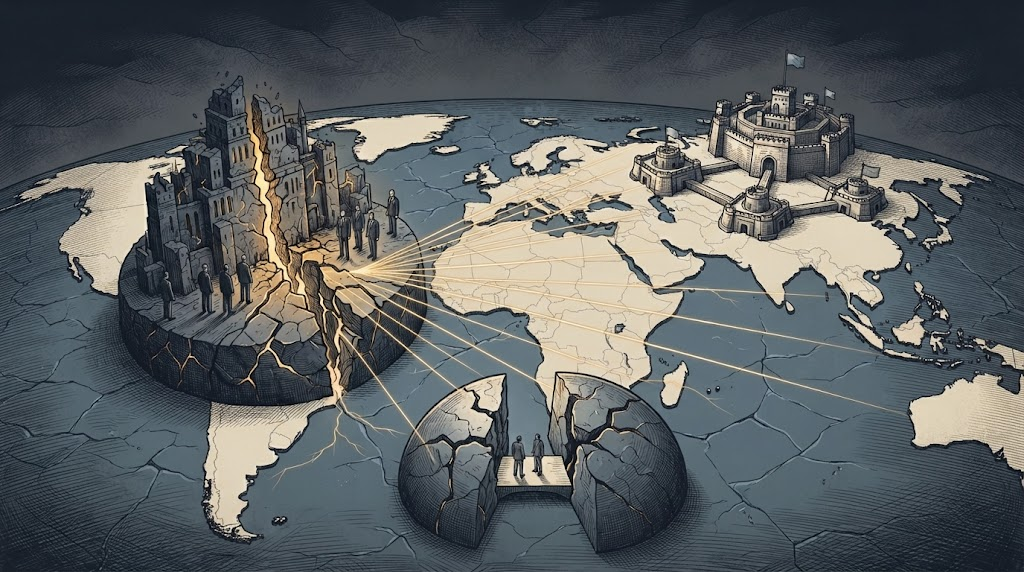


The international system is facing not merely a hegemonic transition but a structural crisis of identity and geopolitical existence. The current global uncertainty, threats, risks, crises, and scenarios of instability are often interpreted through a reductionist lens, primarily in terms of U.S.-China competition. Yet, at the heart of global turbulence lies what I have referred to in my previous studies as the “Western Problem.” The “Western Problem” concerns the internal decay of the power at the center of the system, the fragmentation of leadership, structural divisions, and a neurotic tendency to return to its historical codes. In other words, the true generator of the systemic crisis is not the unstoppable rise of the East, but rather the West’s own ontological, political, and geostrategic crisis.
The picture we face today is taking shape within a triangle formed by internal leadership struggles, deepening identity-based divisions, and the “Order of Controlled Chaos” generated by the reflex to refuse to relinquish hegemonic power. Indeed, today’s world is debating whether the transatlantic alliance will experience a collective recovery or become engulfed within the very “Order of Chaos” it has created. In this context, the Western Problem is crystallizing along three fundamental dimensions: internal leadership competition, ideological-structural fragmentation, and hegemonic resistance toward the East.
New Leadership Struggles within the Transatlantic Matrix and the Recurrence of History
The consolidation of power within the West has historically never constituted a homogeneous structure. History presents the First and Second World Wars as manifestations of a Germany-centered “Western Problem.” Today, a similar geopolitical genetic pattern appears to be awakening. Berlin made the European Union the principal instrument of its “Policy toward the West” for an extended period and embarked on a search for strategic autonomy from the United States, and even for leadership of the West. At the same time, within its “Policy toward the East,” it pursued a balancing strategy centered on Russia. However, the process that began with the war in Ukraine has broken this strategy to Berlin’s disadvantage, once again pushing Germany into a position of strategic constraint.
London, meanwhile, having undergone a sharp geopolitical transformation in the aftermath of Brexit, has recognized the vulnerabilities of continental Europe and made a forceful return to the Anglo-Saxon axis. In other words, the United Kingdom is repositioning itself as a global axis by taking advantage of continental Europe’s strategic paralysis. In this context, Britain is pursuing a more dynamic, less costly, and more aggressive “minilateral” power strategy through arrangements such as AUKUS, in contrast to the EU’s institutional sluggishness. This is shifting the intra-Western leadership struggle from the Germany-France axis toward competition between the Anglo-Saxon and Continental European blocs. More concretely, it is sharpening the struggle for leadership within the West between the traditional Anglo-Saxon alliance (the United States and the United Kingdom) and Continental Europe (Germany and France).
The division of leadership within the transatlantic matrix is undoubtedly paralyzing the collective West’s ability to formulate a common strategy during times of crisis. While seeking to preserve global hegemony, the West is unable to produce a homogeneous leadership architecture of its own; this, in turn, pushes the system into a spiral of “multi-headed anarchy.” In future projections, the gap between the United Kingdom’s aggressive minilateralism and Germany’s cumbersome continental hegemony will widen further. This will cause the single-centered structure of the transatlantic alliance architecture to collapse completely, fragmenting it into multiple, competing regional security enclaves.
Ideological Fragmentation and the Risk of Returning to Europe’s Historical Codes
The second and most dangerous dimension of the “Western Problem” is the deepening structural rifts among the United States, the United Kingdom, and the European Union. In other words, it is the erosion of the liberal-democratic consensus and the ideological ghettoization of the West from within. What we face today is not a unified West, but fragile structures divided into the United States, the United Kingdom, and the EU, each of which is itself shaken by currents of micro-nationalism. The most dangerous aspect of this division is the regression at the level of values, which may be described as a “Geopolitical Fracture of the Post-Enlightenment Era.” Thus, this division is not merely an “economic” or “military” divergence; it is a fracture along “philosophical,” “ideological,” and “values-based” lines. While a profound philosophical rift is emerging between the Anglo-Saxon and Continental European axes, the rise of the far right, xenophobia, and neo-mercantilist tendencies across Europe indicates that the continent is rapidly distancing itself from the values of the Enlightenment. This risk of “internal militarization” extends beyond electoral success, shifting law-enforcement institutions and military establishments toward nation-state-centered reflexes.
Consequently, Europe is on the verge of a neurotic return to the tendencies toward fragmentation and periods of internal conflict embedded in its historical codes prior to Westphalia. In addition to the socio-political rifts intensified by the rise of the far right within the EU, Germany’s Zeitenwende initiative is creating a profound military-industrial division. Berlin’s expansion of its defense budget to enormous levels directly threatens Paris’s traditional leadership of “European Strategic Autonomy.” While France advocates focusing on European-made joint projects, Germany, citing urgent requirements, is opting for American F-35 aircraft and Patriot systems, thereby reinforcing the transatlantic link. This is making the Franco-German divide in the EU’s defense industry increasingly permanent and rendering the ideal of a collective European army impossible.
Europe’s philosophical and institutional disintegration is transforming the continent from a global center of power into a geopolitical zone of fracture. In this context, it would not be unreasonable to anticipate that the deepening Franco-German defense divide will leave the EU militarily dysfunctional, while the micro-nationalist wave fueled by the rise of the far right may, in the near future, push the continent toward the threshold of social civil-war dynamics, in addition to cross-border institutional conflicts and even a bloodless disintegration. In other words, the prospect of a transformation into hybrid internal conflicts driven by social polarization—or even a new “European Civil War” in which nation-states compete with one another—cannot simply be dismissed.
Hegemonic Resistance and the Uncertainty of the “Western Pacific”
It is impossible for the West, particularly the United States, which does not wish to relinquish its status as a global empire, to voluntarily hand over leadership to the East and China. Expecting the United States to implement the Soviet Union’s 1991 model of “voluntary dissolution” would constitute a historical fallacy. Rather than accepting its decline, the United States seeks to reconstruct the global system in its own favor by pushing the world toward controlled instability—in other words, by creating an “Order of Chaos.”
In the “Western Pacific” belt, the most critical theater of this strategy, the remilitarization of the two former Axis powers is raising the level of global military tension. In a possible China-Taiwan or South China Sea conflict, Japan and India appear likely to assume entirely different operational roles. Japan, having relaxed the constraints of its pacifist constitution, appears poised to become the United States’ primary logistical and military base in the region and to become directly involved in conflicts around the Taiwan Strait through intelligence, naval patrols, and missile-defense systems. India, by contrast, appears to be moving toward a role centered on imposing a naval blockade in the Strait of Malacca and the Indian Ocean, while avoiding opening a military front along its land border with China. In this context, New Delhi appears already to be implementing a strategy aimed at paralyzing China logistically by cutting its energy supply routes—avoiding direct hot conflict while providing the Western alliance with a critical logistical lever. Indeed, for India, the Pacific is emerging not as a means of serving the West, but as a lever through which to become an independent leader of the Global South under a doctrine of multi-alignment.
Washington’s “Order of Chaos” in the Pacific may be regarded as a proxy global strategy that pushes its allies toward the front lines. In future projections for the region, Japan’s direct involvement in a hot conflict may become unavoidable, while India, by preserving the flexibility of its multi-alignment strategy, may ultimately reject demands for full military integration with the West and thereby generate a major operational vulnerability in the U.S.-centered containment strategy across the Asia-Pacific.
The East’s Reaction: The Future of Revisionist Organizations and the Eurasian Axis
The structural crisis generated by the “Western Problem” is directly catalyzing shifts in the balance and efforts toward cooperation within the Eastern bloc. The West’s fragmented appearance and aggressive efforts at consolidation have condemned Russia and China to a “forced strategic destiny.” Within the “Russia-China-India” balance, New Delhi’s position will determine the fate of intra-Eastern dynamics. As I examined in detail in my analysis titled “From Rhetoric to Reality: The New Delhi Threshold—The Future of BRICS and Türkiye in the ‘Multi-Structured’ Deadlock of the Global Order” the Shanghai Cooperation Organisation (SCO) and BRICS, emerging as alternatives to the Western-centered international system, are no longer merely economic and regional cooperation platforms. They are evolving into geopolitical shields against the West’s financial and military monopoly and into alternative centers of global governance. In this context, the “BRICS+” mechanism is shifting control of global commodity and energy markets toward the non-Western world. The SCO appears likely to evolve from a regional security pact into a collective Eurasian defense umbrella, while BRICS is expected to develop an alternative development matrix capable of rendering the Western-centered IMF and World Bank models ineffective. As the West becomes increasingly divided by its internal contradictions, the Eastern axis will fill this institutional vacuum through a rational and multipolar expansion strategy. Indeed, institutional consolidation along the Eurasian axis is structurally constraining the West’s sanctions power and financial hegemony. At this point, it is increasingly evident that BRICS- and SCO-led de-dollarization initiatives will capture more than half of global trade volume and, by dismantling the transatlantic-centered Bretton Woods system, divide the world into two clearly defined spheres of economic sovereignty and an irreversible multipolar financial architecture.
Conclusion
The picture we face today is an absurd paradox in which the West itself can no longer comply with the rules of the liberal system it created. The “Western Problem” is giving rise to a smaller but more aggressive Western bloc that seeks to survive through flexible, low-cost, hybrid mini-alliances capable of making decisions more rapidly. The world is caught between, on the one hand, a West that is fragmenting, becoming more authoritarian, and carrying the risk of returning to historical codes of warfare, and, on the other, a revisionist East that is drawing strength from this crisis but has not yet achieved full institutional integration of its own.
In the period ahead, the fate of the global order will be determined not by the pace of U.S.-China competition, but by how bloody or bloodless the internal processes of decay and conflict within the “Western Problem” become. In this new world, the sole path to survival and the preservation of sovereignty is the doctrine of “Strategic Autonomy,” embodied in concrete terms by India and Türkiye.