

Global power balances are undergoing a historic transformation in which the West is becoming stagnant while the East is rising radically. While this profound transformation is deeply shaking traditional structures of hegemony, it is also bringing about the construction of a new global architecture through deliberately manufactured crises and a state of chaos in international relations. The Russia-Ukraine war and the escalating regional conflicts in the Middle East are merely the initial stages of this macro-operation. The objective is to establish global hegemony through instability.
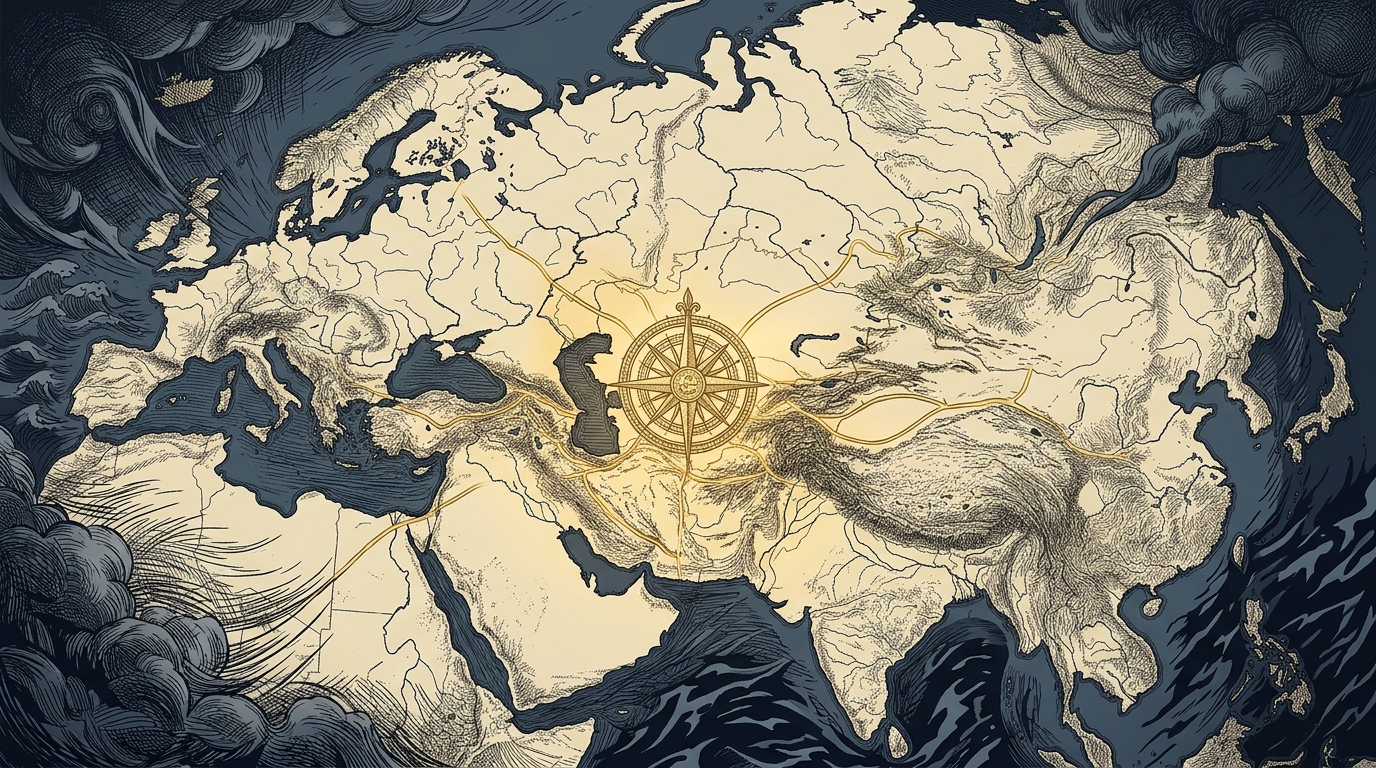
At the very center of this geopolitical storm lies the geopolitics of the Turkic world, which encompasses some of the world’s most strategic underground resources and logistical trade corridors.
Today, the Turkic world stands at an irreversible critical juncture between the risk of becoming an open operational theater and an object of influence struggles among global actors, and the opportunity to become a powerful “Central Actor” capable of changing the course of history. The only way to capitalize on the unique and unparalleled opportunity offered by this geography is to move beyond ambitions, artificial polemics, and narrow interests, and to act with a shared awareness of a common destiny grounded in historical lessons. The Turkic states must unite under a single strategic mind against all forms of external intervention aimed at sabotaging their integration processes, and institutionalize the will for unity, solidarity, and cooperation on the ground.
It is evident that the Turkic world needs a new conceptual framework in order to understand the risks it faces and the potential it possesses under the current circumstances. In this context, it would be useful to approach the process through the following three conceptual lenses:
- Risk of Asymmetric Sabotage: Global actors are triggering micro-nationalism and extreme nation-state-centric rhetoric in target geographies in order to undermine emerging integration processes. At a time when even well-established structures such as the EU are showing signs of fragmentation, the emerging Turkic integration process is being forced toward a “stillbirth.”
- Balancer of Imbalance (Central Actor): The Turkic world has the potential to become not merely a bridge within the geopolitical space between East and West, but the sole “Central Actor” capable of absorbing global instability and balancing global disequilibrium.
- Strategic Traps (Thucydides and Pyrrhus): On the slippery terrain of international relations, short-term gains achieved by actors at enormous cost—“Pyrrhic victories”—may ultimately lead them into the conflict traps set by global powers, namely the “Thucydides Trap.” Regional actors must develop immunity against such traps.
If the Turkic world fails to manage the current process through a common will, the following scenarios will inevitably emerge in the period ahead:
- Becoming the Stage for a “New Great Game”: If supply chains, energy corridors (such as the Belt and Road and the Middle Corridor), and strategic underground resources cannot be managed collectively by the Turkic world, they will come under the direct control of global powers, turning the region into an operational theater.
- A Century-Long Survival Crisis: Impulsive and unilateral nation-state-centric moves that harm the integration process—and, in this context, the vital interests and objectives of each member state, particularly their national survival—will push regional states toward alternative strategies and toward “compelled balancing” arrangements that are far from desirable. This situation could undoubtedly trigger a fragmentation and survival crisis in the Turkestan and Caucasus regions lasting for at least a century.
- Total Loss and Destruction: In an era in which the global system is being reconstructed, acting in a fragmented manner means leaving each individual state vulnerable to global operations. Such a loss could be far more devastating for certain regional countries that possess high geopolitical vulnerability and are undergoing sensitive transitional processes.
Proactive Recommendations for a Solution and Strategic Harmony
At this point, the urgent action plan that the Turkic world should implement in order to break through the global traps and encirclement it faces, both directly and indirectly, and transform itself into a center of attraction, could rest on the following pillars:
- “Strategic Patience” and the “Doctrine of Prudence”: Actors must remain calm in the face of provocations, disinformation, threats and pressure, and “tempting promises.” Instead of day-to-day reactions, a mechanism of strategic patience that preserves a long-term vision must be put into operation.
- “Collective Strategic Mind” and “Integration of National Power”: In this critical process, full harmony must be established among “policy, strategy, and instruments.” The military, economic, technological, and demographic elements of national power possessed by the states should be coordinated within a common pool in a manner that generates a multiplier effect on a global scale.
Accordingly, Strategic Harmony of Mind should be constructed through the following linear flow: The process begins with the Policy phase, which represents a common vision; this vision is then transformed into a feasible action plan and transferred to the Strategy phase; finally, it is implemented on the ground through the Instruments phase, in which the elements of national power are employed effectively.
Institutional Infrastructure, Diplomacy, and the Media Corridor
a) A Joint Crisis Management and Consultation Mechanism within the OTS
In response to the instantaneous and asymmetric threats generated by the global order of chaos, an Institutional Consultation and Permanent Crisis Management Center (OTS-KRM) could be established within the Organization of Turkic States (OTS). This structure should connect the foreign affairs, defense, and intelligence agencies of member states through a secure digital network operating on a continuous 24/7 basis. In the event of a regional border violation, cyberattack, or terrorist threat, the mechanism would proactively activate an “Early Warning System.”
In order to prevent impulsive and unilateral nation-state-centric reactions during crises, joint decisions could be placed on a legal foundation through a “Strategic Coordination Council.” By preventing members from being pushed toward divergent searches on the “slippery terrain” of relations, this structure would function as a collective shield. Thus, the speed of response to asymmetric operations would be increased, while the common backbone would be protected from being fractured by ambitions and manipulations, thereby institutionalizing a will for joint governance and collective security.
b) Preventive Public Diplomacy Methods Against Global Manipulation
A proactive Turkic World Media and Communication Doctrine could be implemented against disinformation and actors seeking to sabotage the process of integration. In this regard, a common data center and an “AI-Supported Perception Monitoring Unit” should be established. Manipulative content in the global media should be detected before it spreads on the ground and immediately countered through simultaneous multilingual broadcasting. In gray areas where direct diplomacy becomes blocked, channels of indirect diplomacy should be activated.
Within this framework, a common historical and geopolitical awareness incorporated into national education curricula would make younger generations more resilient against hybrid warfare agents. With regard to global public opinion, themes such as the security of the “Belt and Corridors” and the stability of energy supplies should be emphasized in order to communicate that the Turkic world is a “Balancer of Imbalance” and a peaceful “Central Actor.” Defensive lines must be established on the digital front before perceptions are manipulated.
c) A Concrete Media Action Plan for Global Perception Management
In order to break global manipulation, a “Common Turkic Media and Digital Broadcasting Platform” could be established. Within this platform, a “OTS News Agency” broadcasting in 12 languages and supported by artificial intelligence could be launched. In the first phase of the action plan, a joint “Digital Strategy Center” could be established to counter social media algorithmic manipulation, while young content creators could be supported. In the second phase, a format of joint and simultaneous “Strategic Agenda” broadcasts could be implemented across the national channels of member states in order to prevent manipulation during geopolitical moments of rupture.
Furthermore, “Turkestan Geopolitical Forums” could be organized on a global scale and disseminated to international public opinion through digital networks in order to activate and mobilize channels of indirect diplomacy and public diplomacy. High-budget documentaries and digital content focusing on the security of energy routes and the Middle Corridor could be broadcast on global live-streaming platforms. In this way, the defensive line could be shifted from reactive denials toward proactive content creation and built around the narrative of the “Central Actor.”
Historical Responsibility at the Threshold of a Common Destiny
The geopolitics of the Turkic world constitutes such a vital backbone that it cannot be sacrificed to any internal polemic. In this turbulent era, in which global fault lines are shifting, ambitions and artificial tensions must not be allowed to blind strategic judgment. The Turkic states will either become passive objects caught in the vortex of global chaos and hybrid operations, or they will unite around a compass of common strategic wisdom and prudence and consolidate their position as a “Central Actor” shaping the multipolar world of the future.
In this regard, the proposed institutionalization of the “OTS Crisis Management Center,” “Preventive Public Diplomacy Doctrine,” and “Multilayered Media Action Plan” represents more than abstract aspirations; these are vital shields that the Turkic world needs to develop against asymmetric threats.
A geography that cannot proactively establish its defensive lines on the digital front, within intelligence-sharing pools, and in the intellectual sphere cannot possibly protect its physical borders and strategic resources. Against micro-nationalist traps and disinformation aimed at undermining integration processes, “strategic patience” and the “indirect diplomacy factor,” as the strategic intelligence and coordination center of public diplomacy, constitute our greatest safeguards.
In conclusion, remaining standing on this slippery terrain between East and West, preserving the enormous energy and supply advantages at our disposal, and managing the future collectively require unity and solidarity. These are no longer romantic ideals; they are an absolute, inevitable, and historic existential imperative for survival.
The geopolitics and prudence of the Turkic world stand above all forms of polemics and manipulation, regardless of their source or origin.