

As I examined in detail in my analysis titled “The Three-Dimensional ‘Western Problem’ and Tectonic Fractures in the Global Order” the issue at hand represents the shattering of geopolitical fault lines within the West itself, the ontological collapse of the Atlantic-centric global order, and a continental struggle for existence. In this context, the emerging security and survival-oriented rapprochement between the United Kingdom and the European Union (EU) in the post-Brexit era is not merely the repair of a standard neighborhood relationship; it manifests as a pragmatic defense reflex developed against a structural dissolution that can be conceptualized as the “Western Problem.”
This new pursuit serves not only as a fortification against the rising Russian military threat, but also functions as a continental “geopolitical insurance policy” against the protectionist, hegemonic, sanction-driven, and aggressively exclusionary moves of the US—an entity nominally coded as an ally.
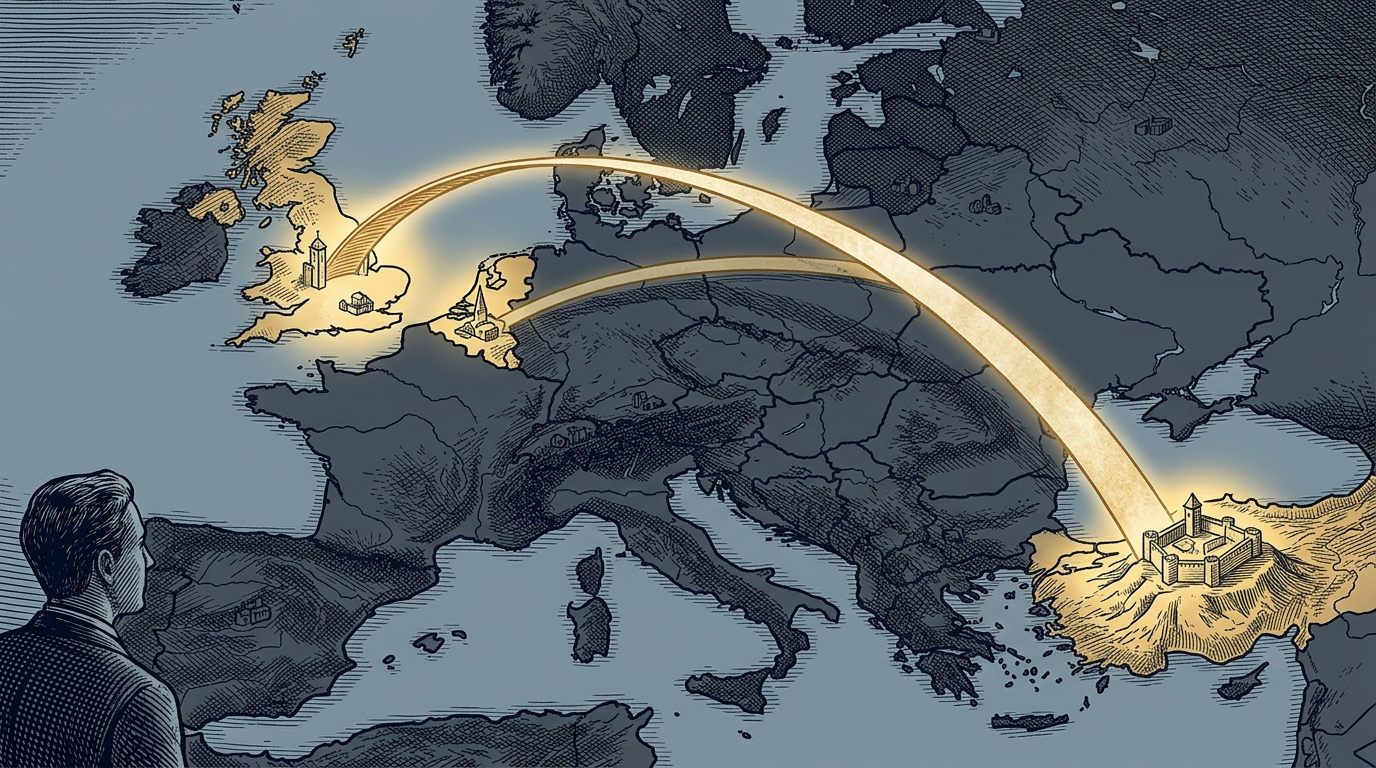
As the myth of the Transatlantic alliance as an unshakable block crumbles, the future of the Old Continent hinges on the locomotive role played by the Paris-Berlin axis, the UK’s capacity to maintain its internal integrity, and most critically—despite persistent efforts by a large portion of Continental Europe to keep Türkiye strictly outside the “Club”—a game-changing strategic alignment within the “Ankara-London-Brussels” triangle capable of absorbing Atlantic pressure. Europe presents a picture of attempting to reconstruct its own geopolitical axis between Washington’s unilateral impositions and the multipolar reality of the global system.
Decoupling from the Alliance: The “Western Problem” and the Dual-Threat Pincer
Today, the European continent finds itself caught in a pincer movement: militarily from the east (Russia) and structurally and economically from the west (US). This predicament forces London and Brussels to set aside historical grievances and unite under a shared perception of threat. The fear of a potential “Great Bargain” between the US and Russia regarding the continent’s future triggers anxieties over Europe losing its voice in determining its own destiny.
At this junction, the risk of a Yalta-like re-division emerges, threatening to redesign Euro-Atlantic security over the heads of Brussels and London. Across traditional spheres of influence such as the Mediterranean, Africa, and the Middle East, Europe is losing ground to aggressive US energy-corridor maneuvers. American hegemony over critical minerals, rare earth elements, and global logistics routes directly underpins the erosion of the EU’s “Strategic Autonomy” vision. Trapped between the US and China in artificial intelligence, semiconductor technology, and quantum computing, Europe faces the risk of falling to a third or even fourth-tier player in the global technology rankings, especially when considering other Asian technological powers.
Furthermore, the perception that micro-nationalist separatist movements within the UK and the far-right within the EU receive overt or covert backing from across the Atlantic is read as a multi-dimensional threat to European sovereign territory. Crisis points such as Greenland and the Falklands demonstrate Washington’s willingness to disregard Europe’s sovereign sensitivities. This dual pressure pushes the continent into a “Geopolitical Limbo” syndrome. Europe risks losing its identity and becoming an “Object of History,” caught between Washington’s “Atlanticist Economic Assimilation” and Moscow’s “Continental Military Boundary Revisionism.”
The Locomotive Roles of France and Germany: “Geopolitical Dualism”
In constructing this new security architecture along the London-Brussels axis, the EU’s primary engines—France and Germany—assume a dual-engine leadership role that can be termed “Geopolitical Dualism.” France provides strategic guidance through its nuclear deterrent and global military projection capabilities. President Macron’s trajectory envisions a “Continental Defense Integration” that integrates British military might into the EU’s defense framework, breaking military dependence on Washington. For France, the UK is a co-founding partner of a non-US security umbrella. Meanwhile, Berlin, as the financial and industrial heart of the continent, funds the logistics and defense-industrial dimensions of this cooperation. Germany’s traditional Atlanticist stance has been shaken by Washington-driven ruptures, forcing Berlin at a historic turning point into partnerships with the UK across ammunition, cyber defense, and critical raw material supply chains. Berlin acts as the main financier ensuring operational sustainability.
However, this partnership risks a “Paralyzing Gear Friction” caught between Paris’s military ambitions and Berlin’s defense-industrial commercial mercantilism. Our projection is that the existential anxiety experienced by the continent will force these two capitals into an “Enforced Geo-Economic Fusion,” spurring the birth of a non-hierarchical continental directorate that bypasses cumbersome EU decision-making mechanisms.
Micro-Nationalist Shackles: The Disruptive Potential of Separatist Movements
The primary structural threat to this global vision is the potential for “Micro-Nationalist Sabotage” gnawing at the United Kingdom from within. The historic joint front forged by pro-independence movements in Scotland, Wales, and Northern Ireland directly undermines London’s clout at the negotiating table as a global actor. As long as London remains consumed with preserving its territorial integrity and expending resources on domestic security and constitutional crises, it cannot serve as a reliable “security provider” for the EU. Potential political crises stemming from the “Northern Ireland Protocol” carry the immediate risk of damaging the Brussels-London trust dynamic. The presence of covert manipulation by actors like the US or Russia behind British separatist currents elevates these movements from mere domestic politics to a “Hybrid Geopolitical Weapon.” Consequently, a fractured or federalized UK slipping into chaos would open a massive security vulnerability in Europe rather than serving as an anchor for its defense architecture.
Evaluating the Chances of Success: Internal and External Dynamics
The sustainability of this “Re-Union” project—built along the London-Brussels security line as a response to or counterweight against the US and Russia—depends on balancing formidable internal and external dynamics. The primary domestic obstacle remains the institutional and psychological residue of Brexit. Sovereign reflexes within British politics combined with the EU bureaucracy’s insistence on rigid regulation could slow the pace of military integration. Conversely, London’s anxiety over its territorial integrity and Europe’s fear for its survival remain the sole catalysts capable of cutting through these bureaucratic hurdles.
On the external front, Washington may deploy its financial, political, and hybrid instruments to prevent Europe from evolving into a fully independent pole and severing ties with the transatlantic framework. A US strategy aimed at dividing the EU or backing a multi-fragmented “Micro-Europe” project represents the single greatest external threat facing this union. Meanwhile, Russia could leverage energy and cyber vectors to intensify pressure, attempting to prevent Europe from consolidating militarily.
In this chaotic environment, the ultimate success of the project relies on developing a “Geopolitical Immunity” beyond mere institutional reflexes. If the continent fails to generate a common “Strategic Defense Genome” capable of resisting micro-political viruses leaking from the Atlantic and conventional shocks originating from Moscow, all steps taken will remain superficial statements of intent.
Our projection indicates that the severity of external pressure will trigger an internal genetic resistance within Europe, forcing a pragmatic “Survival Mutation” that sidelines status quo bureaucracies. The Russian-American military pressures concentrating in the Arctic (the Greenland/Denmark axis) and the Baltic Sea appear set to serve as the primary proving grounds for this immunity. Indeed, the “Euro-British Pact” is giving rise to a new joint deterrence doctrine and naval power architecture across Baltic shores and Arctic transit routes to balance US sovereign interventions and Russian submarine mobility on a continental scale. The backbone of Europe’s “Re-Union” architecture will likely be built upon an institutional EU-UK defense pact, shared cyber and hybrid intelligence, joint procurement mechanisms, and secure energy/critical element corridors. The catalysts driving this architecture are NATO’s deterrence crisis, technological lag, loss of strategic resources, and intra-continental geopolitical sabotages.
The Türkiye Dimension: “From Flank Security to Continental Backbone and Atlantic Balance”
The expansion and consolidation capacity of the London-Brussels security axis cannot be envisioned without taking into account Türkiye’s role as a “Geopolitical Keystone” and its production-driven defense integration capabilities. The confidence crisis unfolding within NATO’s European pillar and Washington’s tendency to bypass the continent make Ankara—for now—the sole “Security Anchor” for continental defense across the “Eastern Mediterranean-Black Sea-Red Sea Triangle.”
In this process, the aviation partnership between Türkiye and the UK—exemplified by structural initiatives like the KAAN fighter jet program and Eurofighter procurement—offers a model of “Flexible Industrial Alliances” against the sluggish structure of the European defense industry. Türkiye’s asymmetric capabilities in UAV/UCAV technologies, along with its active deterrence in Ukraine, Africa, and the Middle East, represent the primary leverage available to cover Europe’s logistical and strategic vulnerabilities.
However, this integration faces a multi-layered containment strategy from the US, which opposes the continent emerging as an independent pole and views potential military-industrial alignment within the “Ankara-London-Brussels” triangle as a threat to its defense monopoly. Washington employs CAATSA sanctions, exclusion from the F-35 program, and delays in air power modernization in an effort to prevent Türkiye from becoming a technology and ammunition provider to this new European axis.
In this context, the US pursues a hybrid pressure scenario aimed at suffocating this strategic aviation pact industrially—tightening supply processes for KAAN’s critical sub-components, consolidating the German veto on Eurofighters through back-channel diplomacy, and leveraging secondary financial sanctions to choke off critical parts flows. Furthermore, by backing alternative energy and military pacts in the Eastern Mediterranean that exclude Ankara, the US seeks to divide the southern flank of any prospective Euro-British architecture. Consequently, alongside the “Israel factor”—which targets Türkiye and attempts to hold US foreign policy hostage—the factor of a potential “Euro-British Pact” holds a pivotal position.
Although this new architecture contains an inevitable clash of interests between British-EU status-quo policies and Türkiye’s “Blue Homeland Doctrine” regarding energy corridors in the “Caspian-Black Sea-Eastern Mediterranean-Red Sea-Persian Gulf” pentagon, it renders a “Geopolitical Compromise and Mutual Shield” model mandatory for maritime security against US and Russian corridor moves that bypass the continent.
Therefore, London and Brussels face a pragmatic necessity: they must break Washington’s pressure and embargo mechanisms to integrate Türkiye into the system. An arrangement that excludes Türkiye and confines itself strictly within “Central Europe” will lack depth, remaining a fragile construct unable to withstand Atlantic pressure. For this reason, defense partnerships established with Ankara extend far beyond a peripheral country dynamic; they emerge as the foundational backbone balancing the global distribution of power within the new architecture.
Future Outlook: Three Potential Scenarios and the Geopolitical Tipping Point
Looking ahead, three primary scenarios can be projected for Europe’s geopolitical design:
- “Strategic Satellitization” (Low Probability): Europe fails to consolidate internally and fragments; the UK weakens while struggling with domestic separatist movements; and the continent surrenders entirely to the US security and economic umbrella. This collapse transfers the continent’s defense industry wholesale to an American monopoly, reducing European states to mere provincial governorships stripped of decision-making authority on their own soil.
- “Fortress Europe” (Medium Probability): The emergence of a geopolitical pole completely insulated from both the US and Russia, maintaining a balanced economic relationship with China, possessing its own cyber, technological, and military infrastructure, and projecting power along global corridors through a UK-EU partnership. This model builds an impenetrable strategic shield against all extra-continental hybrid interventions, re-establishing Europe as an inviolable founding center of the global order.
- “Two-Headed Euro-Atlantic” (High Probability): A hybrid model where NATO continues to exist on paper, but its European pillar (EU + UK + Türkiye) establishes its own command, intelligence, and operational mechanisms. The joint institutional integration of London, Brussels, and Ankara across military and industrial spheres provides the continent with asymmetric diplomatic and operational leverage to negotiate against unilateral Atlantic impositions.
Beyond these scenarios, the continent stands on a dramatic threshold between “Anarchy of Fragmented Sovereignties” and “Post-Atlantic Continental Consolidation.” If the London-Brussels-Ankara triangle fails to neutralize Washington’s “divide-and-rule” micro-nationalist sabotages and defense embargoes, Europe will degenerate into a “Geopolitical Ghetto,” remaining a mere commercial market in the global league. Conversely, achieving an asymmetric, indigenous technological leap in the defense industry could transform the continent into a self-sufficient “Security Ecosystem.”
Conclusion
The West has completely ceased to function as a homogeneous geopolitical block, a unified set of shared values, or a single-centered security shield. The “Western Problem”—which I analyzed in detail in my work “The Three-Dimensional ‘Western Problem’ and Tectonic Fractures in the Global Order”—starkly demonstrates that in this new century, where global power balances are shifting radically eastward and multipolarity has become inevitable, the interests of both sides of the Atlantic have irrevocably diverged.
This security-centric strategic rapprochement between the UK and the EU is not a romantic integration attempt fed by historical nostalgia; it is a stern, rational survival instinct deployed to avoid being swept away in a global storm. The ultimate success of this massive continental effort relies heavily on Paris and Berlin setting aside artificial superiority complexes and protectionist trade reflexes to sustain a shared leadership drive; on London keeping internally fueled micro-nationalist fault lines and constitutional crises under control; on absorbing financial and hybrid sabotages emanating from across the Atlantic; and most importantly, on establishing visionary, full-fledged partnerships on equal terms with Türkiye—the power that holds the continent’s Eastern/Southern defense line, logistical depth, and military-industrial production capacity.
If continental states fail to abandon century-old sovereignty habits, bureaucratic inertia, and ideological prejudices to commit to a collective, inclusive survival strategy, they will be condemned to remain mere trade objects or geopolitical spheres of influence at the negotiating table, rather than independent subjects amidst the re-division wars of global power blocs like Washington, Beijing, and Moscow.
The future of Europe lies hidden within the unshakable resilience of the new triangle it constructs beyond its own borders: Ankara, London, and Brussels.