The Ankara Center for Crisis and Policy Studies (ANKASAM) presents its interview with Amina Munir, Research Associate at the Maritime Centre of Excellence (MCE) of the Pakistan Navy War College (PNWC), on the emergence of the Saudi-led Multinational Maritime Defence Coalition (MMDC), the advantages and limitations of minilateral maritime-security frameworks, the coalition’s potential to develop into a durable regional security mechanism, and Pakistan’s role within this framework.
1. How do you assess the emergence of the Saudi-led Multinational Maritime Defence Coalition, announced on 30 July 2026, as part of a broader trend toward smaller and more flexible maritime-security arrangements?
I might not have wanted to read Multinational Maritime Defence Coalition (MMDC) as a clip-on-the-job creation of the Red Sea crisis. It is more easily viewed as the most recent and, I think, the most institutionally bold manifestation of an evolution in maritime governance that has been taking place over the past two decades or so, from a universal, treaty-heavy multilateralism to “coalitions of the directly affected.
What actually worked was the Malacca Straits Patrol (MSP) initiated by Indonesia, Malaysia and Singapore in 2004 and later expanded with the addition of Thailand in 2008 and the maritime air patrols called Eyes in the Sky from 2005. These events took place in the Straits, where the numbers dropped dramatically, and Lloyd’s Joint War Committee eventually lifted the war-risk listing imposed in 2005. It was accompanied by the enactment of ReCAAP in 2006 as an information-sharing agreement with a fusion centre in Singapore. The Djibouti Code of Conduct of 2009, followed by the Jeddah Amendment of 2017, was a regional legal framework in the Western Indian Ocean, with the task-organised formations EU NAVFOR Atalanta (2008), CTF-151 (2009) and NATO Ocean Shield (2014) working on the operational level. The Gulf of Guinea was no exception with the creation of the Yaoundé Code of Conduct and the Interregional Coordination Centre in 2013. The Trilateral Cooperative Arrangement of 2017 (Indonesia, Malaysia and the Philippines) has brought to an end the menace of kidnapping for ransom in the Sulu-Celebes Sea in two years.
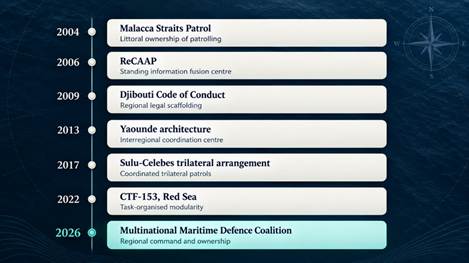
Figure 1. Two decades of minilateral maritime-security arrangements, and the capability each introduced (compiled by author)
There are three things: a relatively focused mandate, a more limited membership with a truly shared agenda, and a focus on speed over breadth. The Combined Maritime Forces model is the institutionalisation of minilateralism: CTF-150 is maritime security operations, CTF-151 is counter-piracy, CTF-153 was created in April 2022 specifically for the Red Sea and Bab al-Mandeb, and CTF-154 is maritime training.
In this context, the characteristic of the MMDC is not to be multilateral. It is that it is owned and led by the regional people. The responses to the Red Sea crisis so far have been led from outside the region and faced a legitimacy issue because multiple regional states had a desire to protect shipping but a lack of political will to be linked to an externally led formation. The MMDC turns that upside down. The founding state and the headquarters of the organisation are Saudi Arabia and its members include the littoral and user states of the corridor, such as Bahrain, Bangladesh, Djibouti, Egypt, Jordan, Kuwait, Pakistan, Qatar, Somalia, Sudan, Türkiye and Yemen. That formation is a coalition problem which is being turned into an ownership proposition.
The rate of institutionalisation provides evidence for the argument. Of the 51 invited military representatives, 40 attended the founding meeting in Riyadh on 30 July 2026, attended by the delegation from the European Union. Within a week, a Commander was appointed. The third planning meeting took place on 13 August at Western Fleet Command in Jeddah, involving the representatives of 39 countries. The joint declaration was signed by 15 states and 13 states had taken their national procedures and signed the charter. The coalition went into its operational phase on 2 September 2026 and Pakistan Navy’s Commodore Rashid Sheikh has been appointed as the deputy commander for the first phase, while the liaison officers of the member and acceding states have joined the team. An instrument of such scope could not be declared as operational in just five weeks. Indeed, the comparative advantage of minilateralism is just that, and as such, it is a space that is gaining momentum.
There is one qualification that I think is analytically relevant that I would add. In the absence of Security Council consensus, and in times where the risks of chokepoints are evident and immediately calculable in freight rates, war-risk premiums, rerouting around the Cape, and inflationary pass-throughs that all of us have seen since the Hormuz disruption, states won’t wait. They will attempt to form the smallest action coalition possible. That’s the logic that’s used on the most consequential maritime corridor in the world, the MMDC.
2. In your view, what advantages and limitations do minilateral maritime frameworks offer compared with broader multilateral mechanisms when responding to threats against commercial shipping and strategic chokepoints?
Let me begin with the benefits in mind, and then be as honest as possible about the limitations, because I do not think anyone can put forth minilateralism as a free option.
Advantages. The first is decision velocity. The negotiation of mandates is the gating mechanism for broad-based multilateral responses, and even the only great power consensus ever achieved for a counter-piracy architecture, which saw a series of Security Council resolutions starting with 1816 in 2008, made it hard to take positive action ashore and at sea. A coalition of the willing operates based on existing rights, self-defence, flag state consent and in accordance with the freedom of navigation provided by UNCLOS, and can act in weeks, not seasons.
The second is mandate coherence. The threats experienced by members in large groups vary, resulting in lowest common denominator demands. A smaller group, all of whom are directly exposed, can write a sharper mandate. The members of the MMDC are not far off stakeholders; they are the states whose ports, seafarers, energy imports and canal revenues are being affected.
The third and in my view the most underrated is legitimacy through ownership. This is what the Malacca case has taught us. The idea of having an external patroller was rejected based on sovereignty; only when the patrollers were owned by the littorals was the problem solved. Any other description of the Saudi-led, regionally staffed coalition is more difficult.
The fourth is differentiated burden-sharing. The advantages of minilateral frameworks are that they can be built on the principle of contribution through comparative advantage, instead of through a uniform obligation. Frigates are not required for all members. The geography, basing and coastal awareness come from Djibouti, Somalia and Yemen, whereas the ports, airfields and the infrastructure next to canals come from Egypt and Saudi Arabia, while platforms, trained personnel and multinational command experience come from Türkiye and Pakistan. The deputy command in Pakistan is the actual representation of division of labour.
The standardisation of common procedures, communications and rules of engagement is much easier to achieve across fourteen navies than they are across forty navies.
Limitations. The most serious and first is legal. A coalition cannot create authority that it doesn’t have. The legality of counter-piracy was based on the principle of universal jurisdiction of piracy, as provided for in Articles 101 and 105 of UNCLOS, which allows any state to board and capture any pirates. Assaults on shipping, initiated by a non-state actor from a coastline, are not of that type. The applicable instruments are narrower but workable, such as the SUA Convention of 1988 and its 2005 Protocol, the flag-state consent regimes or Article 51 self-defence. If this is the case, and the coalition’s operational concept goes beyond its legal mandate, it will lose legitimacy, which is its main asset.
The second is sustainment. It’s simple to form alliances, and costly to uphold them. As the threat faded and focus shifted to the nation, both the Atlanta and CTF-151 teams failed to score anything. If you are at sea, it is only because the hull is available, it is replenished, it is maintained, it is in the cycle of maintenance/money, and you did not declare that you were at sea.
The third is fragmentation. Any multiple parallel missions for the same water space EU missions, CMF task forces, national deployments and now a regional coalition risk duplication, conflicting rules of engagement and, worst of all, interference. This is a fixable problem, and there is an existing precedent: the Shared Awareness and Deconfliction mechanism (SHADE) that was established in Bahrain in 2008 to coordinate the EU, NATO, CMF, China, India, Russia, Japan and Iran in the same waters, with no requirement to be allies. If that be so, I would say that one of the highest-value institutional moves it can make is to create a Red Sea that is hosted by the MMDC. It would make the coalition the hub of a crowded space, rather than one among many.
The fourth is political perception. They might be considered a minilateral bloc focused on a designated opponent, and can lead to counter-coalitions and even to the militarisation of the corridor for which the minilateral framework exists. The founding documents make it clear that the coalition is defensive, open to membership by any state with its goals in mind and based on the UN Charter and international law. The framing is more than just diplomatic decoration; it’s the load-bearing wall of the entire operation and it should be present in the manner of the operation.
The fifth is the sunset problem. Coalitions on issues are usually short-lived and end when the issue does. In the midst of declining Malacca incidents, Eyes in the Sky withered and Somali piracy withered CTF-151. Not a bad thing, but durability must be put in as part of the design.
I don’t think the decision is between the minilateral and the multilateral approach. The best maritime security architectures in the history book are nested elements: those minilateral operational cores that conduct maritime patrolling and escorting missions, and are nested within broader information sharing and legal mechanisms that involve non-members. Malacca is that model that patrols along with ReCAAP. The MMDC should strive to achieve the same nesting.
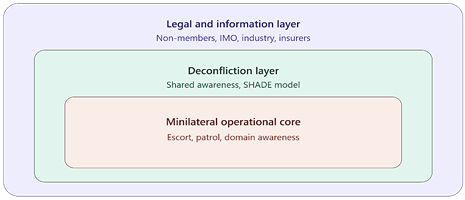
Figure 2. Nested architecture: a minilateral operational core inside wider deconfliction and legal layers (conceptual model developed by author).
3. Looking ahead, could initiatives of this kind contribute to a more durable regional maritime-security architecture in the Red Sea and Gulf of Aden, or are they more likely to remain issue-specific arrangements?
My response is that durability is a design decision, not a natural one, and that, so far, the design choice for the MMDC has been durability-oriented, not a temporary task-force-oriented one. Let me tell you what I will watch.
First, institutional depth. The difference between a coalition and a task force is whether it creates machinery after the crisis. The MMDC has a charter and a permanent headquarters, has appointed a commander and a deputy commander with a first-term rotation arrangement, has established organisational and planning frameworks and reference documents, and has begun seating the liaison officers of the member and acceding states in stages. All these are facts of the administrative world! And it is these facts that count! The ad hoc formations are not chartered or planned for command rotation. However, state-wide reporting of membership (as in the founding declaration) and charter signing and completion of national procedures has varied slightly between sources, as is typical of any organisation that is consolidating; and the ultimate test is conversion from structure to sustained presence at sea.
Second, mandate clarity. The coalition should clarify, in advance and in writing, what constitutes a “threat” at sea. What the coalition is allowed to do, and the rules of engagement, as well as how forces will coordinate in the event of a crisis. Ambiguity is not an evil in a declaratory phase and is a deadly sin in an operational phase.
Third, and I would place particular emphasis here, civil-military integration. Maritime security is not just about the ships! Its consumers are shipowners, charterers, insurers, port authorities and seafarers. A robust structure is required to be connected to the commercial industry reporting, Best Management Practices, coordination with the IMO and the structured relationship with underwriters. This also provides us a direct measure of our success. It is not about sorties flown and patrols conducted but whether the war-risk premium declines or whether the Bab al-Mandeb and Suez transit volumes return or whether the crews stop being killed. Those numbers are published, and they will much better answer the question of effectiveness than a communiqué will. Pakistani seafarers operate on the ships in the merchant fleet all over the world, often times on foreign flags and safeguarding them is not a distant concept for Islamabad.
Fourth, nesting with existing regional legal instruments. The Djibouti Code of Conduct and its Jeddah Amendment already contain an agreed regional framework for the protection against piracy, armed robbery and other illicit maritime activity, including information sharing centres. It would be best for the MMDC to be aligned with that architecture, not built parallel to it, as it would provide legal/ institutional support to the coalition beyond the present threat.
Fifth, capacity building as an exit strategy. Central to the Somali case is this: the piracy issue could only be resolved on the shores, while it was suppressed at sea. The presence of the Navy gives time, but it does not give a settlement. A coalition that works on developing Yemen’s, Somalia’s, Djibouti’s and Sudan’s coast guards and maritime domain awareness is creating something that survives when the warships are gone. A coalition that patrols alone only buys time, which will have to be paid in full.
Sixth, political cohesion. There is no single opinion amongst the members on the conflicts in the region, and there should not be. It requires a mandate that is so small that the differences don’t need to be worked out, protection of commercial shipping, and a lack of the urge to go outside it and a lack of discipline to remain within it. As long as it is viewed as an aggressive actor in a regional conflict instead of a ship’s captain, its membership will split and its credibility will be weakened.
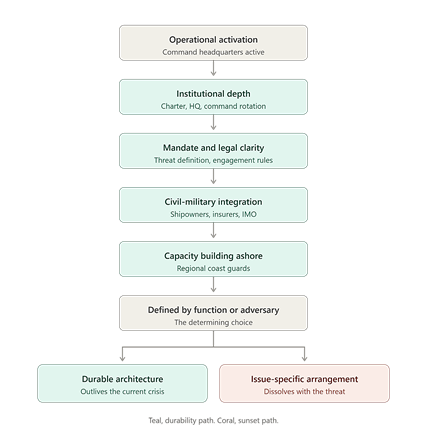
Figure 3. Determinants of durability and the resulting fork (author’s analytical framework).
So, I expect some combination of the two. If institutionalised, the coalition will remain in a diminished steady state and will become a permanent maritime-security framework for this corridor, similar to the way that ReCAAP and the Malacca Straits Patrol survived the piracy boom that created them. If it is based on one opponent, it will be an issue-specific deal, and it will fail when the issue changes form.
Pakistan’s place in this is obvious and, in my opinion, well considered. We have been consistent in defence of global shipping, sea lines of communication, respecting international law and collaborating and de-escalation. Operation Muhafiz-ul-Bahr was scoped to provide escort and protection to national shipping in a carefully planned and bounded operation in coordination with the Pakistan National Shipping Corporation, which was carefully designed to be a defensive operation that demonstrates the Pakistan Navy’s ability to provide sustained escort effect under difficult conditions, and a demonstration of the capability of the Pakistan Navy to provide sustained escort effect during difficult conditions. This is a core national interest and not a discretionary engagement as 90% of Pakistan’s trade is carried out through sea routes.
Our Navy has held the command of CTF-150 14 times and the command of CTF-151 11 times, the most among all partner nations for both task forces and has also been operating the Joint Maritime Information Coordination Centre in Karachi as a national maritime information fusion centre, and has also organised AMAN exercise and AMAN Dialogue, which in 2025 saw participation of some sixty navies. That is an unusual mix of operational experience, information fusion infrastructure, and credibility when it comes to convening and it’s why Pakistan promises the deputy command position in the first term of the coalition. It puts Pakistan in a position to make a substantial contribution, along with Pakistan, Saudi Arabia and Türkiye’s signing of the Mecca Joint Defence Agreement on 7 August 2026, while allowing Pakistan to continue to argue, as we have consistently done for the past two decades, for deterrence exercised through law, restraint and diplomacy.
In brief, I’m convinced this partnership will be a lasting one. Whether or not it does will depend less on the number of states that join it, than on its ability to establish the institutions, the legal clarity and the civilian partnerships that last beyond the crisis that brings them into being.