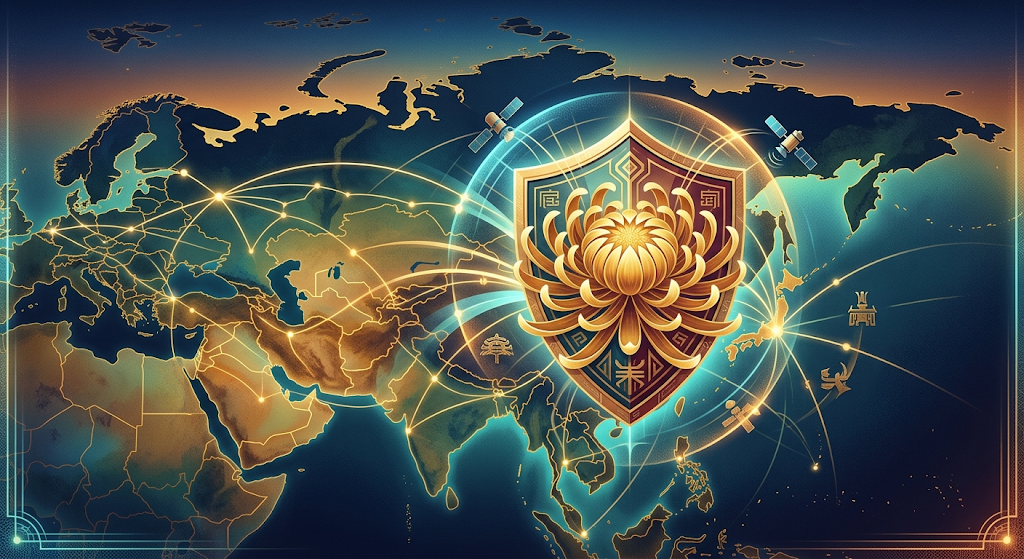


Japan, leaving behind its constitutional restrictions and pacifist foreign policy dogmas in the Pacific, is making a very rapid, systematic, and sharp return to its historical codes and the global political stage, as I discussed in detail in my analysis titled “The New Japan Vision and Active Deterrence in the Indo-Pacific Equation.” This return is built not on classic imperialist expansionism based on direct territorial occupation as in the pre-World War II era, but on “Advanced Defence Autonomy,” legitimized under the umbrella of the US alliance, and an Eurasian-oriented “Economic-Technological Guardianship” strategy.
During this process, instead of confronting Washington, Tokyo assumed the role of the primary guarantor of US global hegemony in the Pacific and Indian Oceans and its main ally in the region. However, this relationship of dependence did not prevent Japan from reviving its national consciousness, militarist capabilities, and industrial base through a historical rupture; on the contrary, it served as a protective shield that accelerated this process.
In today’s multipolar power struggle, Tokyo has become a proactive military powerhouse, aiming not only to protect its own shores but also to gain complete control over the Indo-Pacific routes, considered the heart of global maritime trade. In this context, securing critical straits and continental corridors, which are transit routes for global energy pipelines, has become a fundamental driving force behind the island nation’s new wave of nationalist revival and industrial strategy. These strategic steps expand the geographical boundaries of defense alliances, reinforcing Japan’s military presence with critical overseas bases.
Japan’s Eurasian initiative, launched before September 11, 2001, but shelved by the US intervention in Afghanistan, has entered a new phase in today’s multipolar world order. The fundamental motivation behind Tokyo’s return to Eurasia is to ensure the security of critical raw material and energy supplies and to protect its sea-based logistics routes (SLOCs). This can be seen as a digital and economic transformation of the Lebensraum (Living Space) doctrine, a colonial concept in modern Japanese geopolitics, into a new concept of “Supply Chain Security and Technological Living Space.”
In this context, Tokyo aims to integrate the Eurasian space into its own production ecosystem by maintaining absolute dominance in artificial intelligence and the semiconductor industry. Within this new geopolitical doctrine, a cross-border digital sphere of influence is being constructed through technological dependency relationships, and national security boundaries are being redrawn along cyber-industrial lines. In presenting its revisionist and newly developing militarist policy to the global public, the Tokyo administration emphasizes the following two fundamental arguments:
- “Maintaining the Status Quo and Rules-Based Order”: Against the nuclear and conventional threats from China, Russia, and North Korea, it justifies its military buildup through its “Free and Open Indo-Pacific” (FOIP) vision.
- “Resistance to Economic Coercion”: Breaking the monopoly of actors like China in the supply of rare earth elements and semiconductors is the fundamental motto of new engagements with Eurasian countries.
Bilateral-Regional Relations Networks: The “Japanese Alternative” to the SCO and BRICS, and Potential Breaking Points
Japan, aiming to counter the appeal of China-Russia blocs like the Shanghai Cooperation Organization (SCO) and BRICS in Eurasia, is promising “High-Quality Infrastructure Investments” and “Transfer of Technological Sovereignty” to countries in the region. Tokyo is also creating a strategic protective umbrella by offering financial transparency protocols and corporate data security standards that support local development. This institutional integration guarantees that countries in the region can both protect their sovereignty and gain direct access to Western-centric global markets.
Beyond these, Japan also appears to be accelerating its efforts to develop bilateral and regional relations and partnerships. In this context, a three-tiered strategy emerges:
- “Axial Balance” with India: New Delhi is a critical pillar of Japan’s Eurasian policy. Beyond the QUAD partnership, the two countries are establishing alternative economic corridors in Central Asia and East Africa, regions within the spheres of influence of Russia and China.
- Asia (C5+Japan) and ASEAN: Japan offers Central Asian republics such as Kazakhstan and Uzbekistan, as well as ASEAN countries, a financially transparent model aimed at developing local industries.
- Critical Neighboring Countries: Historical animosities with South Korea have been set aside in the context of a shared threat perception, and military and intelligence integration has been maximized.
The package offered by Japan is being received by Eurasian countries as a very positive and balancing element, due to its structure that does not compromise their sovereign rights.
Undoubtedly, the sustainability of this military apparatus and high-tech industry depends on critical raw materials/rare earth elements. Central Asian states are considered a strategic lifeline for Japan in this regard. Countries in the region, primarily Kazakhstan and Uzbekistan, are deepening their partnerships with Japan in nuclear energy (uranium supply) and rare earth elements. Tokyo is creating mutual dependence by offering technology transfer and green energy infrastructure to these countries, integrating these resources into its own “Technological Living Space.”
On the other hand, the Northern Sea Route (NSR), made accesible by the melting of Arctic ice, represents a radical break in Japan’s Eurasian and Russian strategy. This new corridor, which almost halves the distance compared to the traditional Suez Canal route, creates both a huge logistical advantage and a profound security dilemma for Tokyo. The opening of this route, controlled by Russia, forces Tokyo to renegotiate the “Kuril Islands Crisis” and diplomatic tensions with Moscow within a framework of “geo-economic rationality.”
Japan is accelerating its investments in icebreaker ship technologies and polar navigation in response to China’s “Polar Silk Road” project. In this context, Tokyo is pursuing a dual strategy aimed at weakening the Moscow-Beijing axis by gaining access to Russia’s Arctic energy projects through civilian investments.
Maintaining the Djibouti Base and Eurasian Logistics Lines
Japan’s geopolitical shift toward Eurasia extends beyond the continent’s interior to the furthest reaches of critical maritime routes. In this process, Japan’s military base in the Horn of Africa and Djibouti, opened in 2011–its first official and permanent military base outside the country since World War II–plays a vital operational role in securing Eurasian logistical routes. Located at the gateway to the Suez Canal and the Red Sea, this overseas base maximizes Japan’s surveillance, intelligence, and anti-piracy capabilities along energy and trade routes. Tokyo is continuously reinforcing the military capacity of this base to directly counterbalance China’s logistical hub in Djibouti and secure its commercial lifelines in the Indian Ocean. This military presence in the region enables Japan to respond immediately to maritime trade routes in times of crisis, consolidating the island nation’s supply chain security on an intercontinental scale.
Reactions and Precautions of Regional Powers
Japan’s sharp shift towards the global stage and Eurasian geopolitics is being followed with deep concern and countermeasures by the major actors in the region. In this context, the People’s Republic of China characterizes these moves by Japan as “neo-militarism” and an attempt to establish an “Asian NATO” in the Asia-Pacific region. In response, Beijing is intensifying naval patrols around the Senkaku Islands, expanding its nuclear and hypersonic missile arsenal, and threatening Japan through lines of economic dependence.
The Russian Federation, whose relations with Tokyo have completely broken down due to the territorial dispute over the Kuril Islands, views Japan as an “American proxy” in the Pacific. As a precaution, it is modernizing its Pacific Fleet and systematizing joint naval and air exercises with China in the Sea of Japan.
North Korea, viewing Japan’s military activism as a direct threat to its own regime security, is responding by increasing ballistic missile tests over Japanese airspace and strengthening its nuclear deterrence.
Unlike the other three actors, India is the only Asian actor that welcomes Japan’s comeback. New Delhi is using Japan’s financial and technological power as leverage within Eurasia to counterbalance China’s Belt and Road Initiative.
Conclusion
Japan’s return to Eurasian and global politics is giving the global New Great Game a technological, military, and algorithmic dimension. Aware that the era of traditional military invasions is over, Tokyo is using its military power as a deterrent “shield” and its economic and technological superiority as “sword” for building spheres of influence. Replacing its internal demographic decline with advanced technology, and pursuing a proactive power projection against a Taiwan-centered upheaval, Japan seems poised to remain one of the most proactive actors in shaking the Eurasian balance in the near future.
This new geopolitical initiative, dubbed “Operation Chrysanthemum Shield,” is reshaping global balances by directly limiting the regional influence of China and Russia. Tokyo’s pursuit of absolute dominance in cyber defense, AI-powered naval forces, and intercontinental logistics networks has transformed the island nation from a passive observer in a multipolar world order into one of the most dynamic military and technological powers of the 21st century. In this context, Japan, which has radically increased its defense budget, acquired “Counter-Attack Capability,” fortified trade corridors stretching from the Arctic to the Horn of Africa, and secured the legitimate support of key actors such as the Philippines and Vietnam, is digitizing its revisionist-constructionist new militarist policy under the pretext of “Supply Security,” becoming one of the primary and inevitable poles shaping the future of Eurasia.