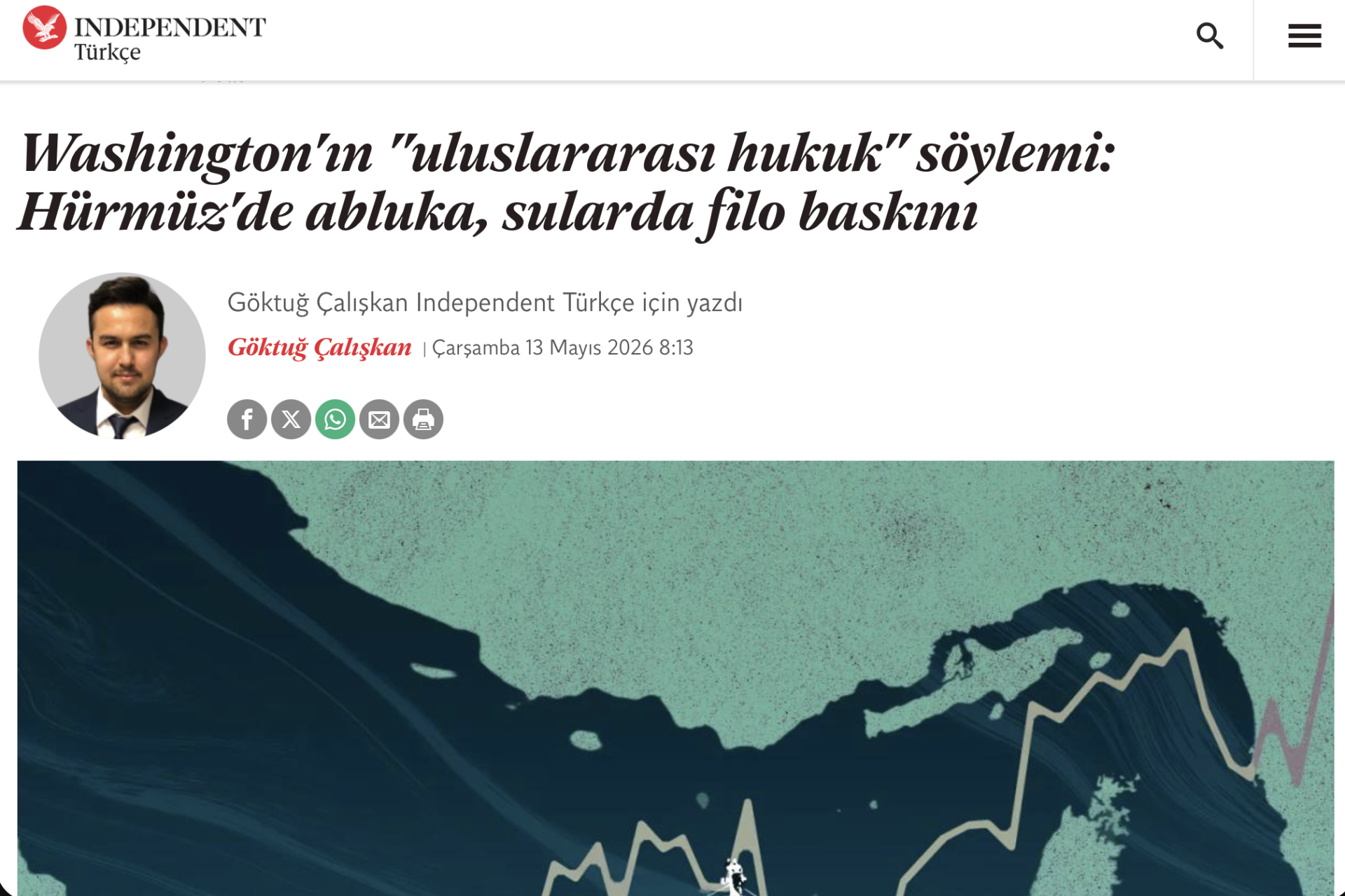


ANKASAM International Relations Expert Göktuğ Çalışkan analyzed the United States’ policies in the Strait of Hormuz and examined the contradiction between Washington’s discourse on international law and its military posture in the region in an article published by Independent Türkçe. Çalışkan argued that while the United States frames its actions through the rhetoric of global maritime security and freedom of navigation, the increasing military presence in the Gulf has effectively created a structure of coercion and strategic containment.
According to Çalışkan, the U.S. administration seeks to legitimize its activities in the Strait of Hormuz under the principles of international maritime security and the protection of commercial shipping routes. However, the deployment of naval fleets and advanced military assets demonstrates that Washington’s strategy is fundamentally based on power projection and geopolitical leverage. In this context, he emphasized that the tension between international legal norms and strategic interests has become increasingly visible in the region.
Çalışkan further underlined that the Strait of Hormuz is not merely a military chokepoint but also one of the world’s most critical energy corridors. He noted that the U.S.-led security architecture in the Gulf not only intensifies pressure on Iran but also directly affects major energy-importing actors, particularly China and Asian economies dependent on Gulf energy supplies. As a result, the region has emerged as a focal point of broader geopolitical competition over global trade and energy security.
The analysis also highlighted that although Washington frequently emphasizes adherence to international law, in periods of crisis it prioritizes military deterrence and naval superiority as primary instruments of policy implementation. Çalışkan argued that this approach reveals the growing discrepancy between the discourse of a “rules-based international order” and the realities of power politics in the Middle East.
In conclusion, Çalışkan maintained that developments surrounding the Strait of Hormuz should not be interpreted solely within the framework of U.S.-Iran tensions. Rather, they reflect a wider strategic struggle involving global energy security, maritime trade routes, and the reconfiguration of great-power competition in the international system.