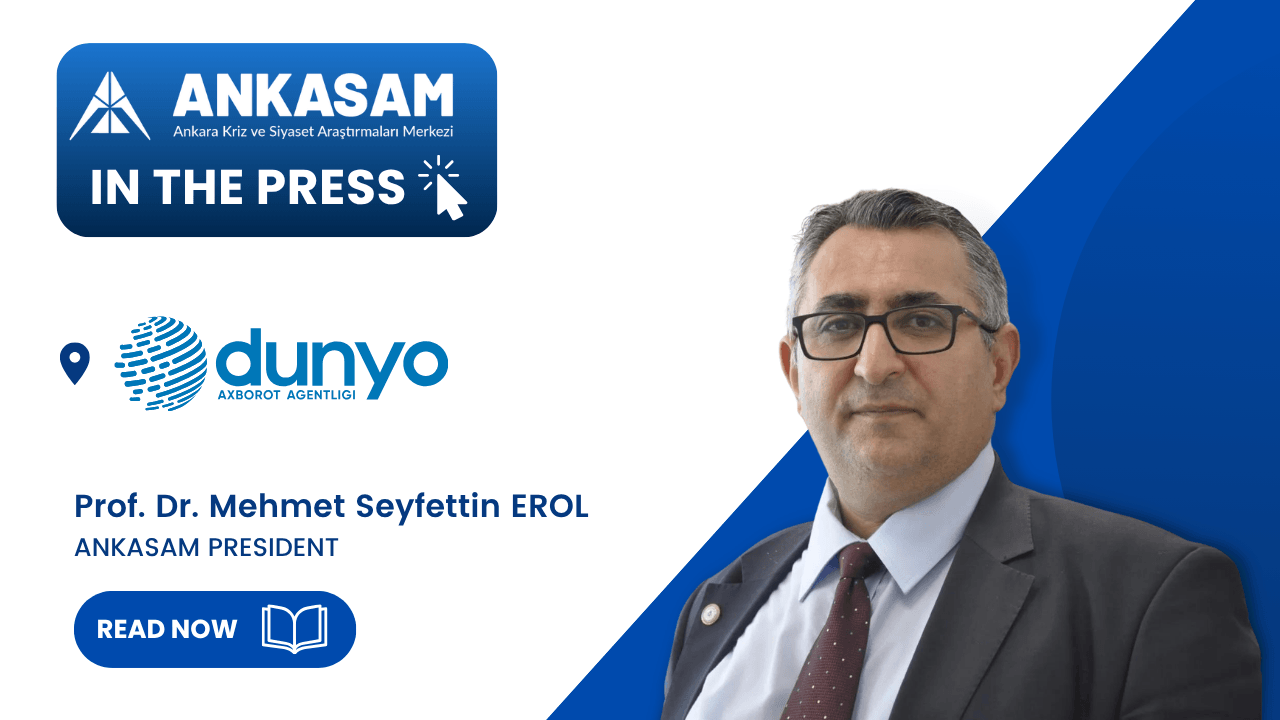


Mehmet Seyfettin Erol: Uzbekistan’s Open and Pragmatic Policy Consolidates Its Position in the International Arena
ANKARA, September 3. /”Dunyo” IA/. Professor Mehmet Seyfettin Erol, President of the Ankara Center for Crisis and Policy Studies (ANKASAM), conveyed his sincere congratulations and best wishes to the Uzbek people through the “Dunyo” Information Agency on the occasion of the 35th anniversary of Uzbekistan’s independence:
“During the 35 years of its independence, Uzbekistan has undergone a new stage of development. Notably, the reforms implemented under the leadership of President Shavkat Mirziyoyev over the past decade have significantly transformed the country’s domestic and international profile. In the policy framework of ‘New Uzbekistan’, openness, pragmatism, the defense of national interests, and the achievement of tangible results have emerged as paramount priorities.
Within this process, the comprehensive strategic partnership with Türkiye bears particular significance. Grounded in historical and cultural affinities, bilateral relations have evolved in recent years into a broad spectrum of cooperation encompassing political, economic, and humanitarian spheres. The robust ties between Uzbekistan and Türkiye simultaneously facilitate the country’s proactive integration into the international arena.
The foreign policy of President Shavkat Mirziyoyev predominantly focuses on devising pragmatic solutions to specific challenges and fostering mutually beneficial cooperation. This has been most unequivocally demonstrated in relations with neighboring Central Asian states. The approach aimed at resolving border disputes, water resource management, and other complex issues through dialogue and consensus has substantially contributed to the consolidation of mutual trust within the region.
Amidst the current milieu of intensifying geopolitical competition, Tashkent is pursuing a multi-vector foreign policy. Relations with China, Russia, the United States, the European Union, Türkiye, and other nations are being cultivated on the principles of mutual benefit and sovereign equality. This paradigm enables Uzbekistan to advance its national interests while maintaining diplomatic equilibrium.
Furthermore, Uzbekistan’s geographical location constitutes a critical factor in its foreign economic policy. As a landlocked country, the diversification of transportation and logistics routes is of strategic importance. From this perspective, Uzbekistan’s participation in the Middle Corridor linking Asia and Europe, the ‘China-Kyrgyzstan-Uzbekistan’ railway project, and its initiatives directed at expanding access to South Caucasian and European markets via the Caspian Sea are of paramount importance.”