
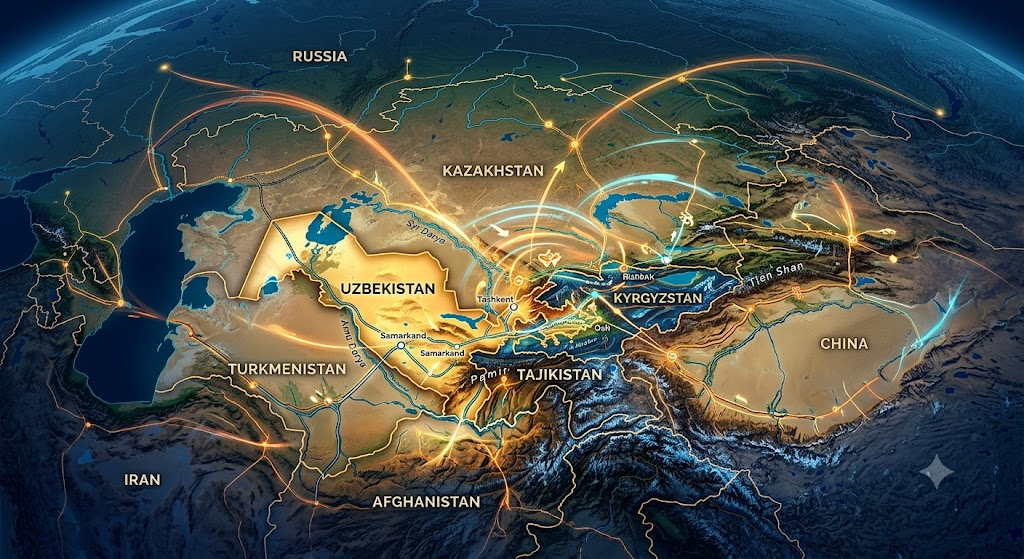


As the international system is being reshaped into a new order characterized by multipolarity, flexible alliances, and inter-bloc competition, the Eurasian region is undergoing a critical period of transition and restructuring. One of the most tangible and dynamic manifestations of this transformation is Central Asia, a region historically associated with structural challenges such as border disputes, water and energy-sharing conflicts, and micro-nationalism. In this context, the summit held in Cholpon-Ata between the President of Uzbekistan, Shavkat Mirziyoyev, and the President of Kyrgyzstan, Sadyr Japarov, represents a historic turning point that has altered the region’s long-standing trajectory and elevated bilateral relations from the level of a comprehensive strategic partnership to an institutionalized model of regional integration.
The decision taken at this summit to establish an Interstate Council, together with the concrete initiatives in the fields of trade, energy, transportation, and industry, represents far more than a rational pursuit of cooperation between two neighbour states. This initiative represents the process through which the philosophy of “Axial Neighbourhood,” the regional foreign policy manifestation of the New Uzbekistan vision, is being integrated with the geopolitical visions of a New Central Asia, a New Turkic World, and, ultimately, a New Eurasia.
This integration initiative mitigates the asymmetric pressures exerted by external actors on the region while maximizing the capacity of local dynamics for self-reliance. At a time when the center of gravity of the global system is shifting toward the Asia-Pacific and Eurasian axes, the institutional consolidation between Tashkent and Bishkek serves as a form of geopolitical fortification.
This analysis examines the Cholpon-Ata decisions—which have emerged as a key catalyst for breaking the regional status quo and advancing structural transformation in Central Asia—from bilateral, regional, and global perspectives. It further analyzes these developments within the broader frameworks of the Organization of Turkic States (OTS), the C5+ processes, the Shanghai Cooperation Organisation (SCO), the Belt and Road Initiative (BRI), and the Middle Corridor, employing a realist and original conceptual framework.
The Bilateral Dimension: The “Win–Win” Paradigm and the “Axial Neighborhood” Model
Historically shaped by border tensions and ethnic sensitivities that rendered bilateral relations inherently fragile, Uzbekistan–Kyrgyzstan relations have undergone a profound paradigm shift with the Mirziyoyev era. The Cholpon-Ata Summit marks the institutionalization of this transformation and constitutes a formal declaration that bilateral relations have embarked upon an irreversible path toward regional integration.
Historically characterized by border tensions and ethnic sensitivities that rendered bilateral relations inherently fragile, relations between Uzbekistan and Kyrgyzstan have undergone a profound paradigm shift under President Shavkat Mirziyoyev. The Cholpon-Ata Summit signifies the institutionalization of this transformation, marking the point at which bilateral relations embarked upon an irreversible trajectory toward regional integration.
In this context, the decision to establish the Interstate Council clearly demonstrates the intention to ensure that bilateral relations acquire a bureaucratic and institutional continuity independent of personal leader diplomacy.
This step will undoubtedly function as a “Geo-Economic Coordination Mechanism” designed to enable the integrated operation of the two state apparatuses. Furthermore, the first “Uzbekistan–Kyrgyzstan Regional Forum,” scheduled to be held by the end of the year, extends the integration process beyond the monopoly of national capitals by expanding it to the level of local administrations and the business community, thereby constructing a socially embedded model of micro-diplomacy.
This institutional transformation is fostering a shared decision-making culture among the bureaucratic elites of the two countries. The Interstate Council is evolving from a mechanism convened solely during periods of crisis into a permanent structure that coordinates day-to-day economic and political processes. Consequently, free trade zones and joint industrial parks in border regions will directly enhance the welfare of local communities, making a significant contribution to erasing the social memory of past border tensions. Therefore, this development emerges as a distinctive regional model demonstrating that two states can preserve their sovereign rights while simultaneously creating a common zone of prosperity.
The Regional Dimension: The Geo-Economic Consolidation of the New Central Asia
For many years, Central Asia was portrayed as a stage of the “Great Game,” a region characterized as an arena of competition among external actors and vulnerable to outside intervention. However, the projects embodied in the Cholpon-Ata Summit demonstrate that the region is no longer merely an object of geopolitical competition, but has evolved into a global subject capable of determining its own destiny.
In this context, the Kambarata-1 Hydroelectric Power Plant Project represents a transition from hydro-diplomacy to hydro-integration in a region where water and energy disputes historically fueled conflict dynamics. The combination of Kyrgyzstan’s water potential with Uzbekistan’s industrial capacity and market scale demonstrates that the region can address its energy security challenges through its own internal dynamics rather than relying on external assistance.
Similarly, the China–Kyrgyzstan–Uzbekistan Railway Project challenges established geopolitical assumptions. This corridor transforms Central Asia’s geographical disadvantage as a landlocked region into an advantage by positioning it as a crossroads of global trade routes. The development of border and trade-logistics infrastructure along the route, together with the digitalization of customs and permit procedures, provides regional states with a space of strategic autonomy through alternative routes, reducing dependence on any single corridor or external actor.
Mega-infrastructure investments such as the Kambarata-1 Hydroelectric Power Plant and the China–Kyrgyzstan–Uzbekistan Railway are deepening intra-regional integration at a sectoral level. This structural partnership in the energy and transportation sectors is binding Central Asian states together through increasingly resilient networks of interdependence. Geo-economic consolidation represents the strongest safeguard against the potential destabilizing influence of external powers in the region. Through these investments, Central Asia is transitioning from a resource-exporting periphery into a hub of value-added production and logistical connectivity, thereby emerging as a regional center of gravity.
The Eurasian and Global Dimension: The Global South, Multidimensional Balancing, and the New International System
The emerging international system represents a period of inter-bloc flexibility, distinct from both the bipolarity of the Cold War and the unipolar U.S. hegemony of the 1990s, in which regional power centers are gaining increasing prominence. In this context, Central Asia is neither becoming fully integrated into the Western sphere nor transforming into a satellite of surrounding great powers. The fundamental strategy pursued by the region is one of dynamic balancing and asymmetric diversification. Central Asia is moving beyond its previous fragmented, inward-looking structure, characterized by persistent border disputes, and is evolving into a comprehensive and institutionalized space of cooperation.
The region’s absolute logistical dependence on northern routes is evolving into a multidimensional network of corridors through the Middle Corridor and new railway projects. Having moved beyond its previous status as a passive sphere of influence for great powers, Central Asia is now emerging as a collective resilience center that balances global actors at the negotiating table through C5+ formats. These expanded diplomatic processes conducted with the United States, China, the European Union, Russia, India, and the Gulf countries are strengthening Central Asia’s collective regional voice. The China–Kyrgyzstan–Uzbekistan Railway, while integrating into China’s Belt and Road Initiative, simultaneously reinforces the Trans-Caspian Middle Corridor project, shifting the center of gravity of global trade between East and West toward the Middle Corridor and shaping the logistical backbone of the New Eurasian architecture.
In this context, a multidimensional balancing policy provides Central Asia with a secure harbor amid an environment of intensifying global power competition. The synchronized actions of Tashkent and Bishkek within multilateral platforms such as the SCO, the OTS, and the United Nations represent a concrete manifestation of the rising voice of the Global South in the region. The political will demonstrated at Cholpon-Ata is transforming the region from a potential arena of great-power rivalry into an independent geopolitical bloc that is directly integrated with global markets within the emerging rules of a multipolar world.
The New Turkic World and the Future of OTS Integration
The decisions adopted at the Cholpon-Ata Summit, together with the emphasis placed on joint coordination by the two countries within regional organizations, contain significant structural implications for the future of the OTS, particularly with the inclusion of the Azerbaijani example in this process.
The emergence of the OTS as a global center of influence is directly linked to the ability of its member states to resolve bilateral disputes among themselves and develop sub-regional integration models. This strategic rapprochement between Uzbekistan and Kyrgyzstan constitutes the strongest pillar of the OTS’ Central Asian dimension.
In this context, close coordination in humanitarian fields such as culture, tourism, youth, and education, together with the cooperation confirmed on international platforms with Azerbaijan and other regional states, is triggering a new geo-economic zone that can be described as the Trans-Caspian Integration Belt. The Uzbekistan–Kyrgyzstan axis, through logistics projects, connects to the Caspian Sea and subsequently to Europe via Azerbaijan and Türkiye, transforming the OTS from merely a cultural association into a concrete, functional, and globally competitive geo-economic and logistical bloc.
This integration process is enhancing the strategic depth of the OTS, transforming it into an actor that must be taken into account within the global balance of power. The infrastructural alignment between Uzbekistan and Kyrgyzstan serves as a structural bridge connecting the eastern and western wings of the Turkic world. Supporting cultural commonality with hard-power instruments such as the economy, energy, and transportation is transforming Turkic integration from a conceptual ideal on paper into a decisive, institutionalized, and enduring bloc within Eurasian geopolitics.
“The Cholpon-Ata Consensus” and the Emerging Eurasian Order
The political will crystallized between Uzbekistan and Kyrgyzstan at Cholpon-Ata represents far more than a simple declaration of goodwill; it constitutes a rational, pragmatic, and forward-looking regional consensus framework. This process, driven by the vision of New Uzbekistan, is repositioning Central Asia from the periphery of the global system toward its geopolitical and geo-economic center. The fundamental projection for the future is that, with the completion of mega-projects such as the Kambarata-1 Hydroelectric Power Plant and major railway initiatives, the structural resilience of regional states against external shocks and the economic sanctions or coercive mechanisms of great powers will reach an unprecedented level. This robust micro-integration model, with the participation of Kazakhstan, will generate a shared Turkic World geopolitics in Central Asia and further consolidate the global agency of the OTS.
Ultimately, the countries of the region will neither completely detach themselves from their existing security umbrellas nor surrender to the economic hegemony of a single actor.
The political will crystallized at Cholpon-Ata is giving rise to a new Central Asian Doctrine, in which the region will conduct diplomatic and economic negotiations with global actors on an equal footing by relying on its own internal capabilities. This doctrine reinforces the emergence of a Central Asia that exercises sovereign control over its own resources while fully overcoming the remnants of intra-regional colonial legacies. Within the future architecture of Eurasia, the agreements signed at Cholpon-Ata will be remembered as the founding document of a flexible, resilient, and independent center of power. This development represents the most tangible evidence of the dawn of a “New Central Asia,” a “New Turkic World,” and a “New Eurasia” interconnected through logistics, energy, and institutional mechanisms, replacing the previous Eurasian paradigm associated with risks of instability.