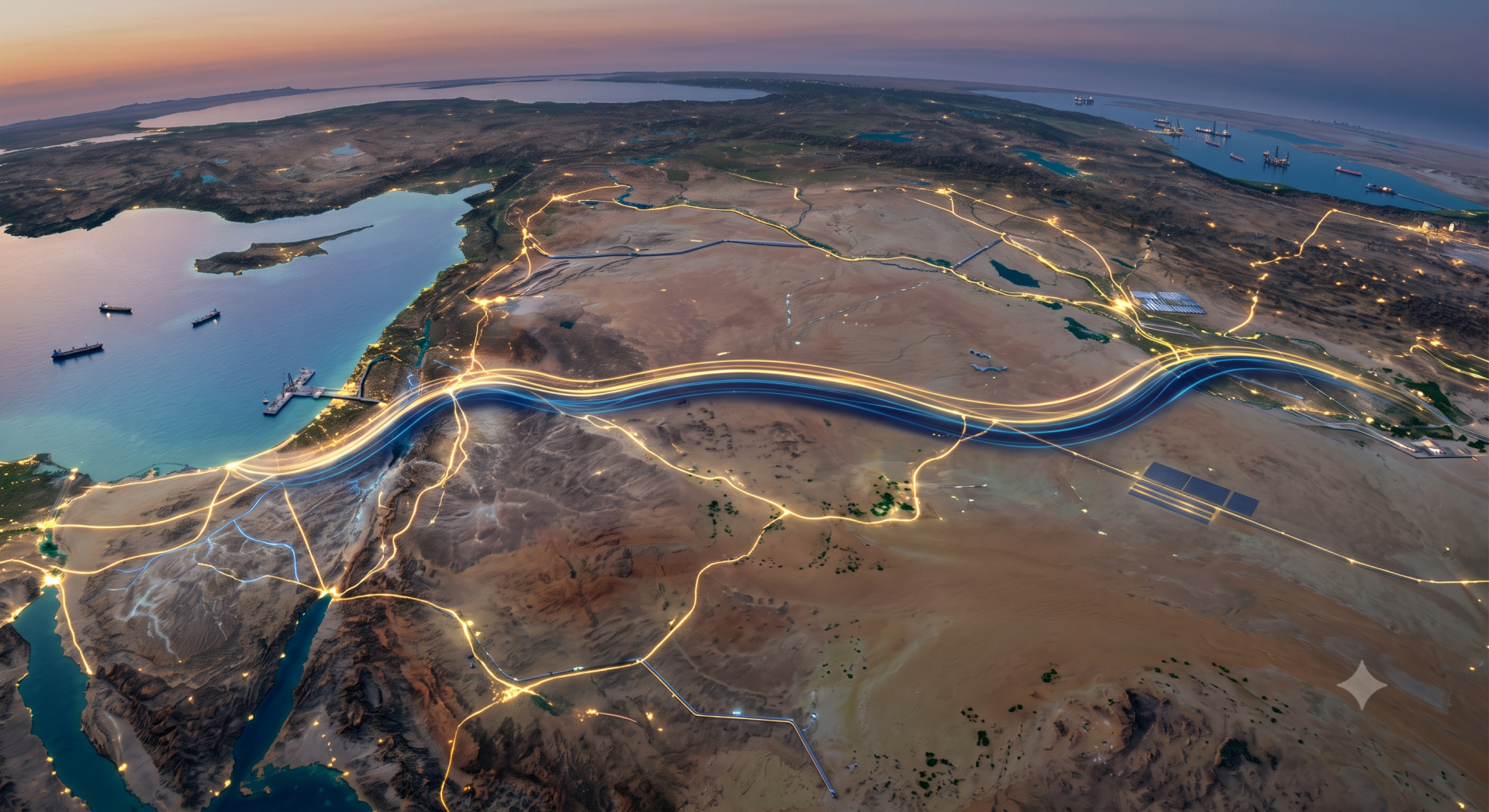


The current global climate, marked by deepening regional crises, necessitates a structural transformation that will fundamentally reshape the Middle East’s security architecture. Traditional crisis management approaches have proven inadequate in resolving proxy wars and the security vulnerabilities created by non-state armed actors. Establishing lasting peace in the Middle East requires the construction of a geopolitical backbone rather than temporary ceasefires. This backbone makes an unbroken belt of cooperation stretching from the Mediterranean to the Gulf of Basra inevitable. In this context, a corridor encompassing Lebanon, Syria, Iraq, and even Kuwait can be viewed as a new geo-economic and geo-strategic hub that will lift the region out of the spiral of instability.
For the current status quo is eroding the sovereign rights of the states along the route while also undermining social welfare. Consequently, this region, which lies at the center of the global power struggle, can only become immune to external interventions by uniting local dynamics and resources under a framework of rational cooperation.
For this reason, the alliance proposed in this study is not a quest for a utopian alliance; rather, it highlights the necessity for states on the brink of military, political, and socioeconomic collapse to come together as an existential reflex. Undoubtedly, the region’s ability to determine its own destiny during this construction process is directly linked to the success of this integration initiative and the diplomatic skill of the visionaries behind it.
The “Mediterranean-Basra Corridor” as a Geopolitical Necessity
The “Mediterranean-Basra Corridor” is based on historical, geographical, demographic, and identity-based cohesion. This corridor, stretching from the Levant to the Gulf, lies at the heart of global trade and energy corridors. On the other hand, while the trio of Lebanon, Syria, and Iraq has long been associated with internal conflicts, erosion of sovereignty, and economic collapse, Kuwait, as one of the weakest links in the region, is gripped by deep anxiety and uncertainty regarding its survival. Furthermore, it is hardly possible to speak of complete harmony or even an atmosphere of friendship among these states.”
Indeed, the historical background and track record of relations in the “Syria-Lebanon,” “Syria-Iraq,” and “Iraq-Kuwait” contexts do not, frankly, look very promising. Consequently, with regard to the survival of these four countries, they must first set aside their historical grievances and, to emerge from the current crisis and uncertainties, implement a new strategy centered on their shared destiny for today and tomorrow; in this context, they must urgently develop a common paradigm of security and prosperity rather than pursuing fragmented visions. And this requires a strong “financial glue.” This “financial glue” is, without a doubt, Kuwait, which finds itself trapped in the Gulf and is seeking an exit strategy in this context.
Including Kuwait in this phase is a critical necessity in terms of the project’s complementary nature. Indeed, with its financial capacity, long-standing diplomatic tradition, and stable state structure, Kuwait has the potential to serve as the economic engine and stabilizing force of this corridor. Kuwait’s financial strength and port infrastructure will provide the lifeblood needed for Iraq’s reconstruction, the restoration of stability in Syria, and Lebanon’s emergence from its economic crisis. This four-way integration is a concrete path forward that will also rapidly move the countries of the region away from being labeled “failed states.”
This integration will undoubtedly also help overcome the artificial borders and deep identity divides left behind by the century-old colonial legacy embodied by the Sykes-Picot Agreement. Revitalizing the natural, organic structure of the historical river basins and trade routes along the Mediterranean-Basra corridor will also put an end to geopolitical fragmentation. In this context, Gulf capital, with Kuwait’s participation, will combine with the Levant’s human resources and agricultural and industrial potential to free the region from a structure of external dependence and fragility.
The Transformation of the Security Equation and the End of Proxy Wars
The implementation of the “Mediterranean-Basra Corridor” will radically transform the security paradigm in the Middle East. In this context, strengthening national armies will, first and foremost, facilitate multidimensional cooperation and enable states to reestablish their spheres of sovereignty. Thus, these strengthened central structures will also fill the legitimacy and security vacuums that proxy organizations have exploited. Border security, intelligence sharing, and joint law enforcement mechanisms will prevent external actors from using the region as a theater of conflict, and these countries will no longer serve as battlegrounds for proxy wars.
Furthermore, with the security framework to be established along this route, Israel’s argument, which uses regional instability and the presence of proxy groups as justification for its own aggressive security doctrine, will also lose its validity. The existence of a regional framework that is institutional, predictable, and grounded in international law will also undermine the “security pretexts” put forward by Israel, which have found resonance in the Western world and the European Union, and which Israel has presented to the entire world, including its own domestic audience.
In addition to all this, the growth of economic prosperity and interdependence will weaken the dynamics of artificial conflicts constructed along sectarian and ethnic lines, and will accelerate the end of identity-based conflicts in the region. For this transformation to proceed on a sound foundation, it undoubtedly requires the building of deep trust among the actors involved. Therefore, the support and guiding influence of a well-established external actor, one free of political baggage, with a deep understanding of regional dynamics, and possessing strong coordination capabilities in crisis management, is vital to ensuring that this process does not come to a standstill.
The Global Equation: Energy, Supply Chains, and the “Convector Country”
The “Mediterranean-Basra Corridor” is not merely a model of local cooperation but serves as a “geo-economic convector” that links global power balances. The energy and logistical synergy that this corridor will generate must be channeled into global markets. Located at the exact intersection of the “North-South” and “East-West” axes, the strategic and logistical gateway that will connect this corridor to global actors is, without a doubt, Türkiye, its immediate northern neighbor, whose status as a “Conveyor Country” is growing in multiple dimensions with each passing day. This strategic bridge possesses the experience, infrastructure, and network to optimize and deliver the entire logistics output of the corridor to global markets; consequently, it also possesses the qualities of a “conveyor” at this stage of development. In this context, the “Mediterranean-Basra Corridor” could become an indispensable “block partner” for global power centers such as China, Russia, and Europe, thanks to Türkiye’s infrastructure networks and its ability to manage them.
A Practical Roadmap: Building Trust and Integration
The current regional crisis has demonstrated that the status quo is unsustainable. This crisis presents a structural window of opportunity for the parties to come together. In this context, a four-phase roadmap can be proposed:
Phase 1: Indirect Diplomacy and Dual-Center Coordination
The institutional mechanism for indirect diplomacy could be established as a two-pronged structure centered in Baghdad and Damascus, taking into account the project’s geographic, demographic, and political balances. The coordination offices to be established in these two historic capitals could be brought together under the umbrella of the “Joint Coordination Committee,” which will manage the process. Kuwait’s participation in this process, particularly in the financial sphere, and the support it will provide are of great importance. It will also be inevitable for the “Joint Coordination Committee” to implement a strict working protocol that is free from political debates and focused on technical and operational continuity.
Phase 2: Partnership on Infrastructure, Supply Chain, and Energy Security
At this stage, the integration of Kuwait’s financial strength with Iraq’s Grand Faw Port project and, in this context, the increasing capacity of the “Development Corridor” project, the modernization of the railway and highway networks between Iraq and Syria to make the Basra-Mediterranean logistics corridor operational, and the synchronization of Lebanon’s and Syria’s energy infrastructure with the Gulf and Iraqi energy grids, as well as with Türkiye’s, are of great importance. Undoubtedly, this physical integration will advance to a stronger phase alongside the establishment of free trade zones in the region and the gradual implementation of customs exemptions. The joint energy corridor will reduce the costs of industrial production while resolving domestic consumption crises in each country along the route. Thus, the uninterrupted flow of raw materials and finished goods from Basra to the Mediterranean and on to Europe via Türkiye will further solidify the region’s identity as an economic hub.
Phase 3: Joint Security Secretariat and Border Management
At this stage, it is necessary to establish a joint secretariat for intelligence sharing against destructive activities, as well as for combating cross-border crime and terrorism. Undoubtedly, ensuring border security through national armed forces will completely restrict the scope of action of proxy organizations. The joint secretariat to be established will develop integrated early-warning systems and joint patrol mechanisms to counter hybrid threats along the border lines. The harmonization of regional military doctrines will be achieved under the guidance of a defense industry partner with logistical depth. This situation will not only enhance the national armies’ capabilities in asymmetric warfare but will also put an end to the physical presence of non-state actors in the region.
Phase 4: Global Integration and Multilateral Agreements
Once the Four-Nation Corridor achieves stability, it will be easier to sign institutional partnership agreements with the European Union, China, Russia, the Caucasus, and Central Asian states via Türkiye, which serves as the geopolitical bridge/link to the north of the corridor. Undoubtedly, multilateral global agreements will ensure the legal and political inviolability of the corridor through international recognition. In this context, by leveraging Ankara’s extensive global diplomatic network, which spans both regional and international dimensions, and its advantage as a hub country, the pipeline’s energy and supply outputs can be integrated into global markets and strategic reserves. Thus, the interests of global actors in maintaining the stability of this corridor will serve as an international guarantee of local stability.
At this point, the project’s inclusive and constructive contribution, focused on “shared prosperity, structural stability, and regional ownership” at the local, regional, and international levels, will undoubtedly play a major role in securing this international acceptance. The fact that the corridor serves as a humanitarian-economic development corridor that resolves global supply chain crises, ensures energy security, and halts migration waves at their source will be accepted as the most rational solution by all actors, particularly the Western world, who prioritize the consolidation of stable state structures in the region.
This new corridor serves as a “neutral and complementary bridge” linking China’s “Belt and Road” vision with Europe’s energy diversification strategies, and in this context, its complementary and reinforcing role within the context of the “Development Road Corridor” and the “Middle Corridor” will also generate a broad consensus regarding the securing of international legitimacy and support.
Conclusion
The “Mediterranean-Basra Prosperity and Stability Belt” is emerging as a project to reshape the fate of the Middle East by freeing it from external interference and guided by the principle of “regional ownership.” This strategic belt, comprising Lebanon, Syria, Iraq, and Kuwait, offers a synergy-based model for resolving chronic crises. The region’s rich underground resources and deep-rooted cultural heritage can only be saved from the clutches of global anarchy through such a holistic vision.
Under this model, the institutionalization of security mechanisms will naturally cut off the financing and logistical lines of non-state armed groups. Joint border management and law enforcement cooperation will eliminate the breeding ground for radicalism. As Israel’s security pretexts are exposed as hollow in the eyes of the global public, the region, thanks to the strengthening of national armies, will permanently cease to serve as a testing ground for the wars of attrition waged by hegemonic powers through their proxy organizations.
The “Mediterranean-Basra Prosperity and Stability Belt” will raise the standard of living for the region’s peoples while transforming the hostilities of the past into shared commercial partnerships for the future. Once the project is implemented, the Middle East will cease to be a theater of conflict and evolve into one of the most dynamic, secure, and productive centers of the global system. Indeed, the transnational nature of security and well-being makes the building of this generation not so much a choice as an inevitable reality of our shared vision of the future. During the construction of this massive architectural project, the presence of an experienced actor who will undoubtedly play a constructive and unifying role that respects the sovereignty of the countries in the region, and who will coordinate the processes behind the scenes with strategic acumen, will be the key to success.