

The crisis that erupted between Russia and Ukraine and evolved beyond its regional boundaries into a global war of attrition has fundamentally transformed its military, political, diplomatic, and economic parameters as it enters its fourth year. Over the course of this period, the evolution of military technologies, the widespread adoption of asymmetric warfare methods, and the targeting of civilian infrastructure by drones and long-range missiles have completely disrupted the tactical balance. More importantly, at the current stage of the conflict, the initiative regarding both war and peace appears to have largely slipped out of the control of both sides.
From the perspective of a realistic analysis, the following assessment has become increasingly unavoidable: as of today, a return to the conditions of “Istanbul 1.0” appears highly unlikely, both militarily and diplomatically, as the realities on the ground have moved far beyond that period and entered a multidimensional phase of chronic entrenchment.
In the face of this geopolitical deadlock, the approach of Kazakhstan’s President Kassym-Jomart Tokayev, founded on a multi-vector balancing policy and rational diplomacy, represents a cornerstone of the Eurasian geopolitical landscape. The “Istanbul 2.0 Vision”, informed by Tokayev’s strategic foresight, is not a utopian scenario of peace; rather, it constitutes a rational and flexible crisis management model dictated by the principles of geopolitical realism (realpolitik) (see: “Geopolitical Realism and the Cornerstone of Eurasia: Tokayev’s ‘Istanbul 2.0 Vision’ and the Strategic Roadmap for Peace”).
Therefore, Tokayev’s vision is based on a pragmatic architecture that seeks, at the initial stage, to ensure the economic and humanitarian security of the basin by setting aside the maximalist demands of the conflicting parties. This approach is rooted in the recognition that the existing status quo has reached a level of financial and military burden that is no longer bearable, manageable, or sustainable—not only for the two belligerent states, but also for all countries of the “Extended Black Sea Basin,” particularly Türkiye.
The Risk of Global Geopolitical “Cancerization”: The Potential Spread of War Along the “Baltic–Balkans–Caspian Security Backbone”
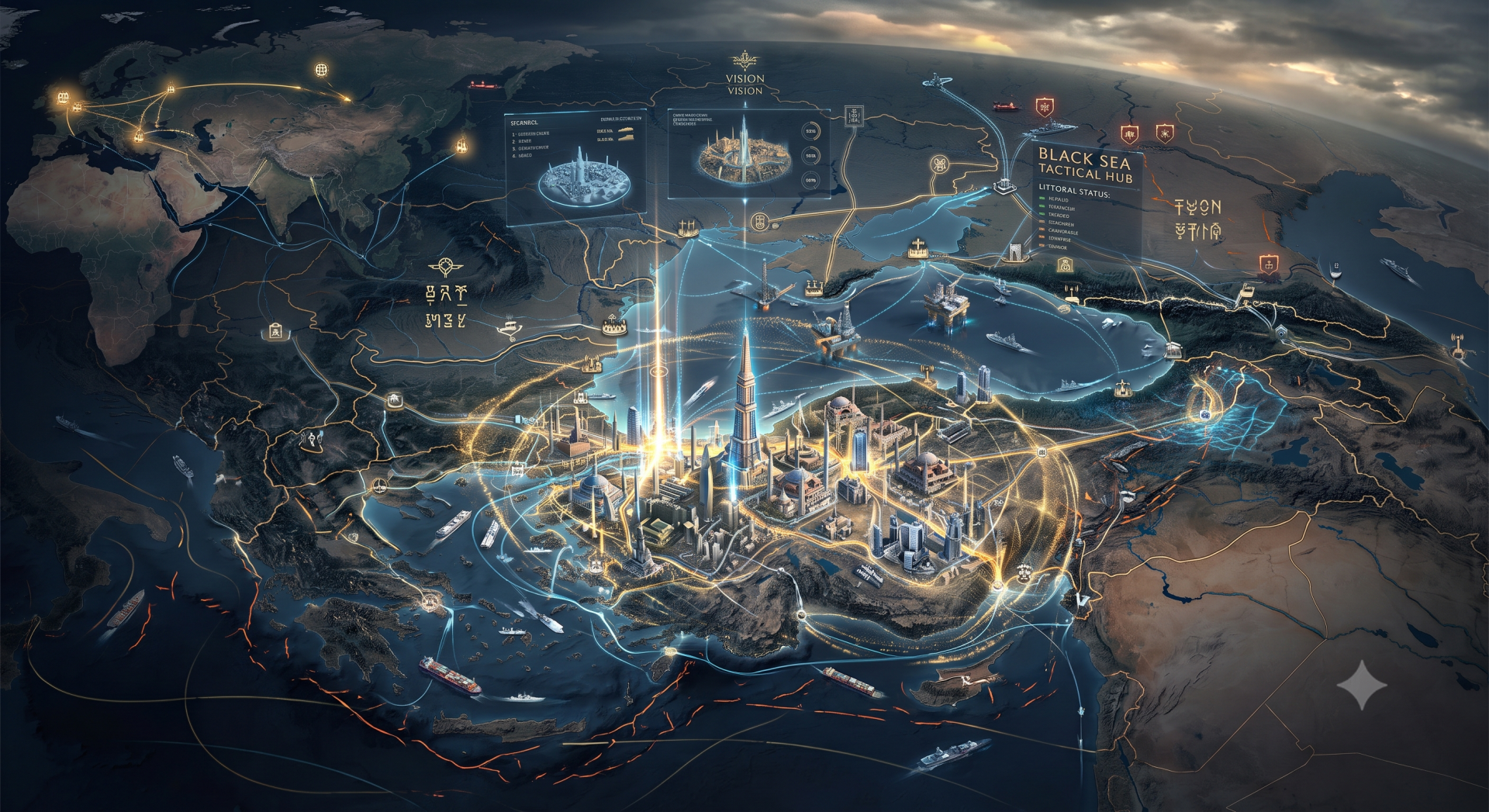
In geopolitical literature, the Black Sea cannot be considered merely as an enclosed sea or an independent geopolitical basin. On the contrary, the Black Sea constitutes the central hub of a vast global security backbone extending from the Baltic region through the Balkans, the Caucasus, and the Caspian basin into the depths of Central Asia. Any disruption to a strategic pillar within the Black Sea region has the potential to trigger vulnerabilities across all other fragile lines throughout this broader geopolitical space.
The greatest risk we face today is that the crisis may not remain localized but instead spread to the peripheries through the mechanism of “Geopolitical Cancerization.” In this context, Transnistria, located on Ukraine’s western border and remaining a frozen conflict zone for years, could become an asymmetric launchpad for further escalation in the Black Sea region. The presence of Russian military forces in the area, combined with Moldova’s efforts toward Western-oriented integration, carries the risk that the corridor could transform into a new active front should the intensity of the conflict in the Black Sea spill over into this zone.
The war in question, due to its current transboundary nature, has already begun to exert its influence in the Caucasus–Caspian region. Consequently, the instability emerging on the eastern flank of the Black Sea has the potential to directly threaten the “Middle Corridor” project, which has become a new lifeline for global supply chains and energy routes. It should be emphasized that the energy security of the Caspian basin is intrinsically interconnected with maritime security in the Black Sea. The transformation of the Black Sea into a theater of war would significantly undermine the logistical and economic integration capacity of the Caspian region. If an urgent diplomatic buffer mechanism cannot be established through the “Istanbul 2.0” framework, the spark in the Black Sea will simultaneously destabilize both the Baltic–Balkan axis, which constitutes NATO’s eastern flank, and the Caucasus–Caspian axis, regarded as the heart of Eurasia. Such a scenario has the potential to transcend a regional conflict and trigger a continental confrontation between geopolitical blocs.
Economic and Social Erosion: “Blue Economy,” “Fishing Crisis,” and “Regional Collapse”
The security vulnerabilities and asymmetric risks in the Black Sea region have begun to directly affect the micro- and macroeconomic balances of regional populations and states, extending far beyond the scope of military analysis. This situation necessitates the urgent establishment of an economic protection belt within the basin.
For the coastal states of the Black Sea, one of the most significant sources of livelihood and employment is the “Blue Economy” and fishing activities based on marine ecosystems. Due to ongoing military activities, uncontrolled deployment of drifting sea mines, and missile/drone activity along coastal areas, the fishing season in the Black Sea has reached a critical point, facing severe disruption. The populations of regional countries that have depended solely on fishing for their livelihoods and sustained themselves from this basin for generations have become direct victims of the current security crisis.
This crisis is not limited to the belligerent parties; it is also profoundly affecting the economies of Türkiye, Romania, Bulgaria, and Georgia. The inability of fishing vessels to operate, the closure of logistical routes, and the heightened perception of risk in international waters have driven insurance premiums to excessive levels. This situation is fueling food inflation across the basin countries, causing significant employment losses, and negatively affecting the socio-economic resilience of local communities.
The Grain Corridor Crisis and Global Food Geopolitics (Quantitative Risks)
The blockage in the Black Sea is once again bringing a global food security crisis (the Grain Corridor Crisis) to the forefront of the international agenda, this time with far greater intensity. The inability to safely deliver Ukrainian and Russian agricultural products to global markets would create a domino effect throughout the global food supply chain. According to quantitative risk assessments, the socio-political and economic chain reactions generated by such a scenario could reach alarming dimensions. Specifically:
- Disruption of Food Supply and Price Escalation: With Black Sea ports becoming non-operational, global grain prices are projected to rise by 35–45% under the baseline scenario.
- Famine Risk in the African Basin: More than 60 million people in the region particularly in Sub-Saharan Africa and North African countries, which are heavily dependent on imports for essential food commodities would face the risk of acute hunger.
- Socio-Economic Protests: Food shortages could trigger social unrest and political instability in these vulnerable regions.
- Mass Migration Waves (EU Dimension): Quantitative projections indicate that, if the crisis deepens, the annual volume of irregular migration originating from Africa and the Middle East and directed toward European Union (EU) territory via the Eastern Mediterranean and Balkan routes could increase by 1.2–1.5 million people. Europe, already politically polarized due to the refugee crisis, would face a profound socio-economic shock as a result of this new wave.
The Transition from Defensive Deterrence to Active Regional Protectionism: Public Pressure and the Changing Dimension of War
If the “Istanbul 2.0 Vision” is not implemented and diplomatic flexibility cannot be achieved, the transition of Black Sea littoral states from static defensive postures to active protectionism in order to safeguard their national interests will become an inevitable historical necessity. In such a scenario, the “Black Sea Mine Countermeasures Task Group (MCM Black Sea)”, established by Türkiye, Romania, and Bulgaria as a commendable example of regional ownership, may be compelled to transform its current limited and defensive mission. As threats within the basin continue to increase, this platform could activate rules of engagement within the participating states’ exclusive economic zones and international waters in order to ensure the safety of fishermen and the security of commercial maritime navigation.
Littoral states, particularly Türkiye, are increasingly approaching a point at which they can no longer tolerate asymmetric attacks targeting the lives of their citizens, drifting mine explosions, or accidental military strikes. In the event of civilian casualties occurring within their territorial waters, domestic public pressure and societal reactions toward governments across the region may become unavoidable. No democratic government can remain indifferent to such public pressure. This situation may compel Türkiye and other Black Sea littoral states to adopt additional measures. The continuation of the current situation under escalating asymmetric risks is becoming increasingly untenable from a geopolitical perspective.
A Concrete and Implementable Roadmap: The “Extended Black Sea Basin Security Belt”
Resolving the current deadlock is possible only through a flexible and constructive diplomatic approach that, regardless of the belligerents’ maximalist military objectives, places “humanitarian, environmental, and economic security” at the center of the process. Within the framework of the “Istanbul 2.0” initiative, the following three-stage concrete roadmap should be implemented as an urgent priority:
Stage 1: Sectoral and Functional “Air Ceasefire” Protocol and International Monitoring
As an initial step, a “Sectoral Air Ceasefire” should be declared within designated coordinates of the Black Sea identified as commercial navigation routes and fishing zones, under which the parties would mutually suspend air and missile attacks. Given the approaching fishing season, this measure is of critical importance in providing legal and security guarantees for fishing activities through the establishment of an air ceasefire regime.
To prevent violations of this mechanism by the parties, a “Technological and International Monitoring Network” could be established. Through this network, designated economic corridors could be continuously monitored on a 24/7 basis by High-Altitude Long-Endurance (HALE) unmanned aerial vehicles (UAVs) and Synthetic Aperture Radar (SAR) satellites, operating under joint operational control of regional states and neutral international observers (for example, under the coordination of Kazakhstan and the United Nations), with Türkiye assuming a leading role.
Accordingly, the launch point of any cruise missile, ballistic missile, or loitering munition (“kamikaze drone”) directed toward the corridor could be detected within seconds through satellite-based early warning systems and publicly disclosed to the international community. The party responsible for the violation would consequently become the direct target of diplomatic and economic sanction mechanisms.
Stage 2: Regional Quadrilateral Monitoring and Coordination Mechanism
The security of the Black Sea could be managed without the involvement of external actors through a “Coordination Council for the Extended Black Sea Basin Security Belt”, established directly by the core regional stakeholders of the basin: Türkiye, Romania, Bulgaria, and Georgia. At this point, while meticulously preserving the historical rights and authorities granted to it under the Montreux Convention Regarding the Regime of the Straits, Türkiye may need to reinforce the principle of regional ownership by preventing the entry of foreign military forces into the Black Sea.
Stage 3: The Istanbul 2.0 Summit and Institutionalization through the Tokayev Formula
The visionary mediation approach of Kazakhstan’s President Tokayev, based on strategic balance considerations, could be combined with Türkiye’s hosting capacity and diplomatic experience. Under the framework of an “Eurasian Diplomatic Umbrella,” the belligerent parties and regional states could be brought together once again in Istanbul under an emergency diplomatic format.
Through this process, the “Istanbul 2.0” framework could establish a strong foundation for a flexible and dynamic agreement among the parties, encompassing a set of functional, institutional, and verifiable arrangements. Such an agreement would primarily aim to guarantee the operational continuity of the “Caspian–Black Sea–Balkans” logistics corridor, safeguard global food security, and ensure the economic sustainability of the marine ecosystem.
Conclusion
The existing security architecture in the Extended Black Sea Basin stands at the threshold of structural collapse. The increasingly heavy burden of the immense military, economic, logistical, and social costs generated by the war, which is being shouldered by the countries of the region—particularly the Türkiye–Romania–Bulgaria–Georgia quartet—is incompatible with both economic rationality and geopolitical realities. This burden is rapidly reaching an unsustainable and unmanageable level.
In this context, the “Istanbul 2.0 Vision” is not a romantic appeal for peace; rather, it represents the only realistic, concrete, and realpolitik-based pathway capable of preventing the region from being drawn into collective self-destruction. For the parties to acknowledge the new conditions and military realities that have emerged over time and to return to negotiations in Istanbul through a flexible and constructive approach is no longer a matter of choice, but a historical necessity.
A “Security Belt for the Extended Black Sea Basin”, established under Ankara’s diplomatic leadership and with Tokayev’s role as a strategic cornerstone, would not only preserve the Black Sea’s blue economy and ensure the safety of fishermen; it would also emerge as the sole strategic shield capable of preventing a far greater and more destructive geopolitical catastrophe along the global fault line stretching from the Baltic region to the Caspian basin.
The table has been set in Istanbul. All eyes are now on Moscow and Kyiv.