
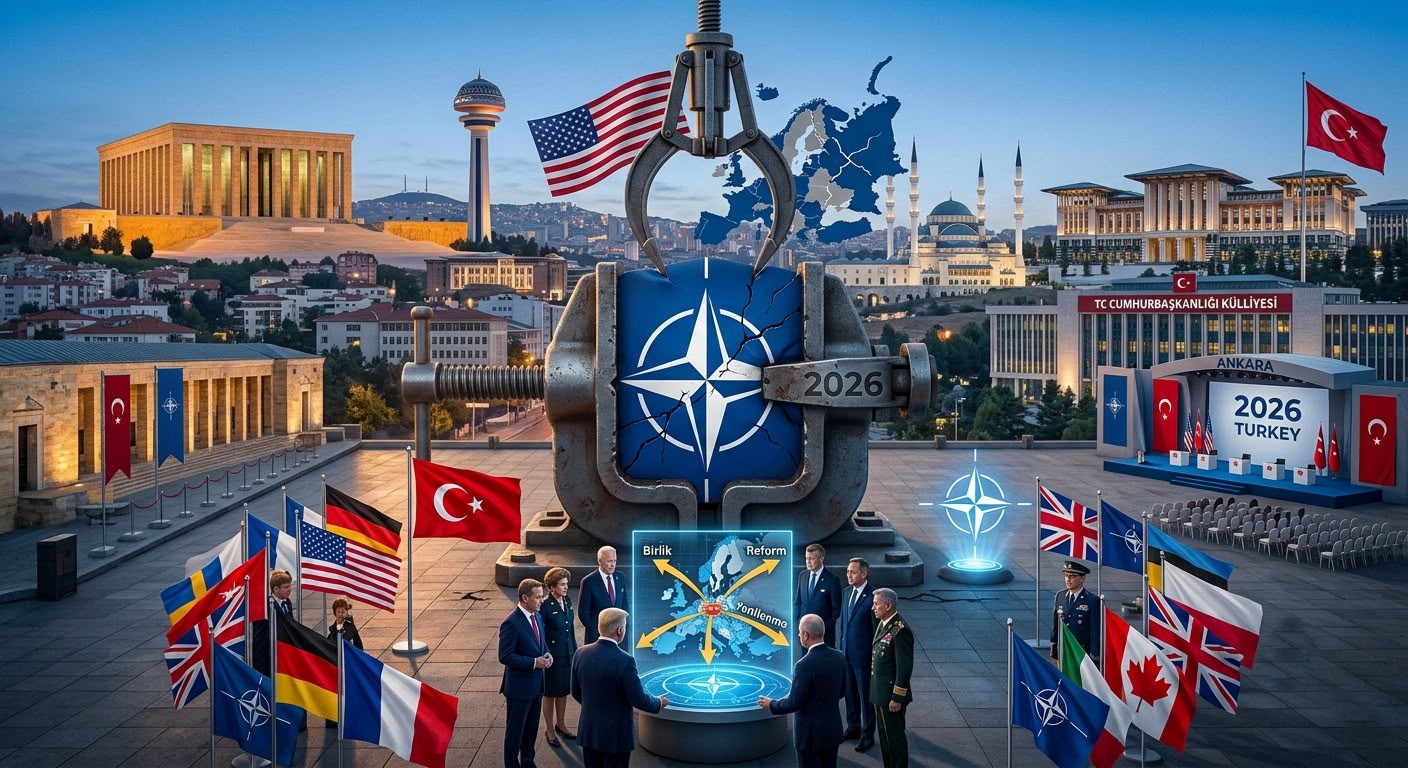


In our turbulent world, as the international system undergoes reconstruction, three options present themselves for all nation-states and existing organizations. These can be listed as follows: first, preserving the status quo within the framework of existing interests, or “status quo”; second, structural transformation in the context of radical change processes, or “revisionism”; and third, “extinction” or “surrender”.
In fact, the ongoing debates within NATO are centered on these three possibilities, and the “2026 Ankara Summit” appears set to be the scene of an intense struggle between the first two of these options.
NATO is in a position where, among the existing organizations here, it was the first to seriously question itself and, as a result, has reached a critical crossroads. The fact that no such debate is taking place within other organizations should not be interpretated as the absence of a problem in those organizations. For these organizations, there is a situation of deferred acceptance arising out of necessity in the face of the U.S.’s quest for/struggle for hegemony and consequently, a belated reckoning. Therefore, the observation I have highlighted in the NATO context “An Alliance in a Two-Axis Pincer” is, obviously, valid for these organizations as well in terms of its fundamental rationale and basis.
What Does the Phrase “An Alliance Caught in a Two-Pronged Pincer” Mean?
To put it plainly, this term serves as both a summary and a key concept for the geopolitical transformation I will address throughout this analysis, as well as the existential predicament into which NATO has fallen. To put it more concretely, the concepts of “two axes” and “pincer” refer to the following two fundamental structural dynamics:
First Axis—The Transatlantic Rift (U.S.-Europe Divide): The first prong of the pincer is within the alliance itself: here, the U.S. side seeks to fully redirect its focus and military resources toward the Indo-Pacific axis to encircle China, while forcing Europe to take responsibility for its own security; Europe (particularly France and Germany) is unwilling to conform to Washington’s global bloc politics and is striving to establish its own industrial and military stronghold (PESCO/EDF) in pursuit of “Strategic Autonomy.” Alongside the ideological and financial divergence between the U.S. and Europe, there is also a divergence regarding threat perceptions and strategic priorities. Consequently, NATO appears to be caught between the conflicting expectations and threat perceptions of these two allied sides.
Second Axis—Global Power Rivalry and Containment (NATO–Eurasian Block): The other aspect of this dilemma centers on the perception of external threats. In this context, the “New NATO” that we anticipate will emerge at the Ankara Summit; AP4 (Japan, South Korea, Australia, New Zealand) integration, and the modular “Regional sub-NATOs” model expected to make its debut as part of the new Middle East process will likely give rise to a “Hybrid NATO” structure seeking to expand its sphere of influence to a global scale.
This hybrid structure is explained by the Trump administration as a situation in which China’s “geo-technological” and “geo-economic” constraints, as well as its restrictions on critical raw materials, and Russia’s military and nuclear buildup are exerting external pressure on the United States—and, by extension, on NATO, its most effective instrument. In other words, there is a situation of encirclement and pressure arising from rising power centers challenging U.S. hegemony, as Trump has argued since his first term, and from new-generation hybrid threats and proxy wars in the power struggle between East and West.
Thus, the possibility that the “Russia-China Axis”—which is Trump’s greatest concern or nightmare regarding the “New NATO”—(and, in this context, structures such as BRICS and the SCO) might form an asymmetric counter-front and deploy new hybrid methods is also viewed as a development that would come as no surprise under the “action-reaction” principle.
Steps NATO Could Take to Break Out of the “Pincer”
In this context, NATO’s ability to bridge the internal rift between the U.S. and Europe and break through the external encirclement by Russia and China is seen as dependent on its complete abandonment of its cumbersome structure and its transformation into a flexible, hybrid, and layered network. Therefore, based on the “Ankara Summit Decisions,” the concrete steps the alliance is expected to take in the near future can be listed as follows:
- Multidimensional Revision of Article 5: A collective defense doctrine based on the condition of a conventional military attack could be expanded to include cyberattacks, sabotage of critical infrastructure (e.g., undersea energy and internet cables such as the Nord Stream pipeline), and artificial intelligence-based disinformation campaigns. The first step in breaking this cycle would be to establish legal clarity regarding gray-zone threats.
- Global Partnership Network (Global NATO): The alliance could focus on functional partnerships rather than geographic expansion. While intelligence and semiconductor supply chain integration with AP4 is being finalized, cyber defense and maritime security pacts could be established with the Gulf Cooperation Council (GCC) countries.
- “Lego-Style” Budget and “Pool of Forces”: In order to reconcile U.S. pressure for burden-sharing and Europe’s industrial protectionism (EDF), budgets are being allocated to region-focused funds. Rather than transferring funds directly to Brussels, allies can optimize the budgetary burden by financing the operational projects of “Regional Sub-NATO-like Organizations/Regional NATO-like Organizations” in their own regions.
“The New NATO”: Hybrid on the Ground, Agile in Command Global Security Architecture
In this regard, the 2026 Ankara Summit emerges as a historic milestone in NATO’s restructuring, marking the moment when the alliance realized it could no longer sustain itself as a “global hegemonic police/gendarmerie force” and instead began to become “localized,” “optimized,” “modular,” and “global” in line with the new realities of a multipolar world.
Hence, the deep frictions within the alliance, the dynamics of the “New NATO” brought about by an international system rebuilt according to the rules of the old status quo, transatlantic balances, the AP4 expansion, and the counter-moves of the Eurasian Axis can be viewed as the birth pains of this process. To put it more concretely, rather than a fragmented, weakened NATO, it appears we are heading toward a new era of the Alliance in which participation is restructured in accordance with national and regional realities through mutual agreement and the sharing of burdens and roles.
In this framework, it appears that in the coming period, the “New NATO” will operate through the mobilized forces of “regional sub-NATO entities” on the field, the integration of the Turkish and U.S. defense industries, and the AP4 global partnership networks.
Ankara Summit: Strategic Balance “Caught in a Two-Pronged Pincer”
In this process of transformation, Türkiye stands out as one of the most indispensable cornerstones of this new modular alliance architecture, thanks to its geographic location, domestic defense industry ecosystem, and unique hybrid diplomatic capacity that allows it to engage with both the Western and Eastern/Eurasian worlds. In this context, the Ankara Summit appears destined to take its place in the history of global politics as the first official laboratory where the asymmetric, cost-effective, and flexible security balances of a multipolar world are established.
Therefore, at the Ankara Summit, Türkiye, which found itself right in the middle of this dilemma, not only served as an actor that reconciled its allies and offered the Alliance ways forward in terms of greater flexibility and effectiveness at a lower cost in the face of external threats, but also by contributing to the establishment of a center of trust between the U.S./West and Eurasia/the East, it can emerge as a strategic balancer in the new geopolitical environment where uncertainty is at its peak. All statements made so far (including threatening rhetoric) and the steps that have been taken point to this.