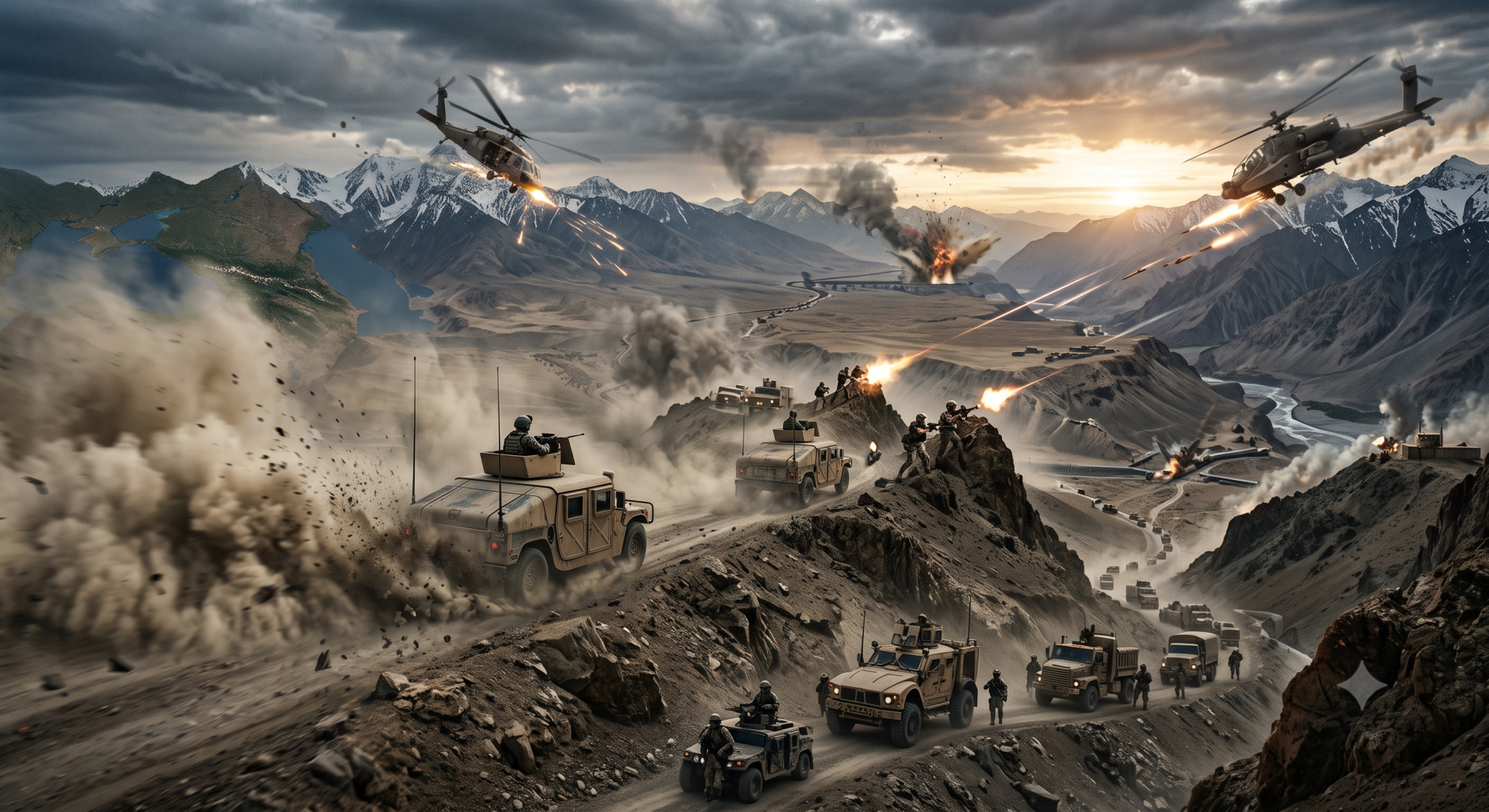


In U.S. foreign policy, the line encompassing the Caucasus, the Caspian Basin, Central Asia, and South Asia is the most critical stronghold of the global struggle for dominance. Geopolitical theories ranging from Mackinder’s “Heartland” theory to Zbigniew Brzezinski’s “Grand Chessboard” theory predict that whoever controls this vast belt will control Eurasia, and whoever controls Eurasia will control the world. For Washington, this line is not just a geographical strip; it is the direct intersection point of strategies to encircle China’s rise, suppress Russia from the south, and isolate Iran.
By 2026, as the global system evolved into a multipolar world, the struggle along this line began to intensify in military, economic, and technological dimensions. The asymmetric pressure of Russia on Central Asia after the Ukraine War, China’s logistical expansion under the Belt and Road Initiative (BRI), and the regional crises in the Middle East disrupting the Caspian and Central Asian supply chains have forced Washington to urgently revise its strategy. Within the framework of these dynamics, the United States’ moves are reshaping the global security architecture by combining with the region’s own explosive fault lines, such as CPEC, Gwadar Port, post-Taliban Afghanistan, and Baloch separatism.
This line occupies a vital place in Washington’s global vision through three fundamental dimensions. The first of these is the “Geopolitical Dimension”, which stands out with its encirclement and balance aspect. Here, the Caucasus and Central Asia stand out as Russia’s historical “backyard” and sphere of influence, as seen in Putin’s message through the Ukraine War; South Asia, on the other hand, is China’s direct border neighbor and the gateway to the Indian Ocean. For the US, being present in this line means preventing Moscow and Beijing from forming a monolithic Eurasian bloc. Washington seeks to weaken the regional integration projects of revisionist powers by supporting the independent sovereignty of these countries, and this desire is in the process of being escalated with Trump.
The second is the “Geostrategic Dimension”, where military and logistical transit is at the center. In the changing global geopolitics, the Caspian Corridor and the Middle Corridor have become the safest trade and military logistics routes between Europe and Asia. After its withdrawal from Afghanistan, the US, unable to maintain direct military bases, aims to keep this corridor under remote control through intelligence networks, cybersecurity collaborations, and airspace permissions. The message Trump sent from Bagram is for this reason.
The third aspect is the “Geoeconomic Dimension”, which focuses on the control of resources highlighted by energy and rare elements. In this context, the Caspian Sea and Central Asia host the world’s richest proven oil and natural gas reserves. Additionally, the region is a treasure trove of rare earth elements (lithium, uranium, cobalt), which are the raw materials for digital and military technologies. From the perspective of the United States, in the process of “decoupling” global supply chains from China, this route is becoming an increasingly critical alternative every day.
Structural Risks to CPEC and Gwadar Port
In the changing global geopolitics and the restructured “Great Game”, the China-Pakistan Economic Corridor (CPEC), to which China has invested billions of dollars, and Gwadar Port, the gateway to the Indian Ocean, emerge as both the heart of Beijing’s strategy to overcome the “Malacca Dilemma” and a significant security vulnerability. The main structural risks concentrated in the region can be listed as follows:
- Asymmetric Security Threats and BLA: Separatist groups like the Baloch Liberation Army (BLA), which argue that the province of Balochistan is economically and politically marginalized, directly target Chinese investments and workers. Indeed, the targeting of Chinese engineers through suicide attacks and attempts to sabotage infrastructure have significantly slowed the progress of CPEC projects.
- Local Reactions: The unfulfilled promises that Gwadar would become “Pakistan’s Dubai” have created deep anger among the local population, and this anger is being carefully monitored by third actors through systematic anti-China social movements.
- Geopolitical Constriction: The deep economic crisis that Pakistan has fallen into is jeopardizing the financing of CPEC projects. China’s cooperation agreements, which include ports and surrounding facilities under the global BRI framework, are closely monitored by the US and its allies, and the financial vulnerabilities along this route are being used by Washington as a diplomatic maneuver to distance these countries from China. Pakistan is also coming to the forefront as part of this process.
Border Security in Post-Taliban Afghanistan and Central Asia
The Taliban’s takeover of Kabul has created a multifaceted border security and instability crisis for Central Asian states. Especially Uzbekistan and Tajikistan represent two different poles of this crisis.
The Dushanbe administration is the Taliban’s most staunch opponent in the region and advocates for the rights of ethnic Tajiks in Afghanistan. The border line is sometimes the scene of infiltration attempts by ISIS-Khorasan (ISKP) and other radical groups. Due to armed conflicts in the border regions and attacks targeting foreign workers, Tajikistan is fortifying its border and increasing the number of outposts with the help of the Russia-backed Collective Security Treaty Organization (CSTO) and China.
Tashkent, on the other hand, has adopted a more pragmatic and humanitarian-centered soft power policy, engaging in dialog with the Taliban and thereby ensuring border security through diplomatic guaranties. In this context, Uzbekistan recognizes the Taliban as a legitimate interlocutor for the security of railroad and energy lines extending from Afghanistan to South Asia and keeps its border gates open for trade. However, the potential for radical groups within Afghanistan to ideologically and logistically infiltrate Central Asia is Tashkent’s greatest “secret and justifiable concern.”
Possible Strategies the US Might Bring to the Agenda in the Upcoming Period
It is expected that the US will adopt a “regionally focused, mini-lateral (flexibly multilateral), and corridor-based” strategy in the upcoming period. These strategies:
- Institutionalization of the “C5+1” and “B5+1” Formats: The U.S. is deepening diplomatic and commercial formats that address Central Asian countries not individually, but as an integrated market of 80 million. The goal is to secure the supply chain of critical minerals and to break the region free from the Russian-Chinese monopoly.
- North-South and East-West Corridor Competition: It is observed that the United States has recently increased its interest in alternative corridors that would bypass Russia, China, Pakistan, and Iran, and in this context, it is making efforts to financially and logistically support the construction of alternative transportation corridors.
- Asymmetric Security Support: Washington, although not directly fueling ethnic unrest in Balochistan and the Afghanistan-originated terrorist threat (especially ISIS-Khorasan), is monitoring their persistence as asymmetric cost factors that undermine China’s BRI investments through diplomatic and intelligence tools. Thanks to technical support in the fields of border security and cyber defense to Central Asian states, it is aimed to break the region’s dependency on the Russian military doctrine.
The Limits and Contradictions of the US-India Strategic Partnership
India is at the center of the US’s South Asia and overall Asia-Pacific strategy. Washington, even though it wants to position New Delhi as the most important geopolitical counterbalance against China, this partnership has structural limitations. These limits can be listed as follows:
- Principle of Strategic Autonomy: India does not abandon its historically closely adhered “strategic autonomy” policy while developing its relations with the West. Indeed, New Delhi does not fully comply with the U.S. sanctions against Russia and continues to purchase cheap oil and military ammunition from Russia. In other words, in summary; India continues to circumvent sanctions by developing its economic partnership with the West while not severing its energy and defense ties with Russia.
- Defense Ecosystem Paradox: The Indian army is still largely dependent on Russian-origin military platforms. This situation hinders the full integration of advanced U.S. command and control systems with India’s defense infrastructure. The strict export control regimes and technology transfer restrictions of the United States are also slowing down the operational pace of the military partnership.
- Economic and Trade Frictions: Serious disagreements are occurring between the two countries regarding customs tariffs and trade agreements. Washington’s protectionist customs policies and India’s reflex to protect its domestic industry are preventing the full reflection of military rapprochement in the economic sphere, and at times even pushing India to seek to soften its relations with China.
Effects on Regional Stability, Security, and Prosperity
The U.S.’s interventionist and corridor-focused strategy creates a double-edged sword effect in the regional geography. In this context, the arrival of Western capital and corporate investments in the Caucasus and Central Asia, along with these countries’ balanced, multidimensional pragmatic policies, reduces the region’s countries’ one-sided economic dependence on Russia and China, increases their welfare levels, and accelerates their integration with the outside world by diversifying infrastructure projects, while also harboring security risks. Therefore, Washington’s view of the region as a zero-sum competition arena could destabilize local fault lines. For example, an escalating asymmetric war in Balochistan could shake Pakistan’s internal balance. The transformation of tensions along the Afghanistan-Tajikistan border into covert proxy wars by global powers could plunge all of Central Asia into a fragile security crisis.
The Effects and Countermeasures of the Eurasia-Centric “New Great Game”
The “Great Game” that took place between the British and Russian empires in the 19th century is being repeated today with a much more complex actor structure. The responses of actors who want to maintain the status quo against the moves of the USA are not delayed. In this context, we see the following picture emerging:
- Strengthening the Beijing-Moscow-Tehran Axis: The West’s encirclement moves are pushing regional powers toward tighter security and intelligence cooperation. Counter-terrorism and regional security mechanisms are being tightened within the framework of the Shanghai Cooperation Organization (SCO).
- Russia’s Security Lever: Moscow continues to play the role of “the ultimate security guarantor of the region” by fortifying its military bases in Tajikistan and Kyrgyzstan through the CSTO. Russia also aims to make Afghanistan a buffer zone against Western encroachment by pragmatically normalizing its relations with the Taliban.
- China’s Security Companies and Yuan Diplomacy: China is increasing its security presence within Pakistan (through private security companies) to protect its CPEC investments in Balochistan and is developing and strengthening its Yuan-based financial systems to break the sanction power of the US dollar in regional trade.
- The “Balance Policy” of Regional Countries and the Rising Trend of Pragmatism: Actors such as Kazakhstan, Uzbekistan, and Azerbaijan do not see shifting entirely toward the Western axis as a very wise choice. Instead, they strive to remain on the ground of a “Balance-Based Multi-Vector Foreign Policy”, seeking to maximize economic benefits from both blocs.
To sum up, the future of U.S. foreign policy along the Caucasus, Caspian Sea, Central Asia, and South Asia axis presents itself as the riskiest and most treacherous labyrinth of great-power competition. Considering Russia’s geographical proximity and military deterrence, China’s immense financial power and infrastructure hinterland, and the instability stemming from Baloch separatism and similar issues originating in Afghanistan—all inherent to the region itself— it seems highly unlikely that the U.S. could establish absolute hegemony in this region through unilateral and direct military interventions or completely sideline its rivals.
Consequently, the coming period points to a controlled “war of attrition” in which fault lines will be further strained through trade corridors, critical mineral supplies, and asymmetric security threats, as global powers wear each other down. On this geopolitical chessboard at the heart of Eurasia, any misstep undoubtedly has the potential to trigger not merely a regional crisis, but a systemic and irreversible rupture that would fundamentally shake the global balance of power. The post-Middle East region appears set to face new geopolitical upheavals and crises. The “Great Game” seems poised to resume for the third time, picking up where it left off.