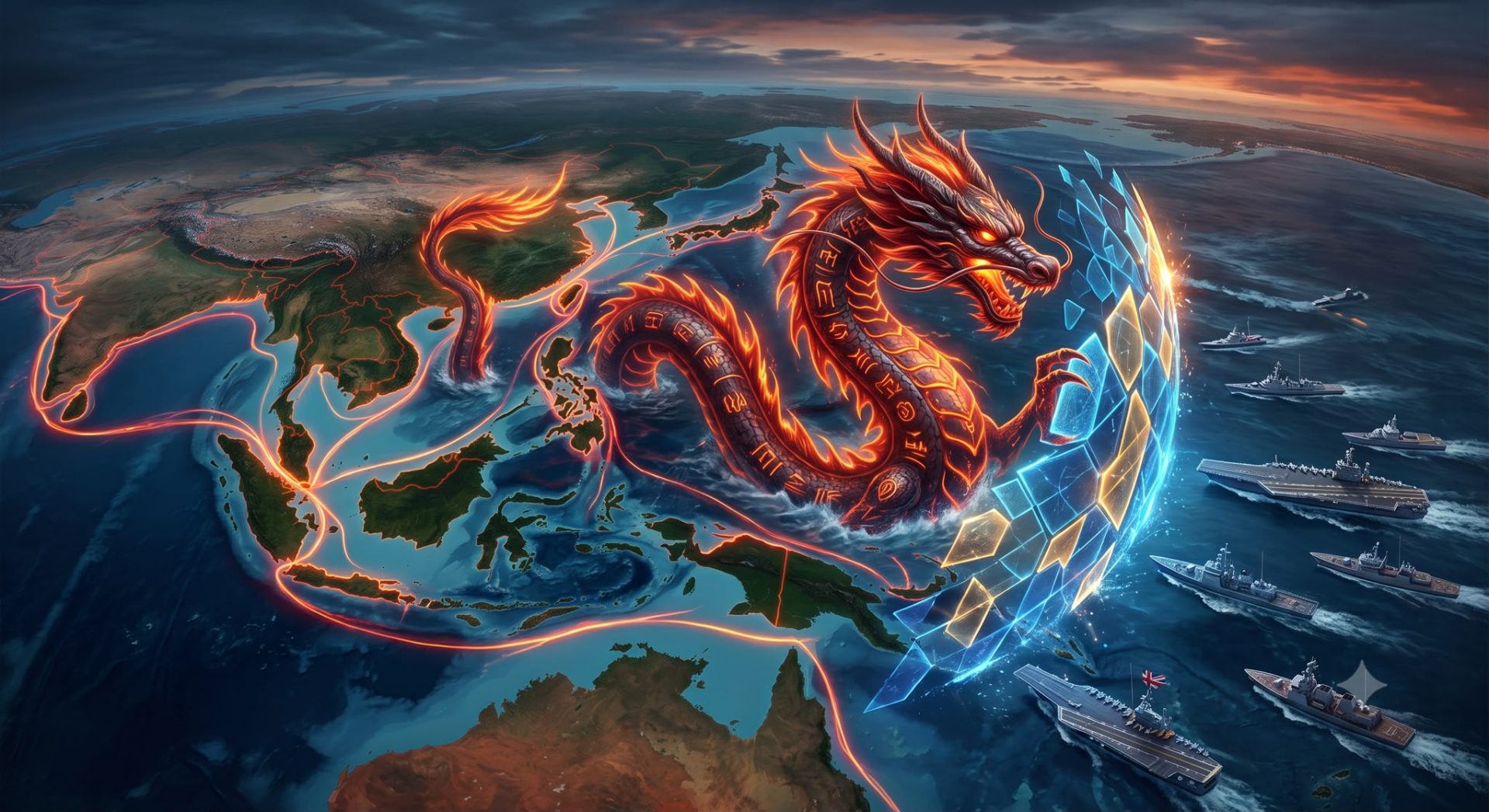


Current geopolitical indicators, global financial flows, and military deployments clearly show that the main target, crisis, and operational area of the United States (US) in the new era is the Asia-Pacific/Indo-Pacific Region. Indeed, the Washington administration is shifting its entire strategic weight to this region by keeping the structural crises in the Middle East and Eastern Europe at a minimally manageable level. The primary target country of this strategy is the People’s Republic of China. In this context, the areas of crisis and potential operations are concentrated in the Taiwan Strait, the South China Sea, and the North Korea line.
There are several structural justifications behind the United States making the Indo-Pacific region its primary operational and political focal point. The hub of world trade and maritime transportation is now the Pacific. A large portion of global gross domestic product growth is also taking place in this region. Beijing’s “Belt and Road Initiative” synonymous with “corridors/supply chains”, “resource politics” associated with critical minerals/metals, and technological advancements are perceived as a direct threat to the U.S.’s global economic and technological hegemony. In this context, Taiwan, which accounts for more than ninety percent of the world’s advanced chip production, stands out as the heart of both the civilian and military technology supply chain. The increasing military-technological cooperation between China, Russia, North Korea, and Iran is shaking the global status quo of the United States. In this context, the Indo-Pacific emerges as the “New Achilles’ Heel” of global geopolitics and is also the rising address of the US-centered “New Geopolitical Paradigm” and the “Containment Doctrine.”
To understand the geopolitical paradigm of the new era, some conceptual frameworks come to the forefront. At this point, the concept of “NATO 3.0” refers to NATO, which, having placed its geopolitical horizon at the heart of Eurasia during the Cold War era’s strategy of surrounding the Soviet Union and later completing its institutionalization process toward this new geography within the framework of Afghanistan-centered counter-terrorism, now implements multi-layered economic, technological, and military measures against China, and of course, its policy of encirclement/siege. In my previous analyzes (for example, “The Phenomenon of ‘Regional NATO-ization’, the Transformation of the Transatlantic Security Architecture and ‘Joker Membership’” and “NATO as an Alliance ‘Caught Between Two Axes’: The ‘2026 Ankara Summit’ and Strategies for Emerging from the Crisis”), I frequently emphasized “Mini-Lateralism”, which stands out as an architecture of more flexible, purpose-driven, and narrowly focused alliances established under U.S. leadership, in contrast to cumbersome structures like NATO. The concept of “Weaponized Interdependence” also describes the U.S. using global financial networks and critical supply chains as tools of sanctions and pressure. The “Porcupine Strategy”, on the other hand, is the concept of equipping Taiwan with asymmetric weapon systems, drone swarms, and coastal defense missiles that would make a potential Chinese invasion operation excessively costly and impossible.
In this strategic framework, the most critical operational area is the Taiwan Strait. Under Beijing’s “One China” principle, Taiwan’s determination has maximized U.S. military logistics lines and intelligence networks in the region. In the South China Sea, the artificial islands built by China and its unilateral claims are pressuring U.S. allies like the Philippines and Vietnam. The US is demonstrating a permanent military presence here thru Freedom of Navigation operations. Additionally, the Strait of Malacca, thru which a significant portion of China’s energy imports pass, is positioned by the U.S. naval forces as a chokepoint in the event of a potential crisis.
Multi-Layered Alliances: AUKUS, QUAD, and Micro Pacts
Washington has woven a multi-layered network of mini-lateral alliances to encircle China in the Indo-Pacific with military, technological, and logistical ties. The most robust military core of this network is currently the “AUKUS Pact.” The operational plan of this alliance, established between the United States, the United Kingdom, and Australia, is to turn Australia into a massive nuclear submarine base and logistical launch point in the southern Pacific. The first phase of the plan involves the permanent rotational deployment of US and UK nuclear submarines to Australian ports. In the second phase, Virginia-class nuclear-powered submarines will be delivered to Australia, and joint SSN-AUKUS submarines will be constructed. Thus, Chinese warships and submarines in the South China Sea and the Taiwan Strait will be continuously monitored and pressured even in shallow waters without being detected by radar. The operational expansion of AUKUS is not limited to submarines; the joint development of artificial intelligence, quantum technologies, hypersonic missiles, and underwater autonomous vehicles also constitutes the deep military operational planning of this pact.
Around this military core, the QUAD alliance, which serves a broader geo-strategic balancing function, is situated. This quartet structure, consisting of the United States, Japan, India, and Australia, has today become the operational coordination center for encircling China by sea. The military operational plan of QUAD is materialized thru the annual “Malabar Naval Exercises.” Thru these exercises, the naval forces of the four countries are elevating anti-submarine warfare, aircraft carrier operations, and joint air defense coordination to the highest level. The more insidious and strategic operational plan of QUAD is the “Maritime Domain Awareness Initiative.” With this system, all civilian and military ship traffic from the Indian Ocean to the farthest points of the Pacific is monitored in real-time thru satellites and radars, and China’s covert maritime activities and logistics routes are being deciphered. Additionally, QUAD is conducting operations to build alternative infrastructure funds and secure telecommunications networks to counter China’s Belt and Road Initiative and its infrastructure construction activities in regional countries.
In addition to these two main alliances, the United States has also initiated new and more aggressive operational partnerships in the region. The most important of these is the “US-Japan-South Korea Trilateral Pact” established at the Camp David Summit. The operational priority of this pact is to establish an integrated missile defense system in East Asia under the pretext of North Korea’s nuclear and missile threats. In this context, the three countries have created a shield that will instantly destroy potential missiles launched from China and North Korea by sharing early warning radar data in real-time. Additionally, Japan’s acquisition of offensive-capable missiles by changing its defense doctrine and South Korea’s massive conventional munitions production capacity ensure that this alliance locks down China’s northern flank. On the other hand, the Philippines, which is directly facing China in the South China Sea, has been transformed into an operational base under the Enhanced Defense Cooperation Agreement with the United States. The US has obtained the right to access military bases in the Philippines at the most strategic points closest to Taiwan and has deployed missile batteries and logistics depots there. This situation means that in the event of a possible invasion of Taiwan, the US could intervene in the region within a few hours.
Global NATO Integration and IP4 Expansion
These local networks in the Indo-Pacific have been introduced into a structural integration process with NATO, which will radically change the global security architecture. As I underlined in my analysis titled “Beştepe Declaration of ‘New World Order’: 2026 Ankara Summit and Geopolitical Codes of NATO 3.0”, NATO’s Ankara Summit and subsequent diplomatic moves have registered the domain of the North Atlantic Alliance in the Pacific. This integration is carried out through “Japan, South Korea, Australia and New Zealand Quartets”, which is called IP4 at the institutional level. At the operational level, the integration plan is realized through “Individualized Tailor Partnership Programs”, also known as a new generation marketing model of the business world.
Within the framework of these programs, the command-control mechanisms of NATO in Europe and the communication systems of micro-alliances in the Pacific are interconnected. Joint data pools have been established in the fields of cyber defense, artificial intelligence-based early warning systems and maritime security. The most concrete operational output of integration is defense industry standardization. By aligning the ammunition, radar and logistics infrastructure of the Pacific allies with NATO standards, Atlantic and Pacific forces are planned to be able to instantly transfer ammunition and logistics to each other in a possible global conflict. Without a doubt, Beijing is reading this expansion of NATO as an attempt to create “Asia-Pacific NATO” and China as a choking move at a global level.
China’s Response: “Asymmetric Sea Dragon Strategy”
In response to this massive encirclement maneuver by the West, China has developed an asymmetric defense and attrition strategy rather than responding with conventional naval warfare. Beijing’s counterstrategy—referred to in military literature as the “Asymmetric Sea Dragon”—is fundamentally based on a multi-layered “Anti-Access/Area Denial” doctrine. The first operational pillar of this strategy consists of “Aircraft Carrier Killer” ballistic and hypersonic missiles designed to keep U.S. aircraft carrier strike groups thousands of kilometers away from the Chinese mainland. China is testing AI-assisted hypersonic missile guidance systems by constructing three-dimensional models of American destroyers and aircraft carriers in its deserts. With long-range missiles such as the DF-21D and DF-26, it is making it prohibitively costly for the U.S. Navy to enter the First and Second Island Chains. The second pillar of the strategy is the full militarization of the artificial islands constructed in the South China Sea. These islands have been equipped with air defense systems, anti-ship cruise missiles, and early-warning radars, transforming them into unsinkable aircraft carriers. The third and most asymmetric layer of the Sea Dragon strategy consists of cyber, space, and electromagnetic warfare capabilities. In the event of a potential military operation, China plans to use anti-satellite weapons and cyberattacks to paralyze the real-time data streams, satellite communications, and coordination networks of the U.S. Navy and its NATO allies—which constitute their greatest strength.
Russia’s Entry into the Equation
This confrontation in the Pacific is evolving into a massive, two-front global conflict, reflecting the military dimension of the unlimited partnership between Russia and China. Following the structural rupture with NATO in Europe, Moscow has turned its entire strategic focus toward the East and has made the Russian Pacific Fleet a complementary element of China’s “Sea Dragon Doctrine.” Based in Vladivostok, this fleet is entering the equation primarily through its nuclear submarine fleet and long-range cruise missiles.
In this context, the Russian and Chinese navies conduct regular joint patrols and live-fire tactical exercises every year in the waters of the Sea of Japan and the open Pacific Ocean. Russia’s operational plan in the Pacific is to break through the U.S. and Japan’s encirclement lines targeting China from the south, starting from the north. Advanced Yasen- and Borei-class nuclear submarines bypass American submarine surveillance networks in the North Pacific, creating a sustained nuclear deterrent pressure directed at the U.S. west coast. Furthermore, by increasing the militarization of the Kuril Islands, Russia is tying down Japan’s military power in the north, thereby preventing Tokyo from focusing its full capacity on the Taiwan Strait. By opening the Northern Sea Route to Chinese merchant ships, Russia is also providing Beijing with a secure logistics corridor through the Arctic that is completely immune to U.S. naval blockades.
The Polar Regions and the Northern Front of Arctic Geopolitics
Tensions in the Pacific and the Russia-China partnership have shifted global competition to the world’s northernmost point—namely, Arctic geopolitics. Melting glaciers have transformed the North Pole not only into a competitive arena for new energy sources but also into a direct theater of operations linking the Pacific and Atlantic military lines. China has launched its “Polar Silk Road” vision by defining itself as a “Polar-Near Country.” In this context, Russia’s Arctic bases—under its military control—and its fleet of nuclear-powered icebreakers constitute the safest alternative route to free Beijing’s strategic maritime trade from the stranglehold of the Strait of Malacca. In response, the U.S. and NATO have completely revised their Arctic strategies. The North Pole is viewed as the “shortest-range attack route” through which Russian nuclear submarines and Chinese hypersonic missiles could reach the U.S. mainland in the shortest possible time. With the NATO membership of Norway, Finland, and Sweden, the Northern European corridor has effectively become a “full-fledged Atlantic lake”, prompting the U.S. to shift its “Greenland, Iceland, and the United Kingdom (GIUK) Defense Line” northward to establish a new early-warning and containment barrier against Russia and China in the Arctic.
Global Energy Routes and the Domino Effect
This massive tension building up in the Indo-Pacific is creating a direct domino effect on the fragile chokepoints of global maritime trade. A potential wave of conflict in the Pacific would, through a chain reaction, instantly paralyze the lifelines of global energy supply, such as the Strait of Hormuz and the Strait of Bab el-Mandeb. In such a scenario, China could transform the waterways of the Middle East and the Red Sea into asymmetric counter-fronts through its strategic allies—actors in Iran and Yemen—in response to a potential U.S. naval blockade via the Strait of Malacca. The closure of the Strait of Hormuz to maritime traffic or the targeting of tankers entering the Red Sea via the Strait of Bab el-Mandeb with kamikaze drones and anti-ship missiles is described as China’s greatest “asymmetric blackmail card” against Western economies. Beijing’s two primary objectives with this card are as follows: 1) Blocking energy corridors will drive oil prices per barrel to unpredictable levels within seconds, striking at the industrial and production machinery of the Atlantic Alliance. 2) Consequently, a spark in the Pacific will trigger a global energy shock via the Strait of Hormuz and the Strait of Bab el-Mandeb, geographically dividing the forces of NATO and allied navies striving to secure energy routes, thereby weakening the U.S. concentration on the Pacific front.
Consequently, it is considered highly beneficial to assess the developments that have taken place in the “Eastern Mediterranean–Red Sea–Arabian Sea Triangle” since October 7, 2023, and, in this context, the war launched by the United States against Iran, from this perspective as well.
The Semiconductor Wars and the Strategy of Alternatives Beyond Taiwan
In the semiconductor wars—which form the technological backbone of great-power competition—Taiwan’s TSMC-centered monopoly is viewed as a “geopolitical vulnerability,” leading to a radical diversification of the global supply chain. The Taiwan crisis has forced global actors to make massive investments in alternative countries under the “Friend-shoring” strategy. In this process, Malaysia and India, in particular, are positioning themselves as new power centers in the global semiconductor market.
Malaysia has gained an advantage by controlling more than 13 percent of the global market in “Assembly, Test, and Packaging” (ATP) processes—the most critical stage following chip production. By transforming the Penang region into a semiconductor hub, Malaysia is vying for leadership in advanced packaging technologies with investments from U.S.- and Europe-based tech giants.
India, meanwhile, is building its semiconductor ecosystem from scratch with its massive workforce, engineering capabilities, and government incentive packages worth billions of dollars (Semicon India). New Delhi aims not only to extend its global leadership in chip design to the manufacturing sector but also to break its dependence on China and Taiwan by establishing joint-venture factories with global technology consortia. These alternative countries serve as the sole strategic buffer zones that would prevent the collapse of the global technology industry should Taiwan be taken out of commission by a potential operation targeting it by the U.S. and its allies.
Possible Outcomes and Future Projections
The U.S.’s aggressive containment and operational alliance strategy in the Indo-Pacific, coupled with the asymmetric response from China, Russia, and their allies, has the potential to trigger major disruptions in the global system. A hot conflict centered on Taiwan or the South China Sea could plunge the global economy into a very deep recession. Indeed, even a mere halt in the supply of semiconductors alone has the capacity to completely paralyze the global automotive, defense, and electronics sectors. As a result, the world economy could split into two major blocs: “West” and “East.” Indeed, “local sourcing” and “sourcing from friendly nations” models are already becoming increasingly mandatory in supply chains, and governments are bringing regional cooperation projects to the forefront every day in response.
In response to North Korea’s nuclear threats and China’s rapid expansion of its nuclear arsenal, countries such as South Korea and Japan will face increasing pressure to develop their own nuclear weapons. This situation could trigger an uncontrolled nuclear arms race in Asia. Before a conventional war breaks out, the parties may carry out destructive cyber operations targeting each other’s critical infrastructure. In this context, disinformation and AI-based perception operations appear set to become the new front line.
When examining strategic projections for the future, it can be said that the U.S. and China will avoid direct confrontation due to nuclear deterrence. Instead, the likelihood of an intense, asymmetric proxy war over Taiwan or the islands in the South China Sea appears very high. In this context, the U.S. will continue to support India militarily and economically to counterbalance China. However, it is assessed that New Delhi will seek to secure the largest share of the pie while preserving its strategic autonomy, rather than becoming a full-fledged Western ally.
Furthermore, China and its allies appear set to continue expanding alternative payment systems and trade in local currencies to shield themselves from U.S. sanctions. This issue presents itself to them not as a choice but as a necessity. While this will undoubtedly not completely end the dollar’s status as the global reserve currency, it will narrow its sphere of influence.
In conclusion, from the U.S. perspective, the new arena for crises and operations has permanently shifted from the traditional quagmire of the Middle East to the technological and geo-economic sphere of the Indo-Pacific. This military network, woven through AUKUS, the QUAD, regional trilateral pacts, and NATO’s IP4 integration, aims to confine Beijing to its own territorial waters. China’s Asymmetric Sea Dragon Doctrine, Russia’s submarine presence in the Arctic and the North Pacific, and the emergence of chip alternatives from countries like Malaysia and India are completely reshaping the global balance of power. A breakdown in these regions would sever all global lines of communication—from the Strait of Hormuz to the Red Sea, and from the Arctic to the Pacific—marking the de facto start of the “New Cold War” that will determine the 21st century’s global leader and the rewriting of the world order.