

As the first quarter of the 21st century comes to an end, the “power shift” long debated within international relations theories has ceased to be merely a theoretical projection and has become a structural reality. The Western-centered liberal international order (Pax Americana), constructed after the Second World War and globalized following the end of the Cold War, is facing the most serious institutional and normative challenge in its history. Two major actors represent the institutional backbone, geographical expansion, and economic depth of this challenge: BRICS+ and the Shanghai Cooperation Organisation (SCO).
In response to the status quo-preserving strategies of Western alliance systems (G7, NATO, AUKUS), based on containment, financial exclusion, and sanctions, these two formations have increasingly begun to evolve from merely defensive platforms into proactive centers of global counter-operational planning. Accordingly, new strategic alignments shaped by mutual threat perceptions are emerging. Within this framework, the geo-economic counter-offensive strategies developed by BRICS+ and the SCO against Western hegemony amid the inevitable transformation of global system-building, the sustainability of the multidimensional foreign policy practices of “swing actors” within these organisations, and particularly their “exit strategies” and “roadmaps,” have become critically important.
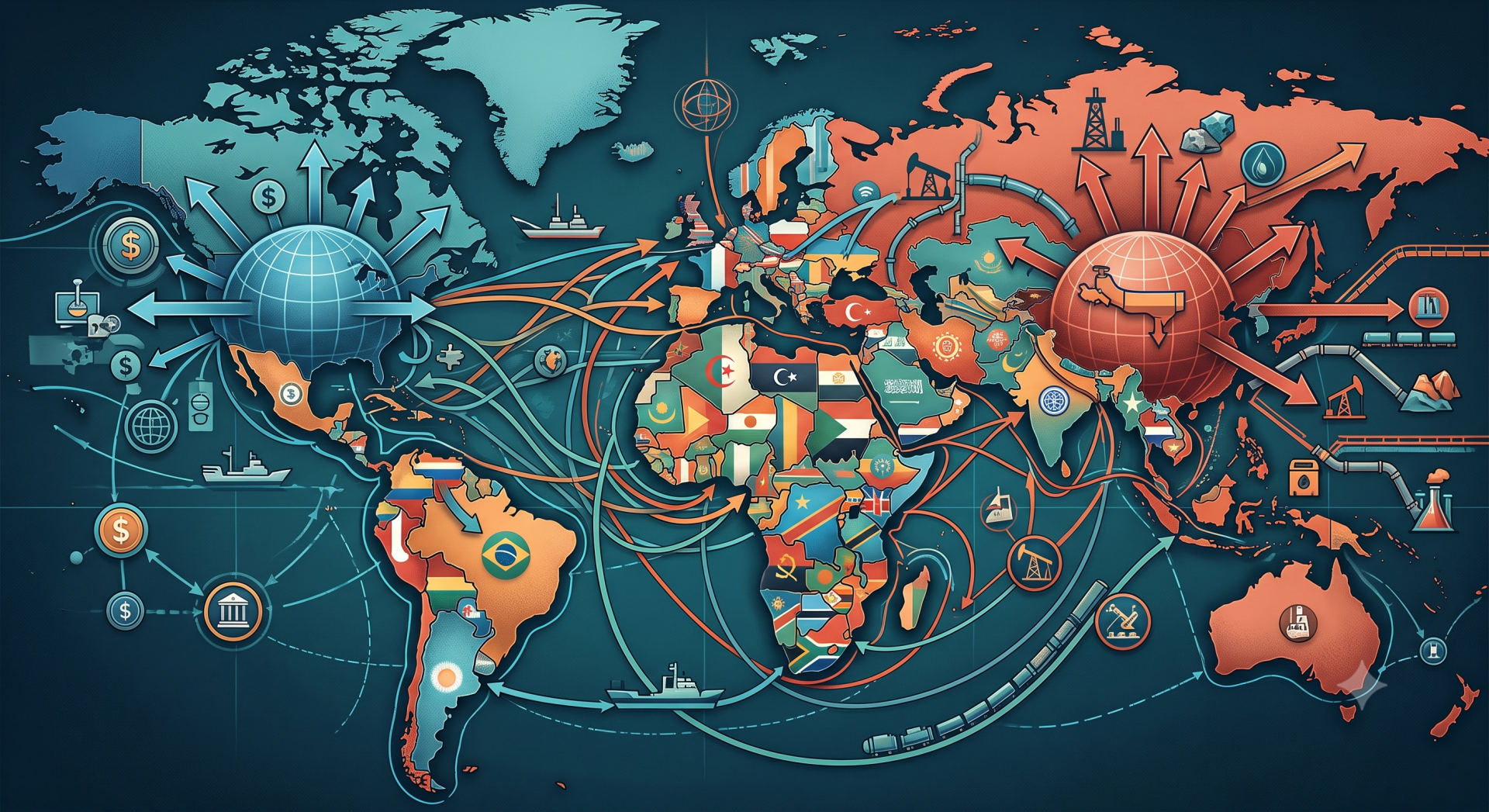
One of the primary issues in this context emerges in the search for an “Exit from the Financial Labyrinth.” The tendency of the West to employ the global financial infrastructure (particularly the SWIFT system and the reserve currency status of the US Dollar) as a geopolitical instrument — a trend that reached its peak with the Russia–Ukraine War — has triggered a radical counter-strategy among the Eastern and Global South blocs. Within this framework, the “Emerging New World” centred around BRICS+ and the SCO appears to be developing four fundamental counter-operational lines in order to escape asymmetric economic dependency networks. These are:
- Liquidity Sovereignty and Dedollarization: The share of local currencies (yuan, rupee, ruble, dirham) in intra-bloc trade is being systematically increased. This development aims not only to undermine the global liquidity monopoly of the US dollar but also to prevent the macroeconomic damage inflicted on the Global South by the interest rate policies of the US Federal Reserve (FED). The partial pricing of oil trade between China and Saudi Arabia in yuan represents a strategic blow struck at the core of the energy-dollar (petrodollar) mechanism.Kurumsal
- Integration of Alternative Systems: CIPS, SPFS, and BRICS Pay: In order to eliminate dependence on the SWIFT system, China’s Cross-Border Interbank Payment System (CIPS) and Russia’s System for Transfer of Financial Messages (SPFS) are being technically integrated. Beyond this, the BRICS Pay infrastructure, based on blockchain and distributed ledger technology (DLT), promises a sovereign financial corridor capable of operating entirely outside Western control mechanisms and secondary sanctions regimes.
- Multilateral Development and Liquidity Pools: The New Development Bank (NDB) and development funds designed within the framework of the SCO bypass the principle of political conditionality imposed by the IMF and the World Bank under the framework of structural adjustment programs. By providing loans to debtor countries without requiring the transfer of sovereign rights, the NDB functions as a financial safe haven for the Global South.
- Logistical Reinforcement of the Eurasian Space: In response to the naval superiority of the West over maritime routes (the Strait of Malacca and the Suez Canal), land-based corridors are being strengthened through the SCO and China’s Belt and Road Initiative (BRI). The North–South Transport Corridor (INSTC) and the Middle Corridor aim to redirect global commodity and energy flows beyond the reach of Western overseas intervention capabilities.
“Asymmetric Multi-Vectorism” and “Geopolitical Limbo”
In this process, the position of countries that are members of BRICS+ and the SCO while maintaining deep ties with the West (such as India, Türkiye, Saudi Arabia, the UAE, South Africa, and Brazil) is undoubtedly of critical importance for the future of these organisations. The situation of these countries can be described through two key concepts:
- “Asymmetric Multi-Vectorism”: These actors seek to integrate simultaneously into both Western security and economic systems (NATO, G20, the EU Customs Union) and Eastern partnerships (BRICS+, SCO, ASEAN) in order to avoid dependence on a single bloc. However, this multi-vector approach is not symmetrical; these countries remain asymmetrically dependent on the West in terms of security architecture, while relying on the East for economic growth potential, market expansion, and commodity/energy supplies.
- “Geopolitical Limbo”: This refers to the situation in which states remain within the grey zone between competing blocs in order to obtain maximum economic and strategic benefits from both sides. While “geopolitical limbo” provides room for manoeuvre and strategic flexibility during periods of low-intensity hegemonic competition, it carries the risk of transforming into a security vulnerability and strategic paralysis as global polarisation intensifies.
The Sustainability Threshold: Structural Contradictions of Multi-Dimensional Policies and the Issue of Leadership
The balancing policy pursued by these countries, which are also described as “swing actors,” is not a strategy that can be sustained indefinitely. Three fundamental structural contradictions lie behind this unsustainability. The first of these is the risk of “the widening gap between security and economy.” More concretely, while a country’s national security is dependent on Western military systems (for example, India’s QUAD membership), the fact that its economic future is indexed to China-centred supply chains and Russian energy may paralyse state mechanisms during times of crisis. The second contradiction emerges in the form of “institutional normative opposition.” Indeed, the discourses of G7+NATO and BRICS+/SCO are increasingly built upon a foundation of “opposition.” The final contradiction manifests itself in the dimension of “internal conflicts.” The SCO and BRICS+ are structures taking steps towards becoming more homogeneous. For example, border conflicts and strategic rivalry between India and China structurally hinder the transformation of these organisations into a collective and sustainable anti-Western military-economic bloc.
On the other hand, while NATO is taking certain steps and experiencing difficulties in addressing the crisis emerging regarding the future and transformation of the organisation, in the SCO and BRICS+ there are “postponed/deferred or frozen” crises instead of such early debates/confrontations.
Another important issue is the question of “leadership” within the context of these organisations. At the current stage, the debates/problems regarding leadership in G7+NATO have been largely resolved. In contrast, although the concept of “collective governance/leadership” is emphasised instead of “leadership” in the SCO and BRICS+, due to the nature of international relations, and particularly in parallel with the loss of superiority by the United States, which is struggling to maintain its position as a “hegemonic power,” a struggle for leadership within the SCO and BRICS+ appears inevitable. Therefore, there are serious uncertainties regarding the future of the SCO and BRICS+.
Breaking Points and the Threshold of “Forced Choice”
The stage at which actors pursuing multi-vector foreign policies will be forced to make a definitive choice by moving beyond “Geopolitical Limbo” will emerge when systemic escalation eliminates the grey zones. This process appears likely to occur through three specific waves of catalysts.
The first wave emerges in the form of “Financial Secondary Sanctions.” At this stage, the West may completely exclude from the US financial system third-country banks using the digital payment systems of the Eastern bloc (such as BRICS Pay) and local currency exchange mechanisms. Current developments so far indicate that this is becoming a more realistic scenario rather than merely a possibility. At this stage, “swing actors,” which still conduct 70% of their global trade in dollars and euros, will be forced to make an immediate “Market Choice.”
The second wave may manifest itself as the “Technological Iron Curtain.” Here, the clear separation of standards in artificial intelligence, semiconductors, quantum computers, and nuclear energy technologies appears inevitable. Therefore, for “swing actors,” it will become impossible to serve as a bridge between the West and the East; countries will be forced to place their data infrastructures under the control of a single bloc.
The third wave may emerge as the “Indo-Pacific Crisis Moment” or the “Taiwan Break.” A direct US-China military confrontation that may erupt in the South China Sea or the Taiwan Strait (although it is assessed as a low-probability scenario) will inevitably activate all global trade routes and alliance commitments. At this stage, neutrality may be coded as “hostility” by both blocs. In this context, “swing actors” may be excluded and become “targets.” Indeed, world political history is full of examples of this.
China and Russia’s Strategic Roadmaps and the Possible Responses of “Swing Actors”
Undoubtedly, overcoming the threshold of “forced choice” and compelling swing actors to choose between blocs will profoundly affect the strategic visions of China and Russia, the two major founding powers of BRICS+ and the SCO. In this process, China and Russia may shift from defensive resistance to a proactive “Anti-Economic Encirclement Defense” doctrine. At this point, Russia, which has completely severed its ties with the West, may resort to using its commodity and nuclear energy leverage as a radical instrument of pressure in order to prevent “swing actors” from shifting towards the West. Alternatively, it may at least apply methods of cutting off energy supplies or imposing asymmetric price-based punishments on countries moving away from it. Indeed, many Russian officials, including Putin, as well as figures presented as “opinion leaders,” have repeatedly expressed these approaches on various platforms. In contrast, China may seek to persuade “swing actors” until the very last moment by employing more sophisticated, non-military methods.
The China-Russia duo may resort to “preventive diplomacy” in order to avoid facing such a difficult situation, and may also seek to develop a common roadmap in this regard. Within this framework, both powers may propose military pact mechanisms such as the “BRICS+ Joint Security Treaty” or the “SCO Mutual Security Protocol,” aiming to transform economic partnership into a compulsory defence alliance and to establish a new institutional discipline designed to completely eliminate grey areas.
On the other hand, such a possibility may prevent BRICS+ and the SCO from remaining a homogeneous global alternative from the perspective of “swing actors.” As the number of members forced to make a choice increases, the global reach of these organisations may narrow. More concretely, the “new roadmap” of the China-Russia duo within the framework of “preventive diplomacy,” based on the clear-cut separation of blocs, may lead to a radical internal political and strategic split among the current member states and, consequently, to strategic divergences. In this context, for example, India may perceive such a proposal as the greatest threat to its national security and may reduce its presence in BRICS+/SCO platforms to a minimum, moving towards full integration into the Western-Pacific alliance system (QUAD), or even into a potential “Asia-Pacific NATO” identified with “QUAD-AUKUS.”
In conclusion, the economic counter-operational plans pursued by BRICS+ and the SCO against Western alliances have achieved undeniable success in altering the unipolar nature of the global system. The West is no longer able to unilaterally impose financial and technological norms on the rest of the world. However, this does not mean that the system is smoothly evolving towards “multipolarity.” On the contrary, the system is moving towards a new bipolarity characterized by greater aggressiveness, the erosion of rules, and a high risk of conflict. In this process, the asymmetric multi-vector policies pursued by “swing actors,” while providing temporary diplomatic flexibility, appear likely to become unsustainable at the moment of systemic rupture. Once the “Technological Iron Curtain” and financial secondary sanctions come into effect, these countries will be forced to make an existential choice between the ideal of “strategic autonomy” and the reality of “structural dependencies.” Ultimately, the new international system will be shaped by the scale and direction of the choices made by these “swing actors”; however, this moment of choice will also represent the greatest strategic cost and risk management test in recent history for these countries.