

As of September 8, 2026, the decision announced in the British Parliament by the government of UK Prime Minister Andy Burnham through Foreign Secretary Ed Miliband regarding a trade ban and sanctions targeting goods produced in illegal Israeli settlements in the West Bank has shifted the foundations of global diplomacy. In other words, one of the deepest and most disruptive fault lines of global geopolitics has been irreversibly fractured through the radical decisions taken by leading European Union (EU) member states, particularly France, together with the United Kingdom and Canada, against Israel’s occupation policies. This move has not only exceeded the boundaries of the Palestinian issue but has also emerged as the first concrete declaration of a new strategic positioning within the Europe–Gulf–Washington triangle after Brexit.
This development represents the clearest and most explicit indication that the Western alliance can no longer tolerate Israel’s state practices that systematically violate international law and that Tel Aviv’s radical Zionist agenda may be sacrificed for the sake of the stability of the global capitalist system. Therefore, while the “asymmetric protection shield” constructed after the Second World War is being dismantled by its very own founders, the period of immunity granted to colonial expansionism in the Middle East from the Western perspective is also coming to an irreversible end. Since global capital can no longer bear the geopolitical risk costs of theocratic expansionism, this move can be evaluated as a radical “systemic restoration” operation initiated by the West’s motivation to preserve its own hegemonic survival and digital sovereignty.
The Post-Brexit London–Brussels Axis and Germany’s Position
London and Brussels (and leading EU countries), which went their separate ways after Brexit, have converged on a necessary minimum common ground in Middle East geopolitics based on “international law” and a “two-state solution.” This cooperation stems from the desire to utilize the United Kingdom’s diplomatic leverage in order to overcome the internal divisions within the EU. Therefore, the fact that London, which institutionally separated from the EU through Brexit, has aligned itself so perfectly with Brussels and Paris on the Palestinian issue demonstrates that a deep and hidden integration remains active in strategic security, intelligence sharing, and trade architecture between continental Europe and the United Kingdom. This joint action should be interpreted not as a rupture, but rather as a structural post-Brexit pragmatism and a model of cooperation on a global scale.
Brussels and London’s primary objective is to convey the message that a radical Israeli regime that has moved completely outside international law, institutionalized apartheid practices, and dragged the region into a continuous cycle of war can no longer be sustained by the Western world.
In this process, Germany, due to the strategic baggage created by its historical guilt psychology and the legacy of the Holocaust, is attempting to maintain its traditional role within the EU as a blocking actor and an unconditional protector of Israel. Although the Berlin administration, together with actors such as the Czech Republic and Hungary, resists the adoption of a comprehensive and institutional sanctions decision across the EU, Germany’s room for maneuver is narrowing in the face of this strong diplomatic wave initiated by the London–Paris axis, and its diplomatic isolation within continental Europe is deepening with each passing day. Therefore, this step also represents a blow directed against the status quo-oriented current within Europe itself and constitutes a declaration that the new European security architecture will not be sacrificed to Israel’s excesses. This situation clearly demonstrates that geopolitical interests render institutional divisions meaningless during moments of geopolitical crisis and that continental security is quietly being reintegrated along the axis of British–French nuclear and military deterrence.
Trump’s Implicit Approval and the United States’ Dual-Layer Strategy
It has leaked that during the meeting between US President Donald Trump and UK Prime Minister Burnham, Trump did not directly object to these sanctions, meaning that he gave implicit approval (“consent”) to the measures. However, this does not directly mean that the United States has shifted toward an anti-Israel axis. On the other hand, strong indications that Trump was informed of the decision beforehand and did not directly veto the process reveal the deep and layered division of labor behind the Anglo-American alliance.
As is known, rather than directly confronting the Zionist lobby, Trump seeks to restrain the Netanyahu government’s appetite for annexation in the West Bank (indeed, Secretary Rubio stated that the annexation vote would undermine the Gaza peace plan) and to make Israel completely “dependent” on the US military-diplomatic umbrella. Within this framework, opening the way for Britain emerges as a “stick” used by Washington against Tel Aviv. In other words, since Trump does not want to directly confront the radical Evangelical base, powerful Zionist donors, and Jewish lobbies in American domestic politics and risk his own political future, he appears to be pursuing a strategy of using Britain to “discipline”, “contain” and ultimately make Tel Aviv completely “dependent on the United States”. This situation means that Washington has deliberately opened the way for Britain against Israel and is using it as a tool.
On the other hand, the fact that Trump supports Argentine President Javier Milei’s claims regarding the Falkland Islands while simultaneously opening the way for Britain and implies that the United States may abandon its neutrality regarding the islands emerges as a deep contradiction. Likewise, the trade war and tariffs escalating between the United States and Canada demonstrate the internal cracks within the Anglo-Saxon bloc. It appears that while Britain is being squeezed in the Atlantic by Washington and Argentina, it is attempting to prove that it remains a “central actor” in the global system by revitalizing its historical sphere of influence (the Eastern Mediterranean and the Levant) through the emerging “US Middle East”.
In other words, it can be argued that London, through this move, is responding to Washington’s unipolar impositions with the instrument of global legitimacy while attempting to balance the deep asymmetry between the two allies in strategic regions. On the other hand, although Trump and London appear to be in agreement regarding Israel, the issue of Britain remaining an equal and founding partner is still on the table from London’s perspective. Because the United States wants to see Britain on the ground only as a subcontractor actor. This situation can be described as an implicit power struggle being staged between the two actors.
Geographical Expansion: The Domino Effect Beyond Palestine
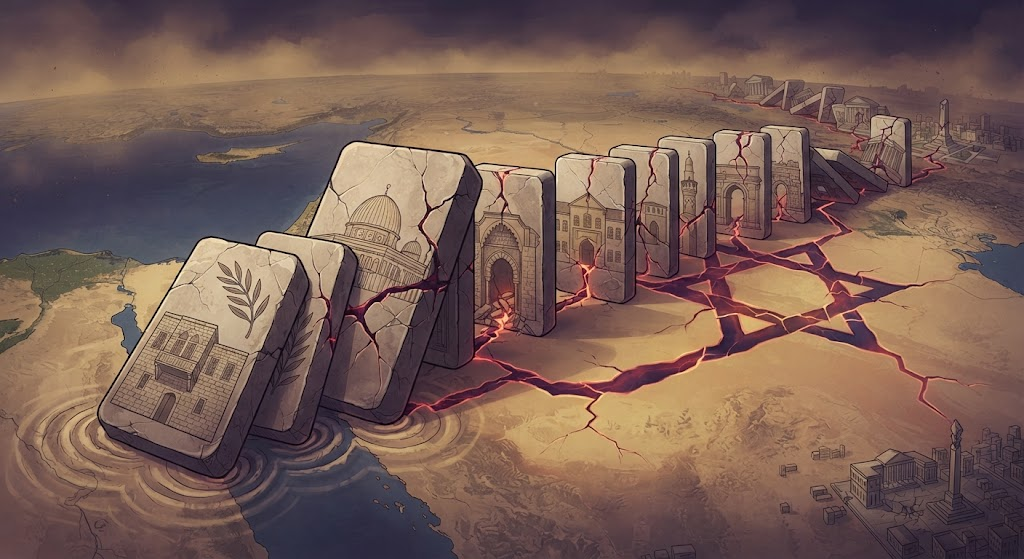
The geographical repercussions of this strategic step will by no means remain limited to the Palestinian territories and the West Bank; rather, they appear likely to trigger a domino effect with multiplier consequences throughout the region. Since the embargo and isolation policy led by Britain has the potential to establish a very strong precedent in international law, it may pave the way in the near future for the international recognition of Israel’s illegitimate position in Syria’s occupied Golan Heights region and along Lebanon’s southern border areas. Indeed, the tendency of some radical EU member states to expand the scope of the ban to explicitly include the Golan Heights constitutes the first concrete indication of this comprehensive containment strategy. Even if Israel attempts to overcome this international legitimacy crisis and divert attention elsewhere by launching new military adventures in Lebanon and Syria, in other words, by expanding the front, this time it will not find behind it a homogeneous and unwavering Western support and logistical protection shield. This situation marks the beginning of a new era in which the absolute immunity shield that has enabled Tel Aviv’s regional military superiority has been breached and the economic-diplomatic costs of its military aggression have reached an unsustainable level. Within this context, the legal containment strategy limits Israel’s geopolitical maneuvering space by economically punishing its military expansion and transforms colonial expansionism into an unsustainable luxury.
Global Trade Wars and the Supply Chain Dimension
The corridor dimension of these developments should also not be neglected. Indeed, when the process is examined from the perspective of global trade wars and the security of logistical corridors, it becomes apparent that this move by Britain and the EU is also closely related to the new supply chain war emerging along the Eastern Mediterranean, Red Sea, and Persian Gulf–Strait of Hormuz routes. Therefore, the issue is not merely Palestine or the humanitarian dimension.
The massive infrastructure, port, and logistics agreements established by the People’s Republic of China with Egypt through the Suez Canal Economic Zone cannot be ignored. Indeed, Beijing’s recent moves in the Egyptian context are regarded as an indication of its sharp return to the region through the Belt and Road Initiative. Within this framework, the London–Brussels axis (and most likely the United States as the background actor) may have sought to place its historical weight on maritime security and port control lines throughout the region by making a strategic counter-move against China’s initiatives, anticipating that alternative routes centered on Israel, particularly projects such as the India–Middle East–Europe Corridor (IMEC), could collapse due to Israel’s destabilizing policies.
In any case, there is a global Anglo-Saxon will that does not want to leave the security of energy supplies in the Red Sea and the Strait of Hormuz, which are the heart of global maritime trade, hostage to Israel’s unpredictable, excessively expansionist, and irrational theocratic ambitions. Therefore, this embargo can also be evaluated as a move aimed at breaking China’s search for influence in the region and re-stabilizing global supply chains under Western control. Thus, the West may be seeking to prevent the sacrifice of energy and trade routes to Israel’s marginalization and to cut off Beijing’s logistical extensions reaching toward the Mediterranean with the wall of international law before they even begin.
Regional Power Balances
From the perspective of regional power balances, this major geopolitical rupture is also radically redefining the roles of regional actors that will seek to use the fracture within the Western world to their own advantage. In this new equation, Türkiye has gained the opportunity to use this deep fracture emerging within the Western alliance as a significant strategic lever. Within this framework, Türkiye may broaden the diplomatic legitimacy ground regarding the Eastern Mediterranean and the Palestinian cause to the greatest possible extent and develop new commercial, technological, and military engagements with London. The Arab world, centered around Saudi Arabia, may also seek to use the diplomatic space opened by Britain to the fullest extent in order to bring relations with Israel onto a more rational and two-state-based foundation, by backing these new Western sanctions in the West Bank as a condition for normalization, following the blockage of Trump’s major peace and normalization project due to Israel’s uncompromising stance.
On the other hand, the London–Brussels axis distancing itself from Israel may expand the room for maneuver of the components of the “Mecca Pact” (particularly Türkiye with its defense industry capacity and Saudi Arabia with its financial strength) in the region. More concretely, the defense-oriented “Mecca Pact” formation, established by bringing together Pakistan, the only actor in the Islamic world possessing nuclear power, Gulf capital, and military cooperation, and of which Türkiye is also among its founders, “may emerge as a bloc with a voice in the new Middle East architecture by strengthening its military deterrence and diplomatic weight in parallel with Britain’s strategy of containing and balancing Israel. This new regional consolidation will undermine the “fragmented Islamic world” paradigm upon which Israel’s security doctrine is based and will force Tel Aviv toward an inevitable compromise. Therefore, Israel’s situation is now more difficult than it was yesterday.
Conclusion: “Post-Zionist Global Order”
In conclusion, the steps taken in the autumn of 2026 are not merely an embargo imposed on the goods of a few settlers in the West Bank. This development can also be evaluated as an operation by Britain and Europe, during the process of the dissolution of Pax Americana, to protect themselves, contain China, restrain Israel’s regional excesses, and secure global supply chains. This move has also triggered transatlantic fault lines (Falklands–Canada), opening the door to new and much deeper crises within the West itself. Furthermore, these restrictions imposed by the West on Israel appear likely to accelerate the institutionalization of the Mecca Pact as a “regional bloc providing stability” in the region.
Therefore, it can be argued that there is a global plan before us that appears fragmented, complex, and full of unknowns at first glance, but which, when examined methodologically, leads to a single macro-strategic center and rational objective. Indeed, the collective mind of the Western world and global financial circles have reached the firm conclusion that the current extreme right-wing, radical, and Zionist governing approach of Israel has made the sustainability of global capitalism, maritime trade routes, and global supply chains impossible.
Within the five-year projection ahead, a completely new “Post-Zionist Global Order” and “Middle East Architecture” is inevitably being constructed, in which Israel, which is entirely dependent on the United States militarily and on European markets diplomatically and economically, will ultimately be forced under this multilateral and layered global pressure to return to its own rational boundaries, end apartheid practices, and accept a permanent two-state solution as a painful prescription. The West is domesticating the monster it created in order to protect its own global future and digital sovereignty sphere.
Within this framework, neither asymmetric diaspora pressures nor the lobbies in Washington will be sufficient to protect this radical deviation that threatens the supply security of macro-level trade corridors. The global system, in order not to compromise its own survival, is forcing Tel Aviv’s anachronistic expansionist utopia and hybrid cyber interventions to remain within the boundaries of rational global realities. But does Israel fail to read all these developments? Of course, it does read them and attempts to put forward certain rhetorical and practical responses. However, are these responses sufficient from the perspective of Israel or Zionist circles, or are they merely the visible surface of the iceberg?