
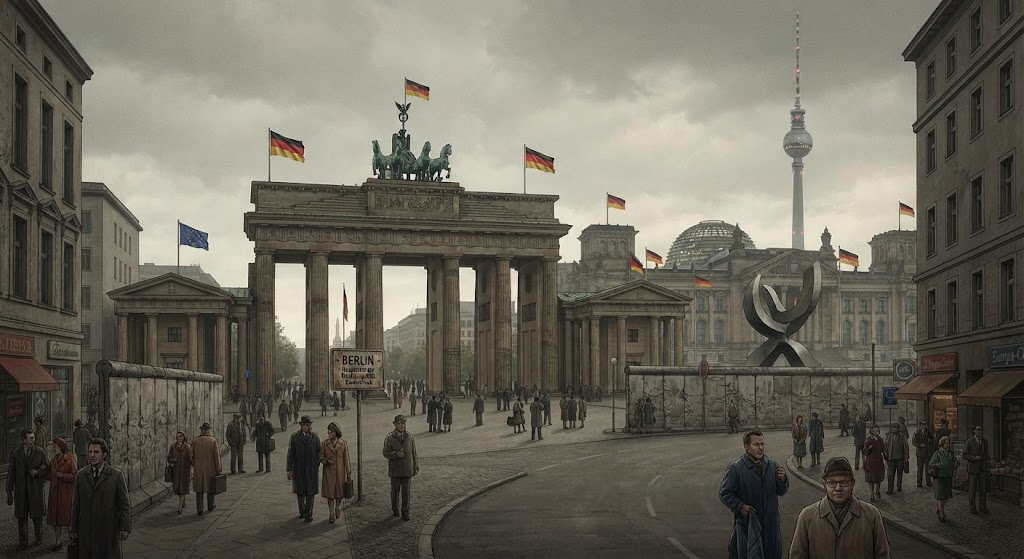


The historic 44.5% victory of the Alternative for Germany (AfD) party in the Saxony-Anhalt state parliament elections has not only created a structural earthquake in German domestic politics but has also deeply activated the fault lines of the global system.
This rise, which completely dismantles the “security wall” built after World War II to keep far-right movements outside the system, is not a singular German anomaly. On the contrary, this development, when combined with the populist wave across the European Union (EU), Japan’s revisionist nationalism in the Pacific, and the erosion of the transatlantic security architecture, points to macro-political dynamics that will fundamentally transform the institutional future of Western civilization, NATO’s operational capability, and the global hegemonic struggle between the United States and China.
The historical cycle of rising fascism during the interwar period, which ultimately resulted in Europe losing its leadership entirely to the United States and the construction of a bipolar world order dominated by the U.S. and the USSR, is now evolving into a much more complex phase. Indeed, today’s global architecture does not resemble a static bipolar structure, but rather presents a deep fracture point that we can conceptualize as “Post-Liberal Polycentrism,” where actors continuously shift ideologically and geopolitically, each power strives to maximize its own regional sphere of influence, and the rules have become ambiguous.
In this context, AfD’s victory confirms the failure of the West’s mechanisms for producing consent, and it suggests that in the upcoming period, the liberal institutions will be completely paralyzed with the participation of peripheral countries in Europe to this movement, and the Western alliance will regress from being a common bloc to a defensive tribalism.
This analysis, starting from AfD’s victory, primarily examines the diverging and overlapping lines between classical fascism and post-modern far-right, the dissolution of West-centric globalization, the structural dilemmas in Washington’s control mechanisms, the military stalemates emerging within NATO, and the asymmetric geopolitical opportunities presented by the rising far-right to the China-Russia axis.
Diverging and Overlapping Lines: Classical Fascism and Post-Modern Far Right
Correctly interpreting the fundamental characteristics that distinguish the AfD and its counterparts in Europe from the Nazi or Fascist movements before World War II, and those that overlap with them, is the most strategic key to understanding the emerging new order.
In the historical context, classical fascism was built on the ideals of expansionist imperialism, physical territorial occupation, an autarkic war economy, and the complete abolition of the parliamentary system; whereas today’s post-modern far-right movements structurally advocate for isolationism, the strict closure of borders, “remigration” policies that involve sending immigrants back, and national market protectionism against globalization. At the institutional level, instead of destroying the system from the outside, they aim to use parliamentary legitimacy and elections as a lever of legitimacy to transform liberal democratic institutions from within.
However, the desire for cultural homogeneity, xenophobia, the cult of strong leaders, and the “historical victimization” narratives that mobilize the masses in both periods perfectly overlap. This situation arises not from a dogmatic and linear return of fascism, but from the failure of liberal democracy to fulfilll its structural promises, resulting in a post-modern variant of fascism mutated by the dynamics of the social media age.
While “classical fascism” aims to expand geographical borders, it is noteworthy that today’s “post-modern right” is erecting “digital and cultural walls.” In the future, these movements seem to have the potential to create “micro-totalitarian” ghettos through cyber sovereignty and biopolitical data control, sabotaging global supply chains on a micro scale instead of physical wars. In this context, while classical fascism dragged the world into a total war between totalitarian blocs, today’s far-right is hollowing out liberal institutions, condemning the system to chaotic uncertainty, and eliminating the predictability of international law.
Washington’s Dilemma: Instrument or Nightmare of the Far Right in the USA?
The United States’ approach to the far-right in Europe and structures like the AfD reflects a deep structural and ideological rift within the American establishment, namely the power struggle between “Transatlanticists” and “Isolationists.” Some neoconservative and geopolitical cliques in Washington view the rising nationalism in Europe as a useful instrument to curb the EU’s aspirations for “strategic autonomy” and its own army, and to maintain a more easily manipulable transatlantic alliance by fragmenting the continent on a nation-state basis.
In an evaluation conducted within this framework, it is very clear that the energy crisis triggered by the Russia-Ukraine war, inflationary pressures, and the new wave of migration have opened up a tremendous political space for the far-right, and the United States is definitely aware of this situation. Indeed, it does not go unnoticed that this controlled crisis and chaos environment has made Europe entirely dependent on Washington both economically and militarily.
On the other hand, the most significant structural obstacle to this geopolitical engineering is the paradoxical and unpredictable foreign policy approaches of parties like the AfD. Indeed, these parties, which evoke concerns about Nazism and fascism, surprisingly advocate for rapprochement with Russia, the reopening of the Nord Stream pipelines, and the complete cessation of military and financial support to Ukraine, contrary to the historical background. Therefore, while Washington hopes for a controllable chaos, it may end up in a situation akin to “the sorcerer’s apprentice.”
Therefore, the U.S. instrumentalization of the far-right could lead to waves of civil disobedience that paralyze the Pentagon’s military logistics networks in Europe, potentially undermining the transatlantic security architecture. Ultimately, while the U.S. seeks to control Europe along its axis through the far-right and encircle Russia, it may face a boomerang effect due to the organic, financial, and intelligence ties these parties have established with the Kremlin. The anti-Russian nationalism envisioned by Washington may give way to “Eurasian right-wing populism” in Europe, which rejects American hegemony.
NATO in the Grip of the Far Right: Military Stalemate and Internal Cracks
The rise of the far right in Europe has a directly paralyzing potential impact on NATO’s collective defense doctrine and military operational capability. The cornerstone of the Alliance, Article 5 (Collective Defense), is based on the unwavering political will of the member countries. However, in an Europe where sovereignty-oriented and pro-Russian structures like the AfD are in power or are decisive, military deployments, budget allocations, and the unanimity mechanism required in times of crisis may face a strategic deadlock. Indeed, the isolationist tendencies of the populist right are undermining intra-alliance trust by cutting off logistical support for multinational military missions and minimizing intelligence sharing. This situation risks transforming NATO from a military deterrent force into a cumbersome diplomatic forum struggling with internal structural cracks and losing its decision-making speed against hybrid threats. The far-right acts as a “Trojan horse” that weakens NATO’s operational muscles from within.
Germany’s Geopolitical Suicide
The ultimate ideological and political goal of the AfD, “Dexit,” meaning Germany’s exit from the European Union and a return to the Westphalian-style rigid nation-state model across the continent, definitively marks the end of Germany’s claims to be a global power from a geopolitical perspective. Federal Germany had indirectly regained the global leadership status it lost militarily after World War II by using the EU as an institutional, economic, and political instrument, a kind of soft hegemony multiplier. Therefore, for Berlin, which determines the economic norms of the entire continent through Brussels and breaks export records thanks to the common market, the EU is almost the face of German geopolitical power that produces consent.
The disintegration of the EU or its dysfunction due to the influence of the far-right would strip Germany of its status as a global actor, transforming it into a fragile piece of Central European land, caught between the moves of massive global superpowers, namely the USA and China, and losing its geopolitical depth and market hinterland. In this context, Germany becomes a victim of its own sovereignty myth.
When the EU dissolves, Berlin will no longer be a subject at the global table but will become an object in the industrial hinterland sharing war between the US and China. This possible process undoubtedly has the potential to drag the rest of Europe into a deep whirlpool of “Balkanization.” This possible situation is definitely against the current Berlin elites and German industrial capital. Therefore, the AfD’s rhetoric of a return to national sovereignty actually means Germany would be destroying the global sphere of influence it has built with its own hands and voting for its own geopolitical suicide.
China’s Hidden Gain and the “Dragon-Bear Alliance”
The rise of the far-right in Europe and its paralysis of institutional structures directly and asymmetrically benefits China in the global hegemonic struggle. The Beijing administration is watching with great geopolitical interest as the AfD and similar Eurosceptic parties weaken the EU from within, create deep structural cracks in the transatlantic alliance, and prevent the West from developing a unified economic and technological embargo strategy against China.
Indeed, in evaluations conducted within this framework, it is sometimes noted that Beijing does not see the European far-right as an “ideological ally” but rather as an “asymmetric lever” that will undermine the West from within. Indeed, according to this thought, the institutional fragmentation of the West would, for example, open new corridors within Europe that do not face resistance for China’s Belt and Road Initiative. In this context, it does not seem surprising that in the coming period, China will sign bilateral free trade agreements with far-right governments, rendering the transatlantic customs barriers completely meaningless.
The US, on the other hand, is making a fatal strategic mistake by hoping that the rising far-right in Europe will disturb Russia or pressure it regionally. On the contrary, the institutional instability triggered by the far right, the unpredictability of the West, and the possibility of cutting off support for Ukraine are pushing Russia more toward China’s economic, military, and technological arms with a desire to survive in the global system. The United States’ tolerance of the far-right wave in Europe or its belief that it can keep it under control further strengthens the “borderless” strategic partnership between Moscow and Beijing. Moreover, within the sociological base and intellectual leadership of the AfD, there is a hidden but profound sympathy for the narrative of a “multipolar world order” that China offers on a global scale, promising not to interfere in the internal affairs of nation-states, in opposition to US hegemony and the liberal norms imposed by the Anglo-Saxon world.
Conclusion: The New Coordinates of the “World Gone Awry”
Historically marked by the recent electoral victories of the AfD, this new post-liberal era presents us not with the static bipolar Cold War order of the post-1945 period, but with an unpredictable “Chaotic Multipolarity” architecture. The far-right is both the most dynamic trigger of this new international system under construction and the most concrete result of the collapse of the liberal world order.
Indeed, in the vast governance vacuum created by the socio-economic inequalities of globalization, uncontrolled mass migrations, and the disconnection of liberal elites from the people, the global system has literally “lost its screws,” opening up wide maneuvering spaces for revisionist powers.
This time, the historical picture seems unlikely to result in the absolute institutional and moral leadership of the United States, the global victory of liberal democracy, or the unshakable integrity of NATO, unlike the mid-twentieth century. The new world we are facing is a “neo-medieval” parochial order ruled not by global rules, but by “regional power barons.” The far-right, while paralyzing NATO and the West militarily and politically and accelerating their decline, is also clearing the last psychological barriers to the ultimate shift of global financial and technological power to the Asia-Pacific axis.
While Europe turns inward and fragments with micro-nationalism, and Japan tries to establish its own militarist and nationalist axis against the rising Chinese threat in the Pacific, the United States must engage in an existential internal struggle with its own far-right, populist, and isolationist faction, namely Trumpism and its derivatives.
While the Western world is decaying from within in the crisis of the liberal values it produced, the Eurasian Bloc, led by China and Russia, is rapidly filling the strategic voids that have emerged to write the new geopolitical and military rules of the post-liberal era. Ultimately, the far-right functions as the sharpest, most dangerous, and most foundational lever of the global decline, defensive weakness, and withdrawal phase initiated by Western civilization through its own hands and institutions.