
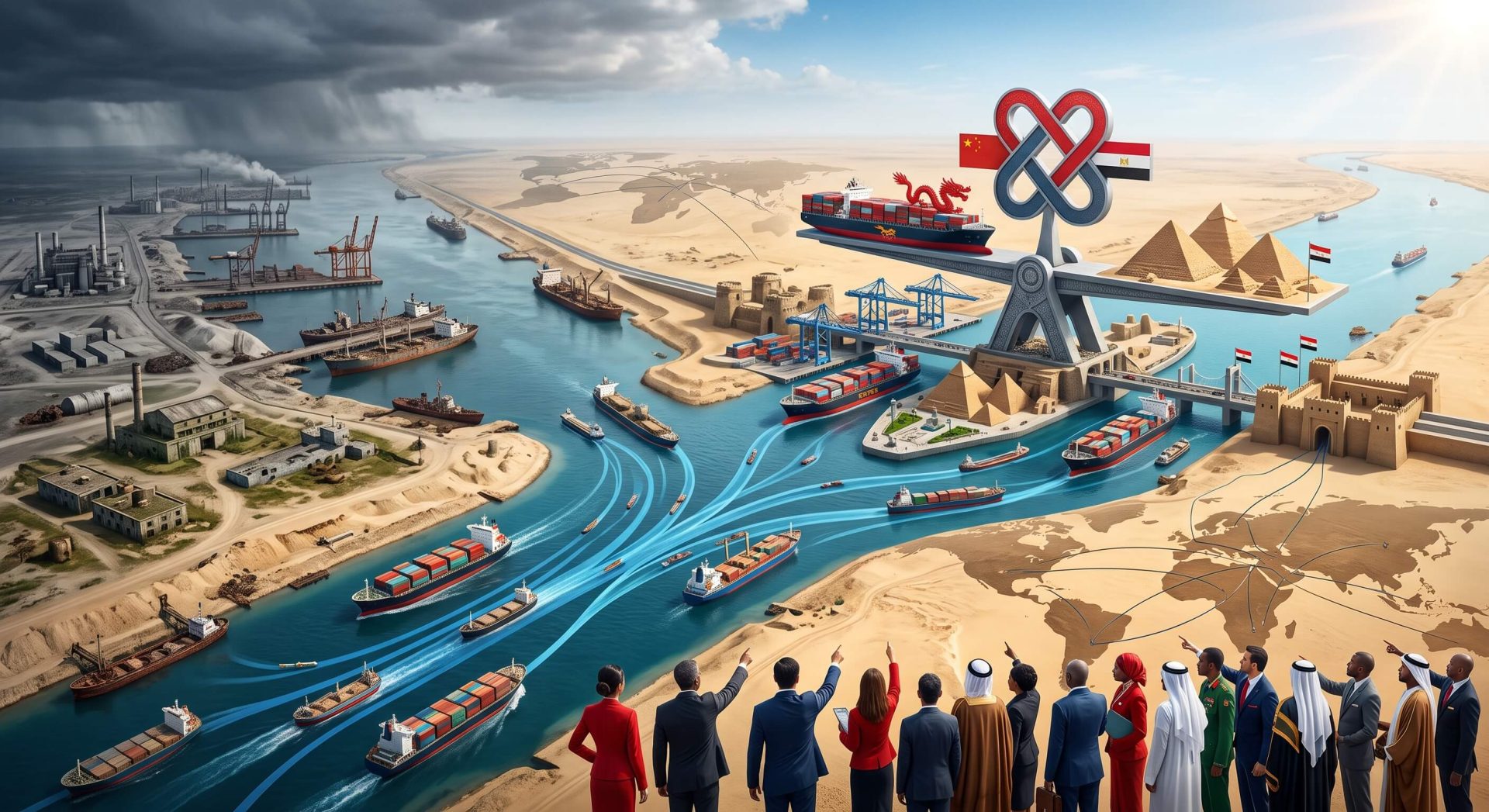


Chinese President Xi Jinping’s Cairo visit, carried out after a 10-year interval, coincided with a period of rupture in which global supply chains have been disrupted and military balances in the Middle East have been redistributed. In this phase, where the US–Israel axis appears to have pushed the region into the vortex of conventional warfare, Beijing seems to aim at reproducing its declining strategic influence through the “Suez Fortification”. Therefore, this move can be considered a strategy aimed at opening an alternative multipolar governance space against Washington’s unilateral security architecture.
Indeed, the diplomatic contacts in Cairo emerge not merely as a symbolic partnership but as an effort to build a new balance of power and an economic-technological bloc along the geopolitical belt extending from the Red Sea to the Mediterranean. Within this framework, while China positions Egypt as an indispensable strategic anchor in the Suez Canal, the lifeline of global trade, and as a gateway opening toward Africa; Egypt, at a time when it is also strengthening its relations with Ankara, seeks to balance great power competition in its favor through China and attempts to develop a multilayered “survival shield” against Western-centered hegemonic pressures by diversifying its military and financial dependencies.
Within this framework, the four-point proposal presented by Xi Jinping in Cairo conveys the message of “reducing dependence on external powers” and “strategic autonomy” to Middle Eastern countries. This proposal also represents the clearest evidence that the global system is evolving from unipolarity toward multipolarity and that a new process has begun in the construction of the “New Africa–Middle East Architecture”. Therefore, this visit should be regarded not only as a rapprochement between the two countries but also as a systemic, continental, and structural challenge aimed at fundamentally breaking the absolute monopoly of the West over global maritime trade, logistics routes, energy basins, and financial sanction mechanisms.
The Largest Laboratory of the “De-dollarization” Initiative in the Middle East and Africa
As partially addressed in my analysis titled “The Suez Exit and the Post-American Order: The Geopolitical Codes of Xi Jinping’s Egyptian Initiative” , the fact that the visit coincided immediately after China’s message of multipolarity to the non-Western world at the Shanghai Cooperation Organization (SCO) Summit is also highly noteworthy in this regard. Indeed, at a time when the United States is attempting to encircle energy corridors through sanctions, the Suez Canal, the lifeline of global trade, has become a vital “safe haven” for China.
In this context, the decisions emerging from Cairo are remarkable as they encompass fields that will directly shape the geoeconomy of the future, such as artificial intelligence, semiconductors, data centers, critical mineral supply chains, green hydrogen, and port logistics. Increasing Chinese investments in electric vehicle production, artificial intelligence, data centers, semiconductors, and cloud computing has been targeted. This situation integrates Egypt into the Chinese corridor against the risks of technological embargoes imposed by the West. Within this framework, one of the most striking steps taken has been the launch of the third phase of the TEDA China–Egypt Industrial Zone in the Suez Canal Economic Zone.
The decision to expand the use of local currencies (Yuan and Egyptian Pound) and Panda bonds in trade emerges as a concrete step taken “against dollarization” in the global financial system; while China’s commitment to technology transfer is transforming Egypt into the region’s new production hub. In other words, China is establishing the largest laboratory of the “de-dollarization” initiative in the Middle East and Africa through increasing the use of local currencies (Yuan and Egyptian Pound) in trade and investments and expanding the volume of currency swap agreements.
Geo-military Integration, Security Umbrella and Surrounding Crises
The geopolitical motivations of the parties, the comprehensive strategic partnership declaration signed, and the reactions of regional actors toward this move are laying the first concrete foundations of the “Multipolar Regional Ownership” doctrine that will replace the dissolution of the Pax Americana era along the Middle East and North Africa (MENA) axis. Within this framework, the China–Egypt strategic partnership is moving beyond economic boundaries and entering the phase of “Geo-military Integration”. The joint air exercise “Eagles of Civilization” conducted between the two countries and Cairo’s procurement initiatives for Chinese-made J-10C and J-31 stealth fighter aircraft demonstrate Egypt’s search for breaking its military dependency on the United States. While China is consolidating a military presence in the Mediterranean and the Red Sea through Egypt, it has the potential to become directly involved in the Horn of Africa and Libya crises by using Cairo as a launching pad.
Beijing is surrounding the Ethiopia–US axis through its support for Egypt’s water rights regarding the Nile River; while in Libya, it gains geopolitical veto power over energy and port projects in the Eastern Mediterranean through the logistical connections it has established with Egypt-supported actors. Xi Jinping’s call from Cairo that “Regional countries should be the masters of their own destiny, and external interventions and coercion should be rejected” can be regarded as a direct response to Washington’s efforts to militarily design the region.
Is the Process Reversing in Africa? China’s New Security Anchor
The security risks created by the instability rising across Africa in recent years, the chain of coups, and the anti-Western wave appear to have challenged China’s doctrine of “only making economic investments”. Chinese analysts have recognized that economic influence must be supported by military capacity in order to protect investments in Africa. Within this framework, from China’s perspective, the emergence of a stable “major partner” with institutional strength, a powerful military, and geostrategic weight appears inevitable in order to prevent the process in Africa from turning against Beijing. It appears that this partner is Egypt. Indeed, Xi’s initiative developed through Egypt constitutes the core of China’s strategy to secure its investments trapped in Africa through the gateway of North Africa.
Diplomatic Turbulence in the North African and Maghreb Balances
The China–Egypt strategic consolidation may create a new diplomatic turbulence in the balances of North Africa and the Maghreb (Algeria, Morocco, Tunisia) by expanding its sphere of influence westward. Indeed, while Beijing is transforming Cairo into the operational and logistical headquarters of its North Africa policy, it is marginalizing the traditional French and American influence in the region. This “geopolitical bridge” established between Algeria, with which China already maintains close military-strategic relations, and Egypt, constructs a multipolar resistance axis against the West along the Maghreb line. This situation is also pushing other Maghreb countries seeking to participate in BRICS processes toward the Beijing–Cairo center of attraction. Morocco, which seeks to balance its relations with the West, and Tunisia, which is experiencing a deep economic crisis, are closely observing the financial autonomy achieved by Egypt through Chinese technology and Panda bonds. Ultimately, this alliance offers Maghreb states an alternative diplomatic leverage against the political conditions imposed by the European Union and Washington and carries the potential to detach North Africa from the transatlantic alliance.
The financial engine behind these geo-military and logistical moves is constituted by Egypt’s BRICS and SCO processes. Egypt’s BRICS membership and SCO “Dialogue Partner” status free the financing of technology, port, and infrastructure agreements signed with China from the Western-centered IMF/World Bank constraints. Chinese capital to be directed to the Suez Canal Economic Zone through the New Development Bank (NDB), together with Panda bonds, functions as a financial shield against Egypt’s deep debt crisis. Trade in local currencies and BRICS’ digital payment systems neutralize Washington’s sanction threats over SWIFT and the dollar. As a result, BRICS and the SCO are transforming the China–Egypt alliance into a “Multipolar Fortification” established against the military, geoeconomic, and financial hegemony of the United States across the Middle East and the Eastern Mediterranean. The phrase “Once you drink from the Nile, you are destined to return”, emerges here as a rhetoric reinforcing this financial and political shield.
Red Sea Sovereignty, Nuclear Vision, and the IMF Constraint
One of the most critical strategic outcomes of the visit is the joint declaration by the leaders stating that sovereign rights in the Red Sea belong exclusively to the littoral states. This statement is considered an explicit geopolitical challenge against the presence of the United States and international naval task forces along the Bab el-Mandeb route. Beyond this, it is also observed that the security consolidation has been extended to the energy front. Within this framework, moving beyond Russia’s El-Dabaa project, China’s conducting advanced negotiations to implement next-generation nuclear power plant projects in Egypt is also highly noteworthy.
Undoubtedly, Beijing’s nuclear technology initiative links Egypt’s long-term energy supply security to the Chinese ecosystem. However, these moves appear to have already triggered alarm bells in Washington. Indeed, the United States is preparing to use the IMF loan leverage and the expanded $8 billion package against Egypt as a financial pressure mechanism in order to break the Beijing–Cairo axis. Within this framework, the White House may use its voting power on the IMF Executive Board and conditions related to exchange rate flexibility as leverage, making the cancellation of China’s nuclear and 5G infrastructure projects a prerequisite for the release of loan tranches.
Maritime Logistics, Port Concessions, and Mediterranean Trade Wars
The most striking geoeconomic dimension of China’s presence in Egypt is the maritime logistics investments concentrated at the entry and exit points of the Suez Canal. Chinese maritime giants COSCO and Hutchison Ports hold major terminal operating concessions at the ports of Port Said, Alexandria, and Ain Sokhna. This situation directly reflects a rupture in the “trade wars” and the struggle for logistical superiority in the Mediterranean. Through this integration between Piraeus (Greece), the Haifa Bay Terminal (Israel), and Suez ports, Beijing controls the main logistical backbone of the Mediterranean. This situation renders alternative routes such as the India–Middle East–Europe Economic Corridor (IMEC), supported by the United States, ineffective before they can fully emerge. The expansion of COSCO’s container terminals in Suez grants China a “logistical customs gateway and quota” power over the flow of goods toward Europe. In the event of a potential global crisis or escalation of trade wars, China gains the potential to create supply chain shocks against Western competitors by giving operational priority at these ports to its own vessels; in other words, it acquires a form of geoeconomic weapon power.
Logistical Hegemony and Asymmetric Maritime Scenarios
This overwhelming port consolidation by China in Suez creates destructive commercial competitive pressure on major ports such as Marseille, Genoa, and Trieste, which serve as the southern gateways of the European Union (EU). By monopolizing Mediterranean logistics, Beijing gains the ability to directly manipulate the speed, cost, and customs clearance processes of cargo flows extending into Europe. Smart automation systems built with Chinese technology in Egyptian ports are causing European ports to fall behind in terms of efficiency, thereby surrounding continental Europe geoeconomically. In response, the United States plans to implement an asymmetric “counter-corridor and new security pact” scenario in order to bypass the China–Egypt axis. Within this framework, Washington is pushing for the construction of an alternative maritime and land logistics route centered around the Gulf of Aqaba, involving Saudi Arabia, Jordan, and Israel. This new pact, which could be designed under the name “Red Sea Security Consortium,” aims to impose hybrid restrictions, security inspections, and artificial navigation limitations against Chinese vessels by keeping routes leading to the Suez Canal under military control. This situation could transform the Red Sea from a secure passage route of global trade into a geopolitical powder keg ready to explode at any moment between two blocs.
Energy Geopolitics in the Eastern Mediterranean and the “Construction of a New Axis”
The China–Egypt partnership may directly affect the fragile energy geopolitics of the Eastern Mediterranean, leading to a redistribution of the cards in the context of Egypt, Libya, Syria, Greece–Greek Cypriot Administration of Southern Cyprus (GASC), Israel, and Türkiye. Beijing’s provision of financial protection for Egypt’s LNG terminals and offshore exploration blocks reduces Cairo’s dependence on the Western-oriented Eastern Mediterranean Gas Forum (EMGF). Because China maintains a distance from the maximalist Exclusive Economic Zone (EEZ) claims established by Greece and the GASC in the Eastern Mediterranean, it seeks a more balanced ground in order to secure its own investments. This situation weakens the strategy of the Israel–Greece–GASC trio to keep Egypt within an anti-Türkiye bloc against Türkiye.At this point, Beijing’s recognition of Türkiye’s geopolitical weight in the region and its critical role in raw material corridors not only disrupts the regional game but also points toward a significantly different future regarding the process initiated within the context of Egypt and the construction of a new axis.
The Anti-China Bloc’s Interpretation of the Process and Possible Reactions
As I partially addressed in my analysis titled “The Suez Exit and the Post-American Order: The Geopolitical Codes of Xi Jinping’s Egyptian Initiative”, the United States, as one of Cairo’s largest military donors, is seriously disturbed by Egypt’s strategic/military rapprochement with China, particularly regarding data centers and semiconductor agreements. Despite the $1.3 billion in military assistance it provides to Egypt annually, the United States, which views Cairo’s deepening military and technological cooperation with China as a “breach of loyalty,” interprets this development as China’s attempt to establish an alternative “Security Architecture” in the Middle East.
Israel, meanwhile, interprets China’s proposal for a new “regional security architecture” along the Suez, Red Sea, and Bab el-Mandeb routes as an encirclement move against Tel Aviv’s operations in the Gaza and Lebanon fronts. In this context, Israel is concerned that the China–Egypt alliance could create a logistical and military shield capable of breaking its regional isolation policy. It is likely that Washington will use military assistance to Egypt as an instrument of pressure in the coming period.
India, on the other hand, evaluates China’s consolidation in the Arabian Sea and the Red Sea within the framework of a “containment policy.” Within this context, New Delhi may attempt to balance China’s weight in Suez by strengthening its bilateral trade relations with Egypt (through efforts to revive the IMEC Corridor). Japan and Australia, concerned that maritime trade routes may come under China’s unilateral control, may demand an increase in patrols conducted by Western coalitions in the region.
For the European Union, Egypt is a critical partner both for migration control and Mediterranean security. The EU considers the domination of Egypt’s industrial infrastructure by Chinese technology as an economic threat. In this context, the EU finds itself caught between opening new financial packages for Cairo and balancing China in order to prevent Egypt, upon which it depends for the security of migration and energy corridors, from completely shifting under Chinese hegemony.
The United Kingdom, due to the historical importance of the Suez Canal, closely monitors China’s military/logistical presence there and may attempt to reduce dependency by offering alternative financing models to Egypt.
Egypt’s Message to the West
Although Egypt’s ability to convince or completely subdue the United States and Israel is limited, it is evident that, thanks to the China card, Cairo has strengthened its hand at the negotiating table with Washington more than ever before. Egypt has raised its leverage at the table by sending Washington the message: “You may lose us completely; therefore, you must reduce economic and military pressure”. More concretely, through nuclear cooperation, strategic port concessions consolidated by COSCO and Hutchison, and its declarations regarding Red Sea sovereignty, Cairo has conveyed the following message to the Western world, particularly the United States: “If you financially collapse me or exclude me militarily, I will integrate the keys to the Suez Canal, control of the Red Sea, Mediterranean logistics networks, energy gateways in the Eastern Mediterranean, diplomatic influence channels in the Maghreb, and critical digital infrastructure with Beijing”.
In this context, in response to Washington’s possible punitive moves in the coming period, such as delaying IMF loans, imposing alternative maritime corridors centered on Aqaba, and suspending military assistance, a scenario of a “Financial, Energy, and Logistics War” appears inevitable, in which Beijing provides direct currency and debt swap support through BRICS mechanisms and the New Development Bank. This situation will transform Egypt into one of the pioneers of the global de-dollarization wave, while also escalating asymmetric commercial pressure on EU ports, destabilizing North African balances, and bypassing traditional energy routes in the Eastern Mediterranean. Because the J-31 aircraft tender, potential Chinese nuclear reactors, and Beijing’s monopoly over Mediterranean ports have permanently breached the traditional American security umbrella in the region. Developments appear likely to lead Washington to implement more aggressive hybrid pressure tools against Cairo. On the other hand, it is evident that this asymmetric shield established by Cairo with China will weaken the West’s ability to impose unilateral sanctions, enforce alliances in the Eastern Mediterranean, manage the Maghreb, and dictate routes.
The Mecca Pact Detail and Egypt’s Persuasion Diplomacy
The greatest geopolitical development recently experienced in the region is undoubtedly the Mecca Joint Defense Agreement (Mecca Pact), signed between Türkiye, Pakistan, and Saudi Arabia, which includes NATO Article 5-like provisions stating that an attack against one member shall be considered an attack against all. Although Egypt maintains an institutional distance from this military axis, it continues to keep its relations with Ankara and Riyadh, the founding actors of the pact, at the highest level.
The fundamental motivation behind Egypt’s opening its doors to China to such a significant extent while maintaining distance from clear military commitments such as the “Mecca Pact” emerges as the pursuit of “Strategic Diversification and Economic Survival”; in other words, it manifests itself as Egypt’s effort to preserve its “strategic autonomy” against the pressure of regional bloc formation created by the Mecca Pact. Cairo does not want to fully enter into the military commitments of the Mecca Pact, nor does it want to completely surrender to the regional design strategies of the US–Israel duo. For Egypt, China serves as a perfect third path and “strategic leverage” between these two major centers of pressure, facilitating Cairo’s pragmatism.
Undoubtedly, Egypt does not want to directly confront the United States and Israel; however, it is also a fact that, in the face of the debt crisis, inflation, and the threat to the Nile, Cairo has not found the unconditional financial and political support it seeks from the West. In contrast, Beijing offers Egypt immediate financial resources, infrastructure investments, and technology transfer. Indeed, this historic visit appears to have provided the Sisi administration in Egypt with a critical lifeline in the face of the deepening economic crisis and the opportunity to continue major infrastructure projects without interruption. In foreign policy, Cairo appears to have, at least for the time being, gained the opportunity for “Strengthened Autonomy” by using the China axis as a structural leverage while maintaining its ties with the West without completely severing them.
Conclusion
Xi Jinping’s visit to Cairo has entered history as a theoretical rupture demonstrating that nothing in the Middle East will remain as it was before. The alternative presented by China — “You no longer have to choose only the United States” — is encouraging regional states to free themselves from the tutelage of external powers and become the masters of their own destinies. Within this context, the Middle East, the Eastern Mediterranean, and the Maghreb basin are now transforming into a new Egypt-centered, multilayered, and bipolar “Cold War theater” where the hard power elements of the United States and China’s nuclear, technological, logistical, and geoeconomic networks collide.
In this process, Cairo is once again positioning itself as a first-class diplomatic actor in the region by combining the “Mecca Pact” established by the Ankara–Riyadh–Islamabad trio with the global protection umbrella offered by Beijing. On the other hand, the inevitable consequences that may arise from each step Egypt takes while walking a tightrope in this dangerous balance should not be ignored, as these steps may lead to the redrawing of global trade routes, Mediterranean logistics and energy maps, North African alliance structures, and military boundaries in the Horn of Africa. Within this framework, in the short term, the integration of port transit processes over the Suez Canal into the digital yuan infrastructure, the alignment of North African regimes with Beijing, and the possibility of the United States playing its counter-military corridor card in the Red Sea appear likely to deepen the global geopolitical rupture irreversibly.
In conclusion, Xi Jinping’s visit to Egypt has been engraved in memory as a historic manifesto in which the shift of the global center of gravity from West to East was registered in the waters of the Nile. The old colonial/hegemonic assumptions are no longer valid for either Washington or Brussels. This new architecture centered on Suez has become the actual lifeline of the multipolar world order.