

The historic state visit of Azerbaijani President Ilham Aliyev to Tashkent and the “Eternal Friendship Agreement” signed with Uzbek President Shavkat Mirziyoyev represent a historic turning point reshaping the geopolitical map of the Turkic world. This visit has not only strengthened the ties between the two states but has also transformed the Ankara–Baku–Tashkent geopolitical axis into the unshakable backbone of the Turkic world in terms of its foundation, framework, and potential outcomes.
The aforementioned visit and the signed agreement have declared to the entire world that Uzbekistan, entering the 35th anniversary of its independence under the visionary leadership of President Shavkat Mirziyoyev, has become not only a strategic actor in Central Asia but also a geopolitical game-changer across a vast geography encompassing the Caucasus as well.
In this critical period of rapidly changing global power balances, this unshakable bond established between Tashkent and Baku has disrupted the conventional assumptions of regional actors and has become the most tangible guarantee of stability, prosperity, and independent agency across the Eurasian geography. This alliance completely erases the remnants of the colonial past and heralds the rise of a fully indigenous, national, and Turkic-centered geopolitical architecture. Especially with the logistical revolution of the Zangezur Corridor, fiber-optic data highways extending beneath the Caspian Sea, and technological nuclear and mining partnerships reinforcing this new order through concrete projects and initiatives, the vision put forward by the two leaders will undoubtedly shift the center of gravity of the global system toward the heart of Asia.
In this context, the Caspian Sea fiber-optic transit project is creating a shift in the axis of global data traffic by building the digital Silk Road of the Turkic world. This independent internet infrastructure established between Baku and Tashkent reduces dependence on foreign servers and safeguards digital sovereignty, while creating a common shield in cybersecurity and transforming the region into a central hub between the West and the East in terms of data transmission.
“Unity in Language, Thought, Action, and Heart”
The summit held in Tashkent witnessed historic moments that went far beyond conventional diplomatic patterns. The hosting of President Ilham Aliyev with an extraordinary ceremony at the highest level represented the sealing of the unshakable affection between the two peoples with the seriousness of state protocol. Within this framework, the fact that leaders, delegations, and ministers communicated in their own native language, namely Turkish, without the need for interpreters, was not merely a symbolic demonstration; it was the confirmation that the centuries-old walls of separation had been dismantled and that unity of hearts and ideas had become the official language of relations. This linguistic integration conveyed the strongest possible message to global centers of power: “We are a single civilization with shared roots and a common future.” These high-level negotiations conducted without interpreters represent a historic milestone in demonstrating that Turkic states have completely overcome the bureaucratic and psychological barriers among themselves. This linguistic revolution, closely followed with admiration and attention by both Western and Eastern blocs, has been recorded as a direct reflection of a common strategic mind and linguistic unity within institutional diplomacy..
The Expanded Caspian Basin: Uzbekistan Is Now a Tangible Part of the Caspian
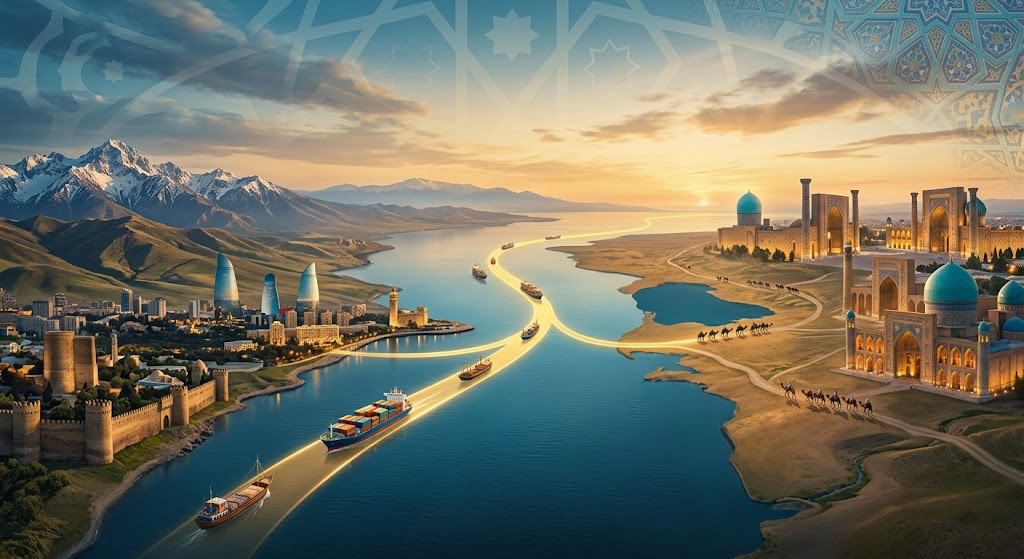
The most striking geostrategic outcome of this historic agreement is that Uzbekistan has moved beyond the boundaries of its foreign policy vision and become anchored to the Caspian littoral. With the signed agreement, Uzbekistan has now become a tangible, integral, and active part of the Caspian Basin. Although Uzbekistan is geographically a landlocked country, President Mirziyoyev’s diplomacy has enabled it to fully open its gateways to the Caucasus and Europe through Baku. The concept of the “Expanded Caspian Basin” is being redefined through Tashkent’s strategic weight. This development has elevated the security, sustainability, and attractiveness of the Middle Corridor, the main artery of global logistics, to the highest level through a single strategic move. The Caspian Sea is no longer only within the sphere of influence of the littoral states; it has also become part of the active logistical and strategic domain of Uzbekistan, the heart of Central Asia. This initiative by President Mirziyoyev represents the outcome of a visionary foreign policy strategy that has liberated Uzbekistan from geographical constraints and indirectly integrated the country into global maritime trade routes.
The opening of the Zangezur Corridor will undoubtedly shorten transit times significantly by directly connecting Uzbekistan’s Caucasus logistics network with the Mediterranean and Europe. This historic milestone, which removes bottlenecks along the route, will exponentially increase the annual freight capacity of the Middle Corridor while transforming Tashkent into one of the most dynamic commercial actors of the Caspian–Caucasus corridor.
The Ankara–Baku–Tashkent Axis: The Geopolitical Backbone of the Turkic World
The agreement has clarified the central hub of the geopolitical and geoeconomic axis of the Turkic world. Beginning in Ankara, where Türkiye represents the western end, extending through Baku, which serves as the strategic bridge, and reaching Tashkent through the Caspian crossing, where Uzbekistan represents the heart of this structure, this geopolitical axis constitutes the main supporting pillar of both the Organization of Turkic States and the Middle Corridor. At the geopolitical level, an independent security belt has been established that generates stability between the West and the East and remains completely closed to external interventions. At the geoeconomic level, the vast production capacity, underground resources, and dynamic markets on both shores of the Caspian Sea are being transformed into a single integrated economic ecosystem. From a geostrategic perspective, this agreement has become the greatest source of motivation for the Organization of Turkic States by accelerating institutional integration and enabling the organization to transform into a global center of power. This backbone corridor strengthens the will of regional countries to determine their own destinies by narrowing the sphere of influence of global powers seeking to create instability at the center of Eurasia.
Political and Diplomatic Aspect: Mirziyoyev’s Caucasus Achievement
President of Uzbekistan Shavkat Mirziyoyev is ushering in what can be described as a golden era for Uzbek diplomacy on the 35th anniversary of independence through his active and balanced foreign policy. This agreement has demonstrated that Mirziyoyev’s visionary leadership has found full resonance not only at the Central Asian level but also within the Caucasus equation. President Aliyev’s aspiration to extend the alliance architecture established after the Karabakh Victory toward Central Asia has achieved full compatibility with Mirziyoyev’s vision. At a time when regional powers are engaged in competition for influence, the two leaders have created an unshakable diplomatic shield by committing that they will not allow third countries to threaten each other’s security by using their territories. Through this initiative, Uzbek diplomacy has demonstrated to the world that it is not merely a regional actor, but has also achieved decisive influence in crisis and alliance processes beyond its borders. This balanced and powerful diplomatic bridge established by Mirziyoyev in the Caucasus has elevated Uzbekistan to the level of global actorhood it deserves in the international arena.
At the next summit of the Organization of Turkic States (OTS), this agreement will accelerate the integration of bilateral alliances among member states into multilateral institutional structures. This strategic model established by Tashkent and Baku will strengthen decision-making mechanisms within the OTS, lay the groundwork for common budgetary and secretariat reforms, and increase the organization’s institutional weight in global geopolitics, transforming it into an operational power.
Economic, Commercial, and Investment Dimension: The Grand $1 Billion Target
Political trust is transforming into a remarkable process of economic integration. The two countries have firmly approved a strategic program aimed at increasing bilateral trade volume to one billion dollars in the near term. In line with this objective, the Azerbaijan–Uzbekistan Investment Company, with a capital base of five hundred million dollars, is financing major projects in the fields of energy, chemicals, mining, and agriculture. As the most concrete step of financial expansion, the initiative by Azerbaijan’s state-owned bank ABB to acquire a 51 percent stake in Uzbekistan’s Davr Bank demonstrates that the financial markets of the two countries have officially begun to integrate. In the field of production and industry, Uzbekistan’s extensive experience in the automotive sector is being transferred to the Caucasus through joint factories established in Azerbaijan’s Hajigabul region. In return, Azerbaijan is entering Uzbekistan’s tourism sector with a substantial investment package worth five billion dollars. These mutual investments not only reinforce the economic independence of the two countries but also create an unshakable economic shield against global economic fluctuations.
Energy cooperation between the two countries has gained a strategic dimension through the Green Energy Corridor project, which aims to transport Central Asia’s renewable electricity to Europe via Azerbaijan through subsea cables to be laid beneath the Caspian Sea. SOCAR’s entry into the Uzbek retail and hydrocarbon market, along with joint green energy investments, is positioning the two states at the center of global energy transformation and supply security.
The Azerbaijan–Uzbekistan Joint Investment Fund is enabling a strategic leap forward by focusing on next-generation nuclear technologies, lithium battery production, and the processing of rare earth elements. The financing of these high-technology mineral projects by the joint fund is making the two countries indispensable actors in global semiconductor and battery supply chains while establishing a strategic economic influence capable of challenging monopolistic structures.
Technological, Educational, and Socio-Cultural Aspect: Investing in the Future
The two leaders are taking joint steps in technology and education in order to embed eternal friendship into the minds of younger generations. Within the scope of the visit, the establishment of two new STEAM schools in Uzbekistan equipped with modern educational standards was agreed upon. Furthermore, joint research and development activities have been initiated in the fields of information, communication, and space technologies. The institutionalization of social prospects and cultural ties is transforming the two peoples from a definition of fraternal relations into a shared vision of the future. These technological bridges will enable the Turkic world to stand out in global competition not only through its underground resources but also through its young minds capable of producing high technology. This visionary cooperation in the field of education is laying the foundation for a common scientific ecosystem.
Future Prospects and Strategic Projections
While Uzbekistan currently stands as the rising diplomatic star of Central Asia, it is expected to become one of the main architects of Caucasus and Central Asian integration in the future under the leadership of President Mirziyoyev. In terms of geoeconomic power, alongside rapid growth in trade, Uzbekistan is expected to transform into a common global actor under the “Made in Turan” brand in international markets. From the perspective of logistics and corridors, Uzbekistan, which is currently a critical transit country of the Middle Corridor, will rise in the future as a central hub fully integrated with the Caspian Basin and capable of directly shaping transportation routes between East and West.
These unwavering projections demonstrate that the multidimensional cooperation between the two states today possesses the potential to rewrite global balances in the multipolar world of tomorrow.
In the near future, a joint digital data hub and an integrated cybersecurity umbrella to be developed through the Ankara–Baku–Tashkent axis will elevate the Turkic states to the highest level of technological independence. Furthermore, smart logistics centers connecting the two shores of the Caspian Sea and customs union integrations will completely eliminate bureaucratic barriers, enabling the flow of global financial capital into the region. President Mirziyoyev’s long-term development vision and foreign policy doctrine will transform Uzbekistan into not only Eurasia’s transportation hub but also a center of finance, industry, and artificial intelligence-based production. This development will permanently narrow the sphere of influence of global monopolies and hegemonic powers seeking to expand their influence in the region, transforming the Turkic world from a structure that generates consent in the global economy into an independent pole that sets the rules.
Conclusion
The signatures placed in Tashkent are not merely diplomatic aspirations remaining on paper. These signatures represent the Turkic imprint left upon the global system by Uzbekistan, rising under the prudent and powerful leadership of Shavkat Mirziyoyev, together with its brotherly nation Azerbaijan and President Ilham Aliyev. As the Ankara–Baku–Tashkent axis continues to be reinforced, the center of gravity of global politics will continue to shift toward the heart of Asia and the ancient cradles of the Turkic world.
Within this context, the “Eternal Friendship Agreement” has already taken its place in history as a “Doctrine” that not only enhances the prosperity of the two countries but also accelerates the re-emergence of the Organization of Turkic States as a global superpower on the stage of history.
This diplomatic victory, crowned on the 35th anniversary of Uzbekistan’s independence, stands as the most concrete and unwavering evidence that the future will be the century of the Turkic world.
The common will demonstrated by Tashkent and Baku has clearly and decisively declared to all global actors that Turkic states will occupy the position of an independent pole in the future multipolar world and will never remain mere spectators in their own geography. The Middle Corridor, strengthened by China’s commercial interest and the strategic investments of the West, together with the Zangezur passage and subsea Caspian fiber-optic networks, confirms that this axis has become an economically and technologically unbreakable fortress.
As demonstrated by our future projections and strategic assessments, this multidimensional deepening, extending from technological infrastructure to nuclear/lithium mining partnerships, from cybersecurity to data sovereignty provided by fiber-optic networks, will transform the Ankara–Baku–Tashkent axis into the most secure and resilient backbone of global geopolitics. The visionary path opened by both leaders will make Uzbekistan the locomotive of the Expanded Caspian Basin while eternally consolidating the unshakable unity of the Turkic world economically, militarily, and technologically. The strategic element production initiatives and digital independence efforts triggered by the joint investment fund are inscribing the Tashkent–Baku alliance in golden letters into history as one of the most powerful, prosperous, and sovereign alliance models of modern times at the heart of Eurasia.