

At the 35th anniversary of its independence gained in 1991, Uzbekistan has become a proactive actor reshaping Eurasian balances beyond merely being a geographical center. Leaving behind the static structure of the transition period, the country has undergone a transformation, particularly through the “New Uzbekistan Movement” that emerged under the leadership of President H.E. Shavkat Mirziyoyev over the past decade.
Within this profound transformation process, the “Comprehensive Strategic Partnership” established with Türkiye has become one of the most vital and steadfast foreign policy anchors accelerating Tashkent’s integration into the global system and its multidimensional international openings.
In this historic process, the vision put forward by President Mirziyoyev represents not a rhetorical political discourse, but rather a state approach based on rationality, solution-oriented policies, project-based initiatives, and concrete outcomes. Indeed, today Tashkent is not only a center where regional crises are addressed peacefully; with ancient cities such as Samarkand, Bukhara, and Khiva hosting modern diplomatic events, it is also becoming one of the emerging centers of gravity in global politics.
The intellectual foundation of this transformation is undoubtedly based on the “Third Renaissance” vision of New Uzbekistan under President Mirziyoyev, which combines the country’s historical depth with the technological and strategic dynamics of the modern world.
This new era reinforces the global actor ambitions of the civilization geography through practical steps, reaffirming Uzbekistan’s role as an indispensable and dynamic visionary leader of Eurasia on the global stage. This visionary breakthrough attributes a central, decisive, and strategic role of geopolitical leadership to Uzbekistan in the future multipolar world order by blending its rich historical heritage with modern institutional structures.
The Diplomacy of Borders: From Chronic Tensions to Regional Integration
Until recently, Central Asia was described in the literature as a “potential conflict region” due to border disputes, water-sharing crises, and ethnic tensions. Border lines were symbols of geopolitical vulnerabilities rather than cooperation. The greatest achievement of President Mirziyoyev’s diplomacy has been eliminating this critical and dangerous perception.
Immediately after taking office, President Mirziyoyev adopted the principles of “People First” and “Priority to Relations with Neighbors”; he resolved chronic border issues through constructive, principled, and mutually agreed negotiations.
This diplomatic initiative eliminated the risk of conflict escalation in the region and contributed to the establishment of the “Central Asia Leaders’ Consultative Meetings” mechanism.
Uzbekistan’s trust-based peace-building role has also become visible in the Afghanistan crisis. Tashkent has become a key mediator in delivering humanitarian assistance to the Afghan people and integrating Kabul into the regional economy. The transformation of borders from impassable barriers into economic corridors represents the clearest manifestation of President Mirziyoyev’s pragmatic and solution-oriented leadership approach.
The Multi-Vector Balance Policy and Tashkent’s Global Rise
New Uzbekistan pursues a “multi-vector foreign policy” based on a symmetrical balance of interests without aligning itself with any single power during a period when global power competition is intensifying. Maintaining relations with China, Russia, the United States, and the European Union (EU) on the basis of equal distance and mutual benefit, Tashkent has assumed the role of a founding actor of stability in Eurasia.
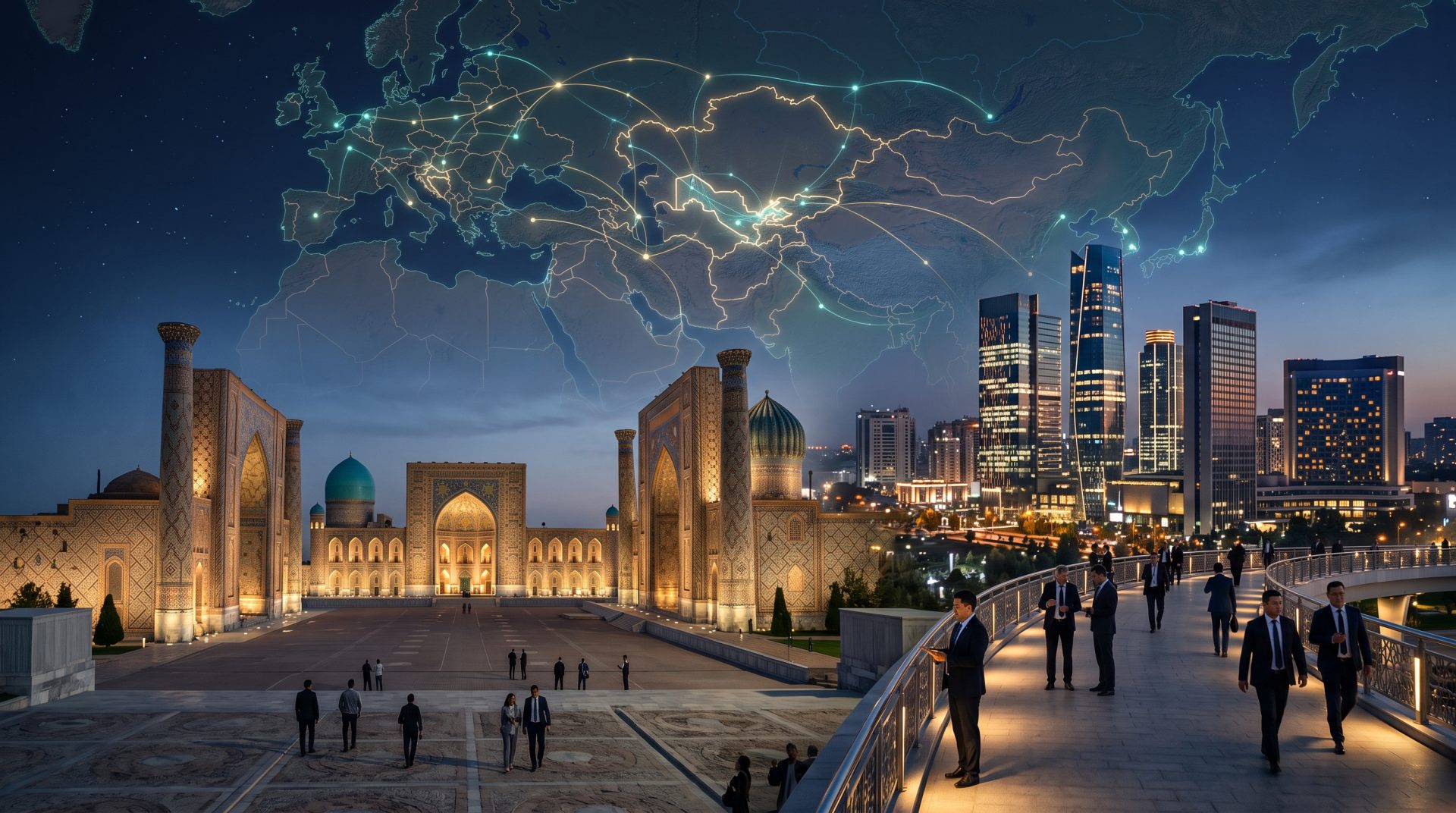
Within this framework, Tashkent has now become one of the world capitals frequently visited by global decision-makers and where international summits are organized. The ancient city of Samarkand has introduced the concept of the “Samarkand Spirit of Global Diplomacy” into international relations through summits of the Shanghai Cooperation Organisation (SCO), the Organization of Turkic States (OTS), UNESCO, and many other international organizations held in recent years. Bukhara and Khiva have also been repositioned as global centers of cultural diplomacy, sustainable tourism, and intercultural dialogue.
The Central Country of the Middle Corridor and the Expanded Caspian Basin
From the perspective of economic geography, Uzbekistan has transformed the disadvantage of being a doubly landlocked (a country surrounded only by countries that themselves have no direct access to the sea) country into a global advantage through President Mirziyoyev’s “connectivity” strategy.
Today, Uzbekistan is located at the heart of the Middle Corridor, the safest and most sustainable route connecting Asia and Europe.
The recent historic visit of President of Azerbaijan Ilham Aliyev to Tashkent represents a geopolitical confirmation of this position. Through this visit and the strategic agreements signed, Uzbekistan has become not only a key geopolitical axis of Central Asia but also of the “Expanded Caspian Basin” and the Turkic world. The China–Kyrgyzstan–Uzbekistan railway project and logistics routes extending through the Caspian Sea toward the South Caucasus are making Tashkent an indispensable actor in global supply chains.
Strategic Resources, Next-Generation Technologies, and Economic Breakthrough
Uzbekistan’s success over the past decade is not limited to diplomatic initiatives. The country has moved from a protectionist structure toward a globally integrated and transparent model in the management of strategic resources such as uranium, gold, natural gas, and rare earth elements. Significant progress has been achieved in green energy investments, digitalization, and next-generation technologies. Structural reforms, including the complete elimination of forced labor in cotton production and integration into global value chains in the textile sector, have accelerated the economy’s outward-oriented transformation.
Youth as a Source of Strength and the Architecture of the Third Renaissance
The greatest source of legitimacy and strength behind President Mirziyoyev’s visionary leadership is the Uzbek people, particularly the younger generation. In Uzbekistan, where the majority of the population is young and dynamic, education reforms and support for youth entrepreneurship have been placed at the center of state policy.This young generation, possessing national consciousness while being integrated into the global world, is strongly committed to Mirziyoyev’s “Third Renaissance” vision.
This spirit does not only aim at the development of Uzbekistan; it also provides the intellectual driving force for Central Asian integration and the institutional architecture of the Organization of Turkic States (OTS). The new vision constructed by Uzbekistan constitutes one of the most dynamic pillars in the geopolitical resurgence of the Turkic world.
Ankara–Tashkent Axis: The Strategic Backbone of the Turkic World and Türkiye–Uzbekistan Relations on Their 35th Anniversary
Türkiye was the first state to recognize Uzbekistan’s independence on December 16, 1991, establishing the historical and fraternal foundation of relations between the two countries.
The past 35 years have witnessed various ups and downs; however, relations have ultimately reached the brightest period in their history, namely the level of “Eternal Friendship and Strategic Partnership”, thanks to the strong “leaders’ diplomacy” demonstrated by President Shavkat Mirziyoyev and President Recep Tayyip Erdoğan.
The personal trust, sincerity, and solution-oriented approach between the two leaders have transformed relations into a multidimensional geopolitical partnership by overcoming bureaucratic obstacles.
When examining the geographical and functional backbone of this strategic structure, it can be seen that the Ankara–Baku–Tashkent line forms a linear geopolitical integration model in which each component strengthens the others. The capital of Türkiye, Ankara, represents the logistical, military, and industrial depth of the western wing; through the Middle Corridor, energy transportation routes, and logistical integration, this axis is directly connects to Baku, the capital of Azerbaijan. Baku functions as the central bridge of Caspian transit routes and the expanded basin, extending this strategic flow eastward and ultimately connecting it with Tashkent, the capital of Uzbekistan and the demographic, cultural, and economic heart of Central Asia. Thus, a geostrategic belt is created that connects Asia and Europe seamlessly and creates a resilient strategic framework.
The practical manifestations of this integration are deepening in a multidimensional manner across political, economic-commercial, educational, and technological fields. In the political sphere, the “Comprehensive Strategic Partnership” and “Eternal Friendship” agreements have legally institutionalized the ability of the two capitals to demonstrate a common response to regional and global crises. In economic and commercial relations, bilateral trade volume has reached targets worth billions of dollars, while Turkish contracting and textile companies have played a leading role in the infrastructure transformation of New Uzbekistan. In the field of education, the campuses of Turkish universities established in Tashkent and Bukhara, joint scientific projects, and student exchange programs are strengthening the intellectual foundations of the “Third Renaissance” vision. In the technological dimension, Türkiye’s defense industry capabilities and digital transformation experience are being integrated into Uzbekistan’s modernization processes across a wide range of areas, from unmanned aerial vehicles to smart agricultural technologies and cybersecurity.
In order to deepen its influence over global supply chains, the Ankara–Baku–Tashkent axis is being reinforced through new logistics corridor investments and customs integration. The Digital Customs Corridor and the “Simplified Customs Line” projects reduce bureaucratic obstacles and shorten transit times. The China–Kyrgyzstan–Uzbekistan railway project and Trans-Caspian infrastructure investments passing through the Caspian Sea are lowering transportation costs between Asia and Europe. The harmonization of customs procedures and the establishment of joint logistics centers are transforming this trilateral axis into the safest, most sustainable, and uninterrupted transit belt of global trade routes, thereby maximizing the geoeconomic efficiency of the corridor. Within this framework, when Ankara’s strategic depth, Baku’s role as an energy and logistics bridge, and Tashkent’s demographic, cultural, and economic centrality are combined, the route extending from Asia to Europe becomes fully consolidated as an integrated strategic corridor.
The Founding Vision of Global Transformation
In conclusion, the 35th anniversary of Uzbekistan’s independence should not be considered merely as a turning point on the calendar; rather, it represents the confirmation of a comprehensive state transformation built through rational reforms, proactive diplomacy, and visionary leadership. The Third Renaissance vision implemented under the leadership of President Mirziyoyev has transformed the country from an inward-looking structure into one of Eurasia’s most dynamic centers of attraction.
The replacement of chronic border crises with regional cooperation and the strengthening of the Middle Corridor through digital customs integration have placed Tashkent at the center of global value chains. Within this process, the Ankara–Baku–Tashkent geopolitical axis has emerged as an unshakable strategic backbone that crowns the institutional architecture of the Turkic world. With its youth equipped with national consciousness and its balanced foreign policy that takes global dynamics into consideration, New Uzbekistan will continue to rise as a global founding actor of peace, stability, and prosperity in the future multipolar world. By filling power vacuums across the Eurasian geography, this remarkable development initiative inspires regional integration models and leaves lasting impacts by serving as a strategic cornerstone in the construction of a fairer global order.
On the 35th anniversary of independence, Uzbekistan–Türkiye relations, under the visionary leadership of President Shavkat Mirziyoyev and President Recep Tayyip Erdoğan, have transformed the Turkic world from a passive geography into one of the most secure backbones of global peace and geoeconomic stability within the evolving global balance of power. This multidimensional and unwavering axis will continue to serve as a geostrategic seal that sustains the institutional architecture of the Turkic world rising at the heart of Eurasia, while resolutely contributing to the construction of a future century of peace and prosperity through the shared will of the two brotherly nations.