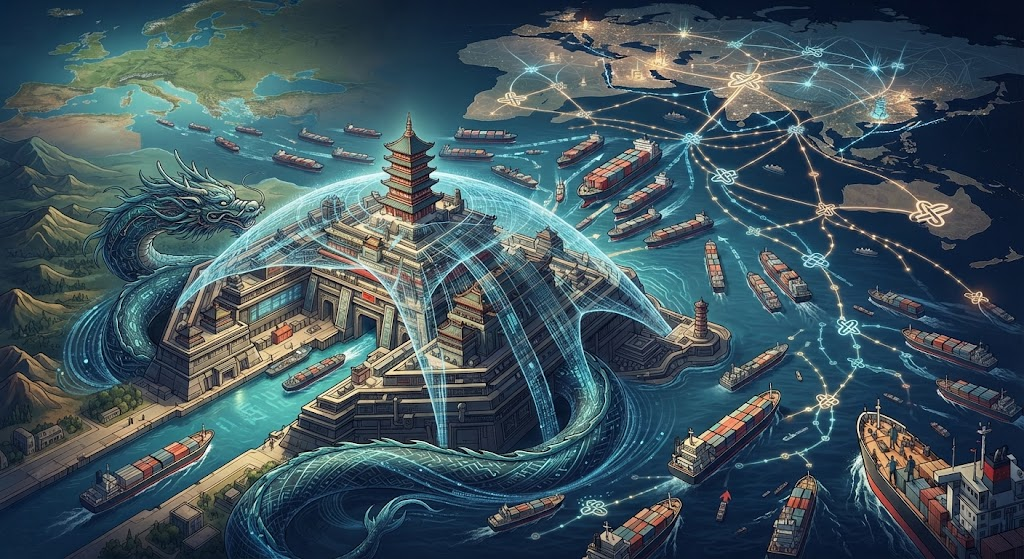


Chinese President Xi Jinping’s historic visit to Egypt after a 10-year hiatus symbolizes a pivotal moment in global geopolitics where the foundations are being shaken. This move, coinciding with the 70th anniversary of diplomatic relations between the two countries, cannot be described merely as a bilateral trade summit. For this development, under the shadow of the destructive regional war between the US and Israel with Iran, the maritime security crises in the Strait of Hormuz and Bab el-Mandeb, and the multipolar world shaped by the Mecca Defense Alliance established by Saudi Arabia, Türkiye, and Pakistan, presents itself as a new projection of power. More concretely, Beijing aims to break through the geopolitical and geoeconomic constraints that Washington has faced due to its massive military and logistical return to the Middle East after October 7, through Egypt.
This strategic move, fortifying the Suez Canal as the main backbone of the Belt and Road Initiative, clearly demonstrates China’s challenge to the unipolar American hegemony at the Mediterranean and African gateway. Cairo, with this rapprochement, seems to intend to balance its dependence on the West and open an autonomous corridor for itself in a post-American world. In this context, the timing of the visit also reveals China’s desire to overcome the geopolitical constraints it has faced in the Middle East. The October 7 crisis and the subsequent escalation of the US-Iran conflict have seriously strained the Iran axis, which is Beijing’s largest energy supplier and logistical ally in the region. Moreover, the United States’ massive military and logistical engagement in the Middle East to control strategic resources, energy routes, and corridors has brought China to the brink of being geopolitically paralyzed.
With the Shiite Crescent and Resistance Axis established through Iran and Syria being battered by the Washington-Tel Aviv line, China seems to have been forced to implement the “Suez Exit” strategy to maintain its influence in the Middle East. In this context, the significance of the agreements signed and the strategies implemented from both sides is as follows:
• China’s Perspective (Geostrategic Anchor): For Beijing, Cairo is the key to the Suez Canal, the heart of global trade, which remains open after the blocked sea routes (Hormuz and Bab el-Mandeb). China positions Egypt as a logistical base that will prevent the collapse of the Belt and Road Initiative and as a secure gateway to the African-Arab world.
• Egypt’s Perspective (Diversified Autonomy): For Egypt, which is struggling with an economic bottleneck, Beijing is a lifeline that provides critical technology transfer in the fields of artificial intelligence, semiconductors, data centers, and advanced manufacturing, generating alternative financing against the IMF’s stranglehold. Cairo is trying to balance its absolute security dependence on Washington with China.
Possible Reactions of Global Actors Against China
Global actors undoubtedly perceive China’s incursion into Cairo not as a simple bilateral partnership, but as a revisionist threat to the established security architecture. Indeed, the United States has already recorded a major alarm as Egypt, which receives 1.3 billion in annual military aid, conducted joint exercises with China’s J-16 fighter jets and its own Rafale aircraft. Indeed, Xi’s statement in Cairo that “the fate of the Middle East should be determined not by external interventions, but by the people of the region” has been perceived as a direct challenge to the US’s hegemonic presence in the region. In this situation, the US may seek to bring Cairo into line by imposing CAATSA sanctions on Egypt or cutting military aid. Israel, on the other hand, views China’s establishment in the Mediterranean through Egypt as a strategic barrier to its own regional security doctrine and the geopolitical plans it has devised following the Gaza/Lebanon operations. Tel Aviv may aggressively revive alternative projects like the “Ben Gurion Corridor” in collaboration with Washington to counter the risk of the Suez coming under Chinese control.
In addition to this equation, China’s signals of deepening cooperation in nuclear energy and missile technology in Egypt seem to necessitate a radical revision of the Pentagon’s naval force deployment in the Red Sea and Eastern Mediterranean. The Western alliance may view the Chinese logistics bases in Egypt’s Suez Economic Zone (TEDA) as military “Trojan Horses” and adopt a strategy of imposing secondary sanctions on the companies there.
The anti-China bloc, consisting of India, Japan, South Korea, and Australia, views this visit as a rupture in their own maritime security chain. India views Egypt’s shift toward the China axis as a fatal blow to the IMEC (India-Middle East-Europe Economic Corridor) project, of which it is a part, and which aims to bypass the Suez. New Delhi may try to break Beijing’s monopoly by increasing its patrols in the Red Sea and offering direct investments in Egypt’s alternative ports in response to this move.
Japan and South Korea are deeply concerned about the entry of these critical waterways, through which more than 80% of their energy imports pass, into China’s sphere of influence, and they plan to make their military presence in the Gulf of Aden permanent. Australia and the United Kingdom, on the basis of the AUKUS partnership, could intensify diplomatic pressure on Egypt against China’s strategy to control global maritime chokepoints. This bloc could impose strict “economic security” checks on its trade agreements with Egypt to prevent China from accessing Africa’s critical mineral deposits and rare earth elements through Egypt.
China Trapped in Africa and the “Geopolitical Invitation of the Nile”
The move in Egypt indicates a shift in China’s strategy in Africa. China has seen the process working against it in recent years in Sub-Saharan Africa due to criticisms of “debt trap diplomacy,” local coups, and rising instabilities. In this context, instead of a resource-focused fragmented structure in Africa, it seems that China has chosen Egypt, which has the continent’s largest army, a deep-rooted diplomatic tradition, and geopolitical weight, as a “Continental Partner and Regulatory Actor.” At this point, Xi Jinping’s mention of the ancient Egyptian proverb “Once you drink from the Nile, you are doomed to return” in Cairo seems to go far beyond a simple cultural gesture. Behind this saying lie two deep geopolitical messages:
- Nile Basin Power Balance: China has remained close to Addis Ababa in the Grand Ethiopian Renaissance Dam crisis. However, with the recent military rapprochement between the United States and Ethiopia, China has implied that it recognizes Egypt’s right to water and food security with this move, sending a message to Egypt: “I am now at the table regarding your existential issues, and I have no intention of leaving.”
- Declaration of Permanent Hegemony: In the Middle East and Africa, where Western powers come and go periodically, it declares that China has permanently settled into the region’s capillaries and can no longer be uprooted from this geography.
Egypt’s “Suez Exit” Motivation
It seems that Cairo does not want to be a junior partner in a military pact in the Sunni world whose axis it did not determine. Instead, it seems to aim to create its own elite league by directly establishing a “Comprehensive Strategic Partnership” with China, a global superpower. The excessive caution it shows toward the US and Israel factors in this process stems from Egypt’s economic vulnerability. At this point, Cairo’s main motivation is to gain “Strategic Autonomy”; that is, neither completely severing ties with the West nor becoming a satellite of the East, but rather using the competition between the two blocs as leverage in its favor. Despite all these sensitivities, Egypt seems to be facing a full-blown “Multiple Alignment” crisis in foreign policy. For it is geopolitically impossible for Cairo to convince the US and Israel that this massive Chinese partnership is harmless to Western interests. In this context, it may not be surprising if Washington tries to economically corner Egypt by using the leverage of IMF loans and military aid as a mechanism of coercion. Therefore, it can be said that in the upcoming period, Egypt will be tested by much harsher geopolitical storms between Beijing’s attractive infrastructure funds and the West’s financial and military punishment mechanisms in the energy-sharing wars in the Mediterranean and the Red Sea transit corridors.
Conclusion
Xi Jinping’s visit to Cairo can be considered as part of China’s strategy to expand its move in the Middle East equation through Egypt, spreading its influence across the Mediterranean and Africa. Cairo, on the other hand, seems to be trying to build a secure, independent, and sheltered harbor in the post-American world by mixing the ancient waters of the Nile with Beijing’s strategic ink. This alliance, which has become the epicenter of the search for a new pole in the non-Western world, is emerging as a harbinger of a new era in which Washington’s unilateral sanctions and control mechanisms have become ineffective; in this dangerous game, Egypt faces the risk of becoming the front line in the struggle between global powers. Ultimately, this visit has declared to the entire world that the Suez Canal is not merely a commercial waterway but also the most critical front in the 21st-century struggle for global hegemony—and that the cards are being reshuffled on this front.
In this context, the “Suez Exit” can be viewed not merely as an economic refuge, but as a structural rupture that overturns asymmetrical dependency relationships. This new “patronage model” backed by China’s nuclear energy and advanced military technologies, when combined with Egypt’s BRICS membership, serves as a direct challenge to the global reserve currency system and the U.S.-led maritime security architecture. By making Cairo a new distribution hub for global value chains, Beijing is both thwarting the West’s potential containment strategies and grounding its approach in “strategic reciprocity.” Egypt, meanwhile, is evolving from a geopolitical buffer zone into an active rule-maker capable of forging multiple alliances within a multipolar order. This scenario can also be viewed as the most concrete and irreversible example of regional powers seeking to protect their right to self-determination by aligning with a global superpower in opposition to Washington’s unipolar impositions. In this context, it is crucial to emphasize that we are facing a new process that could be characterized as the “Suez Balance”!