

The bilateral meeting between President of the Republic of Kazakhstan Kassym-Jomart Tokayev and President of the Russian Federation Vladimir Putin, held within the framework of the “22nd Russia–Kazakhstan Interregional Cooperation Forum” in the Russian city of Omsk, will go down in history as an exceptionally significant “manifesto of strategic thinking” articulated at a moment when global politics has reached an impasse and conventional diplomacy has demonstrated its limitations. This initiative represents a remarkably bold step aimed at bringing to an end a crisis that has rapidly evolved from the local to the regional and then to the global level.
In this context, President Tokayev’s call to freeze the conflict in Ukraine and revive the updated version of the “Istanbul Formula” under the title “Istanbul 2.0”—a framework that brought the parties close to a final settlement during the early months of 2022—after subjecting the multidimensional signals emerging from the Western world to rational analysis, should be understood not merely as a diplomatic initiative but also as a humanitarian and moral message conveying that “there is still hope” for humanity and civilization.
Therefore, this proposal should not be interpreted in the literature of international relations as an ordinary diplomatic aspiration or a tactical maneuver. Rather, it should be regarded as an example of “responsible realism” articulated by a statesman who possesses a profound understanding of the structural vulnerabilities of the post-Soviet space and a comprehensive grasp of the risk landscape of Eurasian geopolitics. Tokayev’s critical and strategically timed initiative represents the intellectual and rational culmination of Kazakhstan’s balanced, multi-vector foreign policy tradition, which has been carefully maintained since the country gained independence.
Tokayev’s Leadership and “Domino Realism” in the Post-Soviet Space: Institutional Ties and the Rational Limits of Mediation
Although Kazakhstan has consistently pursued an active foreign policy strategy based on balance, diplomacy, and multidimensional partnerships, emerging as a reliable actor that has made significant contributions to regional and global peacebuilding efforts, President Tokayev’s latest statement points to a much deeper geopolitical reality. Tokayev has openly acknowledged that assuming a direct “mediating” role in the Russia–Ukraine war would not be geopolitically rational, given that Kazakhstan is a former Soviet Socialist Republic (USSR), shares a thousands-of-kilometers-long uninterrupted border with Russia, and, more importantly, is a core member of Moscow-centered institutional frameworks such as the Collective Security Treaty Organization (CSTO) and the Eurasian Economic Union (EAEU).
At the heart of this position lies a profound ethical and moral stance. Undoubtedly, this represents a manifestation of Kazakhstan’s ancient civilization and its deep historical heritage. Therefore, Tokayev’s statement and decision should by no means be interpreted as a sign of diplomatic weakness or passivity. On the contrary, they demonstrate geopolitical honesty, structural awareness, and substantial strategic weight.
In this context, Tokayev’s statement emphasizing that Russia is a major global power and that the Russian people represent a great nation with a profound historical legacy — “I believe that it will overcome the issues on its agenda without the need for any mediator” — constitutes a sophisticated diplomatic maneuver. While honoring his counterpart through diplomatic courtesy, this approach simultaneously protects Astana from accusations of partiality or political bias. This perspective fully corresponds with Tokayev’s broader foreign policy philosophy, frequently articulated on the global stage: “Diplomacy is not about disappearing in the shadow of great powers; it is about rationally defining the boundaries of that shadow.”
Therefore, this initiative has established its place in history as a rational foundation that allows Kazakhstan to safeguard its national interests while simultaneously assuming the role of an intellectual architect of peace.
The Post-Soviet Instability Spiral and Concerns over the “Domino Effect”
Since the institutional dissolution of the Soviet Union (USSR), the former Soviet space has continued to struggle with chronic structural crises, including border disputes, ethnic tensions, and micro-nationalist movements. The Russia–Ukraine war in particular, along with previous crises such as the Russia–Georgia War (2008), the Azerbaijan–Armenia tensions that paralyzed the South Caucasus (although the 2020 Second Karabakh War led to a ceasefire process, uncertainty continues due to the absence of a comprehensive peace agreement and the region’s volatile geopolitical environment), and the devastating Tajik Civil War of the 1990s, have collectively generated a persistent “spiral of instability” and security vacuums across the region.
In this context, President Tokayev’s greatest strategic concern is that this massive geopolitical rupture centered around Ukraine could trigger a destructive “domino effect” throughout the post-Soviet space, pushing the sovereignty, territorial integrity, and political independence of other newly independent republics in the region into an unpredictable state of uncertainty.
Reminding that Kazakhstan has always acted according to the principle that “a fire on your neighbor’s roof is a warning sign of the sparks that may enter through your own window,” President Tokayev draws attention to the young lives lost in the war, emphasizing that these individuals represent the “common genetic heritage of the brotherly Russian and Ukrainian peoples” and arguing that this tragedy must be brought to an immediate end. In Tokayev’s clear assessment, “What is happening today serves the interests of the enemies of both Russia and Ukraine and brings them satisfaction.”
President Tokayev’s foreign policy statement that “Peace is not merely the silence of weapons; it is the inability of external forces to interfere in a region’s own destiny” demonstrates his identity as a pragmatic and realistic leader grounded in rational analysis rather than emotional rhetoric. This principle also constitutes the intellectual foundation of his latest diplomatic initiative.
Global Disconnection: The Void Left Behind from the Alaska Summit to the Present
The historic summit held in August 2025 in the U.S. state of Alaska between President of the United States Donald Trump and President of the Russian Federation Vladimir Putin represented a highly significant act of “political flexibility” aimed at reducing global tensions and establishing a new strategic balance between major powers. The appreciation expressed by Tokayev toward Putin in Omsk was precisely an emphasis on and reminder of this leadership flexibility and willingness to maintain dialogue.
However, the harsh geopolitical reality is that the high-level bilateral process initiated in Alaska failed to produce an institutional solution to the structural problems of the global system and the European security architecture. It could not be transformed into a sustainable peace agreement and ultimately remained an isolated diplomatic initiative that lacked continuity. The meeting between the two superpowers along the Arctic frontier was insufficient to stop the bloodshed on the ground.
President Tokayev’s earlier observation regarding this situation — “Global agreements among great powers remain nothing more than diplomatic exercises on a map unless they are grounded in regional realities” — most clearly explains why the Alaska process remained incomplete.
The Unsustainable Cost of Continuing the Conflict
At this historical stage, the further continuation of the Russia–Ukraine war has become increasingly unsustainable for both sides from military, economic, logistical, and humanitarian perspectives. The war has moved beyond the scope of a regional confrontation and has transformed into a structural crisis that increasingly threatens global supply chains, energy routes, and financial stability, evolving into a deeply entrenched geopolitical “cancerous cell.”
While describing the current deadlock, President of Kazakhstan Kassym-Jomart Tokayev summarized the helplessness of global diplomacy by stating: “No one knows exactly how to get out of this situation, because the parties have their own positions,” and immediately pointed toward a rational path forward: “Perhaps this conflict needs to be frozen and the Istanbul 2.0 formula should be revisited. Because significant results had been achieved there.”
In this context, the “Istanbul 2.0” format conceptualized by Tokayev should no longer be viewed merely as a diplomatic alternative, but rather as a geopolitical necessity and a historical imperative capable of preventing the complete self-destruction of Eurasia.
The Vital Geopolitics of the Ankara–Astana–Moscow Axis
The realization of the “Istanbul 2.0” vision and its ability to produce tangible results on the ground are directly dependent on the strategic permeability, flexibility, and dynamism of the trilateral relations between Türkiye, Kazakhstan, and Russia. Within this geopolitical equation, Kazakhstan and its leader Tokayev are tasked with constructing the intellectual architecture of peace, establishing its rational foundation, and securing its diplomatic legitimacy; while Türkiye and President Erdoğan are expected to serve as the global implementer of this vision on the ground, its diplomatic engine, and its logistical host. The unshakable historical trust-based relationship between Kazakhstan and Russia, together with the tested mechanisms of rational dialogue between Türkiye and Russia, provide more than sufficient minimum diplomatic confidence necessary for establishing this peace negotiation platform. The Türkiye–Kazakhstan partnership, particularly within the framework of the Organization of Turkic States (OTS), also represents one of the most dynamic pillars capable of shaping a new security and stability architecture for Eurasia.
Türkiye’s Unique Facilitating Role
Türkiye’s greatest strategic advantage within this vast global geopolitical equation lies in its deep military-technical and political partnership with Ukraine, as well as its institutional alliance ties with the European Union (EU), the United States, and the broader Western world. As a NATO member that, however, has not become blindly aligned with any single global power bloc and has managed to maintain open and functional high-level diplomatic channels with Moscow, Türkiye occupies a unique position among international actors. It is the most credible and legitimate “facilitator” capable of bringing the security concerns, strategic sensitivities, and political signals of the Western world to the negotiating table.
By recognizing this fundamental reality and once again pointing to Istanbul as the venue, President Tokayev’s proposal represents a clear expression of the substantial diplomatic trust and international recognition granted to Türkiye’s constructive and balancing role in global affairs. This is by no means coincidental. Indeed, Tokayev’s well-known statement that “Multivector diplomacy is not about accumulating enemies; it is the art of expanding the geography of friends while bringing rivals together at a reasonable negotiating table” clearly reveals the philosophical foundation of the critical facilitating role undertaken by Türkiye.
The Istanbul 2.0 Roadmap: From Freezing the Conflict to a Sustainable Peace Architecture
To permanently end this war, which has become chronic, increasingly entrenched, and transformed into a structural deadlock, what is required is not merely rhetoric but a concrete roadmap containing feasible, measurable, and reasonable conditions upon which all parties can reach a minimum level of consensus. Within this framework, under the “Istanbul 2.0” initiative, a five-stage strategic solution plan can be proposed as follows:
- Immediate Ceasefire Based on the “Status Quo” Principle and Freezing of the Conflict: As the first and most urgent step of this roadmap, all military operations, missile attacks, and logistical movements on the ground must be immediately halted. As President Tokayev emphasized — “There is also the option of freezing the conflict. This is a method that has been previously tested in international practice” — hostilities can be frozen on the basis of the existing lines of control. Such an approach would first and foremost prevent further loss of young lives and protect the shared historical and civilizational heritage from irreversible destruction.
- “Safe Buffer Zone” and Multinational Monitoring Mission: Along the line where the conflict has been frozen, demilitarized “Safe Buffer Zones” may be established, with the parties withdrawing heavy weaponry from these areas and the depth of the zones being determined by military experts. The security of these critical areas should be monitored on a 24/7 basis through military observer missions from neutral countries agreed upon by all parties, with the active participation of Kazakhstan and Türkiye, or through peacekeeping forces operating under the auspices of the United Nations (UN), in order to prevent possible provocations.
- Political Negotiations Accompanied by a “Consortium of Guarantors”: Simultaneously, at the diplomatic table to be established in Istanbul, a “Consortium of Guarantors” may be formed, including not only the parties to the conflict but also the “great powers” referred to by Russia in the text — the United States, China, the United Kingdom, the European Union/Germany, and Türkiye as the host country. As President Tokayev stated: “Later, it may be possible to move toward the long-awaited peace under the guarantees of the great powers, including Russia.” Under such institutional guarantees, a rational balance can be established between Ukraine’s sensitivities regarding sovereignty and Russia’s strategic concerns over border security. In achieving this balance, the participation of Kyiv at the negotiating table as an equal and sovereign actor will undoubtedly be indispensable for building a healthy and stable future.
- The Dimension of the Gradual Elimination of Economic and Logistical Sanctions: To ensure the sustainability of the negotiation process and to create rational incentives that would encourage the parties to remain at the negotiating table, military and political measures may be supported by a parallel economic roadmap implemented simultaneously. Within this framework:
- In exchange for full compliance with the first phase of “Istanbul 2.0,” global financial restrictions imposed on Russia’s civilian banking sector and food/medicine trade should be gradually eased (including the partial restoration of access to SWIFT channels in specific sectors). At the same time, the blockade on civilian transportation through Black Sea ports should be lifted, and airspaces should be reopened for reciprocal commercial flights. It should also be clearly stipulated that any violation of the agreed timeline would automatically trigger the reinstatement of sanctions through a “snap-back” mechanism.
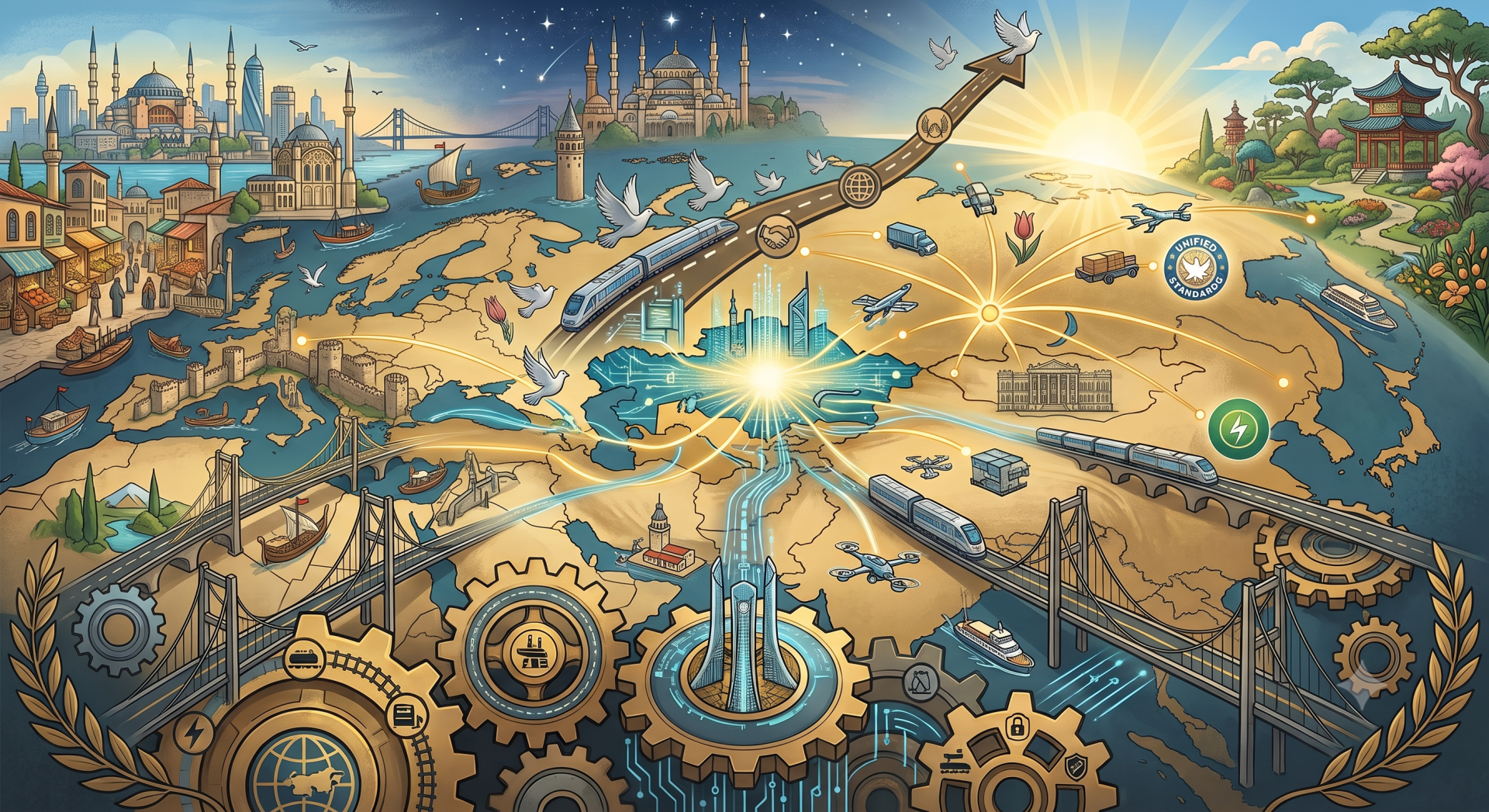
- Within this process, the “Northern Corridor,” whose logistics have been disrupted due to the war, could be replaced by the “Middle Corridor,” which has been gaining prominence through infrastructure cooperation between Kazakhstan, Türkiye, and other Turkic republics and has also emerged as a key project within the framework of the Organization of Turkic States (OTS). In this way, a secure trade corridor between Asia and Europe could be established. A portion of the transit revenues generated by this corridor could be transferred to a global fund dedicated to the reconstruction of civilian infrastructure damaged by the war in the region.
- In this process, it is of critical importance that the security of the pipelines passing through Ukraine be placed under the supervision of an international consortium (for example, comprising Türkiye, Kazakhstan, and the European Union). The status of Russia’s frozen global assets should be clearly defined at the negotiating table, and the possibility of releasing a designated percentage of these resources for the restoration of Ukraine’s energy networks and civilian infrastructure may be considered.
- Institutional Construction of a New Eurasian Security Format: “Istanbul 2.0” should not be limited solely to a temporary armistice or an isolated peace agreement to be signed between two states. This process should serve as the foundation for a broader institutional framework capable of eliminating the chronic sources of insecurity across the post-Soviet space, fundamentally limiting potential domino effects in the region, and reaffirming the sovereign rights and independence of states. Furthermore, it should pave the way for the establishment of more effective and multipolar institutional structures — similar in purpose to the Organization for Security and Co-operation in Europe (OSCE) but equipped with stronger operational mechanisms — such as a potential “New Eurasian Security and Cooperation Pact.”
Conclusion
With this historic initiative in Omsk, President of the Republic of Kazakhstan Kassym-Jomart Tokayev has once again demonstrated to the world his qualities as a visionary, pragmatic, and realistic leader in the arena of global diplomacy and geopolitics. Without in any way jeopardizing his country’s sensitive geopolitical position, its partnership within the Collective Security Treaty Organization (CSTO), or its vital allied relationship with Russia, President Tokayev has succeeded in laying the intellectual and philosophical foundations of a global peace architecture capable of safeguarding the entire post-Soviet space.
At precisely this point, the statement that summarizes the Kazakh leader’s foreign policy vision — “We seek justice not at the center of power, but within the rational balance of international law” — constitutes the fundamental philosophy underlying the “Istanbul 2.0” proposal.
Within this framework, an “Istanbul 2.0” format integrated with Türkiye’s unique role as a facilitator on the ground, its ability to establish direct channels with the Western world, and its dynamic mediation capacity emerges as the only rational, feasible, and reasonable formula available for escaping the prolonged and deeply entrenched cycle of conflict in Eurasia.
Therefore, President of Kazakhstan Kassym-Jomart Tokayev’s strategic appeal can be characterized as the most realistic and implementable “manifesto of peace” produced by the internal logic and dynamics of the region itself, rather than by the hegemonic ambitions of global powers.